Maths4UBETA

Completing the square and turning points

Read a vertex, sketch the graph and give its range from completed-square form.

Try the quick check →
Lesson 2 of 8

Section 1 of 3 · Lesson · about 8 min

How do I complete the square with a leading coefficient?

Take the leading coefficient out of the variable terms. Halve the new coefficient of x and square it.

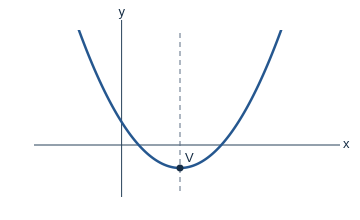
A parabola has a minimum at its vertex and rises on either side.

A parabola has a minimum at its vertex and rises on either side.

Worked example

Complete the square and interpret the turning point

Let f(x)=2x2−8x+4f(x)=2 x^{2} - 8 x + 4.

Write an equivalent expression in completed-square form.

  1. Factor the leading coefficient from the quadratic and linear terms. Complete the square inside the bracket.

  2. The horizontal offset is 22, yielding 2(x−2)2−42 \left(x - 2\right)^{2} - 4.

  3. Final answer: 2(x−2)2−42 \left(x - 2\right)^{2} - 4.

Your turn

Let f(x)=2x2−16x+29f(x)=2 x^{2} - 16 x + 29.

Write an equivalent expression in completed-square form.

Enter an expression in x; use ^ for powers and / for fractions.

Worked example

Complete the square and interpret the turning point

Let f(x)=3x2−12x+9f(x)=3 x^{2} - 12 x + 9.

Write an equivalent expression in completed-square form.

Try it on paper first.

  1. Factor the leading coefficient from the quadratic and linear terms. Complete the square inside the bracket.

  2. The horizontal offset is 22, yielding 3(x−2)2−33 \left(x - 2\right)^{2} - 3.

  3. Final answer: 3(x−2)2−33 \left(x - 2\right)^{2} - 3.

Your turn

Let f(x)=3x2−24x+46f(x)=3 x^{2} - 24 x + 46.

Write an equivalent expression in completed-square form.

Enter an expression in x; use ^ for powers and / for fractions.

Section 2 of 3 · Lesson · about 8 min

How do the brackets identify the turning point?

Find the input where the square is zero. Take the output at that input as the second coordinate.

Worked example

Complete the square and interpret the turning point

Let f(x)=2x2−8x+8f(x)=2 x^{2} - 8 x + 8.

Give the coordinates of the turning point.

  1. The square is zero at the horizontal coordinate of the turning point.

  2. At x=2x=2, the minimum output is 00.

  3. Final answer: (2,0)(2,0).

Your turn

Let f(x)=2x2−16x+33f(x)=2 x^{2} - 16 x + 33.

Give the coordinates of the turning point.

Enter a point as (1, 2) or x = 1, y = 2. Separate complete pairs with commas or semicolons.

Worked example

Complete the square and interpret the turning point

Let f(x)=3x2−18x+28f(x)=3 x^{2} - 18 x + 28.

Give the coordinates of the turning point.

Try it on paper first.

  1. The square is zero at the horizontal coordinate of the turning point.

  2. At x=3x=3, the minimum output is 11.

  3. Final answer: (3,1)(3,1).

Your turn

Let f(x)=3x2−30x+77f(x)=3 x^{2} - 30 x + 77.

Give the coordinates of the turning point.

Enter a point as (1, 2) or x = 1, y = 2. Separate complete pairs with commas or semicolons.

Section 3 of 3 · Lesson · about 8 min

Does the vertex give a minimum or maximum?

The square is non-negative. Multiplying by a negative coefficient reflects the opening direction.

Worked example

Complete the square and interpret the turning point

Let f(x)=−2x2+12x−14f(x)=- 2 x^{2} + 12 x - 14.

State the range for the domain of all real numbers.

  1. The sign of the leading coefficient determines which side of the vertex is reached.

  2. The vertex gives the maximum value 44 and is attained.

  3. Final answer: y≤4y\le 4.

Your turn

Let f(x)=−2x2+20x−45f(x)=- 2 x^{2} + 20 x - 45.

State the range for the domain of all real numbers.

Give the complete set: {1, 4} for separate values, (1, 5] for an interval, U for union or empty for no real solutions. Use sqrt(...) for exact roots.

Worked example

Complete the square and interpret the turning point

Let f(x)=−3x2+18x−22f(x)=- 3 x^{2} + 18 x - 22.

State the range for the domain of all real numbers.

Try it on paper first.

  1. The sign of the leading coefficient determines which side of the vertex is reached.

  2. The vertex gives the maximum value 55 and is attained.

  3. Final answer: y≤5y\le 5.

Your turn

Let f(x)=−3x2+30x−80f(x)=- 3 x^{2} + 30 x - 80.

State the range for the domain of all real numbers.

Give the complete set: {1, 4} for separate values, (1, 5] for an interval, U for union or empty for no real solutions. Use sqrt(...) for exact roots.

Worked examples

Practise the method

Core practice

Question 1 of 5

0 / 5 checked in this collection

Question list

Core practice

Fresh variants

Exam-style

Complete the square and interpret the turning point

1 mark

Let f(x)=3x2−54x+247f(x)=3 x^{2} - 54 x + 247.

Write an equivalent expression in completed-square form.

Enter an expression in x; use ^ for powers and / for fractions.

Full answer-format guide

Exact numbers: 3/2, sqrt(5), 2-sqrt(3), pi/6, 3*pi/2. Sets: {1,4}. Intervals: (3,5]; a round bracket excludes the endpoint. Infinity: inf; union: U; no solutions: empty. Separate coordinate pairs or triples with semicolons. Expressions: 2x^2+3x-1; equations: x^2=3x+1 or the polynomial equal to zero. Factors: x-1 ; x+2. Parameter fraction: numerator ; denominator. List integer answers individually.

Review the method

Progress stays in this browser. Create an account to save it or sign in.

Extra practice from this lesson

Let f(x)=4x2−48x+144f(x)=4 x^{2} - 48 x + 144.

Write an equivalent expression in completed-square form.

Enter an expression in x; use ^ for powers and / for fractions.

Let f(x)=x2−12x+37f(x)=x^{2} - 12 x + 37.

Write an equivalent expression in completed-square form.

Enter an expression in x; use ^ for powers and / for fractions.

Let f(x)=4x2−56x+200f(x)=4 x^{2} - 56 x + 200.

Give the coordinates of the turning point.

Enter a point as (1, 2) or x = 1, y = 2. Separate complete pairs with commas or semicolons.

Let f(x)=x2−14x+54f(x)=x^{2} - 14 x + 54.

Give the coordinates of the turning point.

Enter a point as (1, 2) or x = 1, y = 2. Separate complete pairs with commas or semicolons.

Let f(x)=−4x2+56x−199f(x)=- 4 x^{2} + 56 x - 199.

State the range for the domain of all real numbers.

Give the complete set: {1, 4} for separate values, (1, 5] for an interval, U for union or empty for no real solutions. Use sqrt(...) for exact roots.

Let f(x)=−x2+16x−66f(x)=- x^{2} + 16 x - 66.

State the range for the domain of all real numbers.

Give the complete set: {1, 4} for separate values, (1, 5] for an interval, U for union or empty for no real solutions. Use sqrt(...) for exact roots.

Apply it · original exam-style problems

Show your working on paper and compare it with the worked solution and marking guidance.

Come back to what needs practice

Quick revision sheet (A4)

Your review plan starts after your first check.