Maths4UBETA

Quadratic inequalities and sign diagrams

Find all intervals, including the correct endpoint choices and repeated-root cases.

Try the quick check →
Lesson 5 of 8

Section 1 of 3 · Lesson · about 8 min

Which parts of the graph satisfy an inequality?

Find the roots and mark them on the axis. Check whether each region lies above or below.
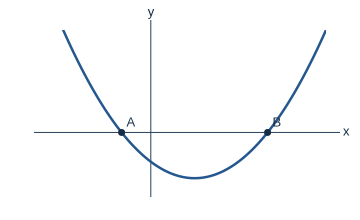
The quadratic is below the horizontal axis between its two intercepts.

The quadratic is below the horizontal axis between its two intercepts.

Worked example

Use two zeros to solve a quadratic inequality

The quadratic expression is g(x)=2x2−8g(x)=2 x^{2} - 8.

Solve g(x)<0g(x)<0.

  1. Mark the roots and check the sign in each region.

  2. The solution lies between the roots. Exclude equality at either root.

  3. Final answer: −2<x<2-2<x<2.

Your turn

The quadratic expression is g(x)=2x2−4x−16g(x)=2 x^{2} - 4 x - 16.

Solve g(x)<0g(x)<0.

Use inequalities in x or interval notation. Join intervals with ‘or’ or ∪. Enter an isolated value on its own.

Worked example

Use two zeros to solve a quadratic inequality

The quadratic expression is g(x)=3x2+3x−18g(x)=3 x^{2} + 3 x - 18.

Solve g(x)<0g(x)<0.

Try it on paper first.

  1. Mark the roots and check the sign in each region.

  2. The solution lies between the roots. Exclude equality at either root.

  3. Final answer: −3<x<2-3<x<2.

Your turn

The quadratic expression is g(x)=3x2−3x−36g(x)=3 x^{2} - 3 x - 36.

Solve g(x)<0g(x)<0.

Use inequalities in x or interval notation. Join intervals with ‘or’ or ∪. Enter an isolated value on its own.

Section 2 of 3 · Lesson · about 8 min

When do I include a root?

Evaluate the original statement at equality. Include a root when equality satisfies the inequality.

Worked example

Use two zeros to solve a quadratic inequality

The quadratic expression is g(x)=2x2+6x−36g(x)=2 x^{2} + 6 x - 36.

Solve g(x)≥0g(x)\ge0.

  1. Mark the roots and check the sign in each region.

  2. The solution lies outside the roots. Include equality at either root.

  3. Final answer: x≤−6x\le -6 or x≥3x\ge 3.

Your turn

The quadratic expression is g(x)=2x2+2x−60g(x)=2 x^{2} + 2 x - 60.

Solve g(x)≥0g(x)\ge0.

Use inequalities in x or interval notation. Join intervals with ‘or’ or ∪. Enter an isolated value on its own.

Worked example

Use two zeros to solve a quadratic inequality

The quadratic expression is g(x)=3x2−6x−9g(x)=3 x^{2} - 6 x - 9.

Solve g(x)≥0g(x)\ge0.

Try it on paper first.

  1. Mark the roots and check the sign in each region.

  2. The solution lies outside the roots. Include equality at either root.

  3. Final answer: x≤−1x\le -1 or x≥3x\ge 3.

Your turn

The quadratic expression is g(x)=3x2−12x−15g(x)=3 x^{2} - 12 x - 15.

Solve g(x)≥0g(x)\ge0.

Use inequalities in x or interval notation. Join intervals with ‘or’ or ∪. Enter an isolated value on its own.

Section 3 of 3 · Lesson · about 8 min

What if the graph only touches the axis?

A repeated root touches the axis and does not change the sign of the quadratic.

Worked example

Handle a repeated root in an inequality

Let q(x)=3x2−24x+48q(x)=3 x^{2} - 24 x + 48.

Find the solution set of q(x)>0q(x)>0.

  1. Use the fact that a perfect square is non-negative.

  2. A repeated root touches the horizontal axis. The sign elsewhere does not change.

  3. Final answer: x≠4x\ne 4.

Your turn

Let q(x)=3x2−42x+147q(x)=3 x^{2} - 42 x + 147.

Find the solution set of q(x)>0q(x)>0.

Use inequalities in x or interval notation. Join intervals with ‘or’ or ∪. Enter an isolated value on its own.

Worked example

Handle a repeated root in an inequality

Let q(x)=4x2−32x+64q(x)=4 x^{2} - 32 x + 64.

Find the solution set of q(x)>0q(x)>0.

Try it on paper first.

  1. Use the fact that a perfect square is non-negative.

  2. A repeated root touches the horizontal axis. The sign elsewhere does not change.

  3. Final answer: x≠4x\ne 4.

Your turn

Let q(x)=4x2−56x+196q(x)=4 x^{2} - 56 x + 196.

Find the solution set of q(x)>0q(x)>0.

Use inequalities in x or interval notation. Join intervals with ‘or’ or ∪. Enter an isolated value on its own.

Worked examples

Practise the method

Core practice

Question 1 of 5

0 / 5 checked in this collection

Question list

Core practice

Fresh variants

Exam-style

Use two zeros to solve a quadratic inequality

1 mark

The quadratic expression is g(x)=3x2−27x−30g(x)=3 x^{2} - 27 x - 30.

Solve g(x)<0g(x)<0.

Use inequalities in x or interval notation. Join intervals with ‘or’ or ∪. Enter an isolated value on its own.

Full answer-format guide

Exact numbers: 3/2, sqrt(5), 2-sqrt(3), pi/6, 3*pi/2. Sets: {1,4}. Intervals: (3,5]; a round bracket excludes the endpoint. Infinity: inf; union: U; no solutions: empty. Separate coordinate pairs or triples with semicolons. Expressions: 2x^2+3x-1; equations: x^2=3x+1 or the polynomial equal to zero. Factors: x-1 ; x+2. Parameter fraction: numerator ; denominator. List integer answers individually.

Review the method

Progress stays in this browser. Create an account to save it or sign in.

Extra practice from this lesson

The quadratic expression is g(x)=4x2−12x−112g(x)=4 x^{2} - 12 x - 112.

Solve g(x)<0g(x)<0.

Use inequalities in x or interval notation. Join intervals with ‘or’ or ∪. Enter an isolated value on its own.

The quadratic expression is g(x)=x2−2x−35g(x)=x^{2} - 2 x - 35.

Solve g(x)<0g(x)<0.

Use inequalities in x or interval notation. Join intervals with ‘or’ or ∪. Enter an isolated value on its own.

The quadratic expression is g(x)=4x2−24x−64g(x)=4 x^{2} - 24 x - 64.

Solve g(x)≥0g(x)\ge0.

Use inequalities in x or interval notation. Join intervals with ‘or’ or ∪. Enter an isolated value on its own.

The quadratic expression is g(x)=x2−5x−24g(x)=x^{2} - 5 x - 24.

Solve g(x)≥0g(x)\ge0.

Use inequalities in x or interval notation. Join intervals with ‘or’ or ∪. Enter an isolated value on its own.

Let q(x)=5x2−100x+500q(x)=5 x^{2} - 100 x + 500.

Find the solution set of q(x)>0q(x)>0.

Use inequalities in x or interval notation. Join intervals with ‘or’ or ∪. Enter an isolated value on its own.

Let q(x)=2x2−44x+242q(x)=2 x^{2} - 44 x + 242.

Find the solution set of q(x)>0q(x)>0.

Use inequalities in x or interval notation. Join intervals with ‘or’ or ∪. Enter an isolated value on its own.

Apply it · original exam-style problems

Show your working on paper and compare it with the worked solution and marking guidance.

Come back to what needs practice

Quick revision sheet (A4)

Your review plan starts after your first check.