Worked example
Collect like surds
Write in the form . Find .
Simplify each term first. and .
The radicals now match. Use the coefficient calculation and keep the radical.
The fully simplified result is , so .
Decide when to collect matching radicals and when to combine two radicands.
Try the quick check →Section 1 of 3 · Core · about 7 min
Identify what the operation does before moving anything under or out of the root. A sum or difference can be collected when the simplified radical parts match.
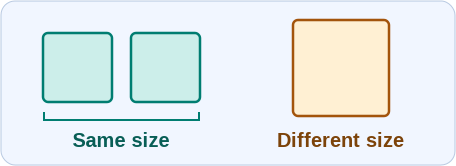
Equal tiles can be counted together. Terms with different simplified radicals remain separate when added.
Worked example
Write in the form . Find .
Simplify each term first. and .
The radicals now match. Use the coefficient calculation and keep the radical.
The fully simplified result is , so .
Worked example
Write in the form . Find .
Try it on paper first.
Simplify each term first. and .
The radicals now match. Use the coefficient calculation and keep the radical.
The fully simplified result is , so .
Section 2 of 3 · Core · about 7 min
The simplification test comes first. If the square-free radicands differ, the sum stays as separate terms. A product follows a different rule.
Worked example
Choose the fully simplified form of .
The first square factor is and the second is .
The simplified terms are and .
The square-free radicands differ, so leave the exact sum as .
Worked example
Write in the form . Find .
Try it on paper first.
A product of non-negative square roots can be grouped into one positive square root.
Here the product of the radicands is . Extract the square factor.
The fully simplified result is , so .
Section 3 of 3 · Core · about 7 min
The quotient can be put under a single radical with a strictly positive denominator. Squaring a single surd term multiplies it by itself.
Worked example
Write in the form . Find .
The denominator is positive. Divide inside one radical to give .
The simplified radicand still has square factor . Extract it to find the coefficient.
The fully simplified result is , so .
Worked example
A square has side length cm. Find its exact area in square centimetres.
Try it on paper first.
Square the entire length, including the coefficient .
. The area is square centimetres.
Question 1 of 5
0 / 5 checked in this collection
Write in the form . Find .
Enter the complete form using all three fields: a(x − h)² + c.
Progress stays in this browser. Create an account to save it or sign in.
Show your working on paper and compare it with the worked solution and marking guidance.
Your review plan starts after your first check.