Maths4UBETA

Expand brackets with surds

Write every product in a bracket expansion, then collect rational and irrational terms.

Try the quick check →
Lesson 3 of 5

Section 1 of 3 · Core · about 6 min

How do I distribute a surd across a bracket?

The same distributive rule works for rational numbers and surds. Start by showing explicitly which two terms the outside factor multiplies.

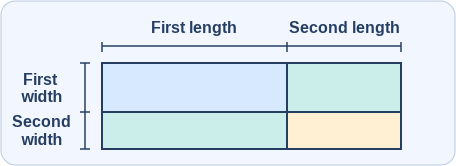
A rectangle is divided into four regions by splitting each of its two side lengths.

Each region uses a different pair of side segments. All four products contribute to the area.

Worked example

Expand one surd across a bracket

Write 25(3+5)2\sqrt{5}\left(3+\sqrt{5}\right) in the form a+b5a+b\sqrt{5}. Find aa and bb.

  1. Multiply the outside surd by both terms inside the bracket.

  2. The two products are 656\sqrt{5} and 2×52\times 5. The second product is rational because the two roots match.

  3. The resulting expression is 10+6510+6\sqrt{5}, so a=10a=10 and b=6b=6.

Your turn

Write 33(4+23)3\sqrt{3}\left(4+2\sqrt{3}\right) in the form a+b3a+b\sqrt{3}. Find aa and bb.

Enter one number. Fractions and decimals are accepted.

Enter one number. Fractions and decimals are accepted.

Worked example

Expand two brackets with surds

Write (3+7)(2+27)\left(3+\sqrt{7}\right)\left(2+2\sqrt{7}\right) in the form a+b7a+b\sqrt{7}. Find aa and bb.

Try it on paper first.

  1. Distribute both terms from each bracket to get four products.

  2. Collect the rational terms 6+14=206+14=20 and the surd coefficients 6+2=86+2=8.

  3. The resulting expression is 20+8720+8\sqrt{7}, so a=20a=20 and b=8b=8.

Your turn

Write (4+25)(3+35)\left(4+2\sqrt{5}\right)\left(3+3\sqrt{5}\right) in the form a+b5a+b\sqrt{5}. Find aa and bb.

Enter one number. Fractions and decimals are accepted.

Enter one number. Fractions and decimals are accepted.

Section 2 of 3 · Core · about 8 min

How do I keep track of all four products?

Each term of the first bracket multiplies each term of the second. For a square, both brackets are identical, so the middle terms match rather than cancel.

Worked example

Track negative terms in an expansion

Write (2−26)(4+6)\left(2-2\sqrt{6}\right)\left(4+\sqrt{6}\right) in the form a+b6a+b\sqrt{6}. Find aa and bb.

  1. The product of the two rational terms is 88. The product of the two surd terms is −12-12.

  2. The middle terms are 262\sqrt{6} and −86-8\sqrt{6}. Combine their signed coefficients.

  3. The resulting expression is −4−66-4-6\sqrt{6}, so a=−4a=-4 and b=−6b=-6.

Your turn

Write (3−33)(5+23)\left(3-3\sqrt{3}\right)\left(5+2\sqrt{3}\right) in the form a+b3a+b\sqrt{3}. Find aa and bb.

Enter one number. Fractions and decimals are accepted.

Enter one number. Fractions and decimals are accepted.

Worked example

Square a two-term expression

Write (3−23)2\left(3-2\sqrt{3}\right)^2 in the form a+b3a+b\sqrt{3}. Find aa and bb.

Try it on paper first.

  1. Write the square as a product of two identical brackets. Both cross terms are −63-6\sqrt{3}.

  2. The endpoint terms give 32+22×3=213^2+2^2\times 3=21. Together the cross terms give −123-12\sqrt{3}.

  3. The resulting expression is 21−12321-12\sqrt{3}, so a=21a=21 and b=−12b=-12.

Your turn

Write (4−311)2\left(4-3\sqrt{11}\right)^2 in the form a+b11a+b\sqrt{11}. Find aa and bb.

Enter one number. Fractions and decimals are accepted.

Enter one number. Fractions and decimals are accepted.

Section 3 of 3 · Core · about 8 min

When do the cross terms cancel?

When the brackets have the same terms with opposite signs between them, one cross product is the negative of the other.

Worked example

Spot a difference of two squares

Work out the exact value of (7+25)(7−25)\left(7+2\sqrt{5}\right)\left(7-2\sqrt{5}\right).

  1. The two brackets have matching rational parts. Their radical terms have opposite signs.

  2. The cross terms cancel. The rational result is 72−22×5=297^2-2^2\times 5=29.

Your turn

Work out the exact value of (8+37)(8−37)\left(8+3\sqrt{7}\right)\left(8-3\sqrt{7}\right).

Enter one number. Fractions and decimals are accepted.

Worked example

Expand to find an exact area

A rectangle has sides 4+54+\sqrt{5} cm and 252\sqrt{5} cm. Write its area in square centimetres in the form a+b5a+b\sqrt{5}. Find aa and bb.

Try it on paper first.

  1. Multiply length by width to find the area in square centimetres.

  2. The products are 858\sqrt{5} and 2×52\times 5. Add the rational and surd parts.

  3. The resulting expression is 10+8510+8\sqrt{5}, so a=10a=10 and b=8b=8.

Your turn

A rectangle has sides 5+2115+2\sqrt{11} cm and 3113\sqrt{11} cm. Write its area in square centimetres in the form a+b11a+b\sqrt{11}. Find aa and bb.

Enter one number. Fractions and decimals are accepted.

Enter one number. Fractions and decimals are accepted.

Worked examples

Practise the method

Core practice

Question 1 of 5

0 / 5 checked in this collection

Question list

Core practice

Fresh variants

Exam-style

Expand one surd across a bracket

1 mark

Write 52(6+2)5\sqrt{2}\left(6+\sqrt{2}\right) in the form a+b2a+b\sqrt{2}. Find aa and bb.

Enter the complete form using all three fields: a(x − h)² + c.

Enter one number. Fractions and decimals are accepted.

Enter one number. Fractions and decimals are accepted.

Full answer-format guide

Exact numbers: 3/2, sqrt(5), 2-sqrt(3), pi/6, 3*pi/2. Sets: {1,4}. Intervals: (3,5]; a round bracket excludes the endpoint. Infinity: inf; union: U; no solutions: empty. Separate coordinate pairs or triples with semicolons. Expressions: 2x^2+3x-1; equations: x^2=3x+1 or the polynomial equal to zero. Factors: x-1 ; x+2. Parameter fraction: numerator ; denominator. List integer answers individually.

Review the method

Progress stays in this browser. Create an account to save it or sign in.

Extra practice from this lesson

Expand one surd across a bracket

Write 47(5+37)4\sqrt{7}\left(5+3\sqrt{7}\right) in the form a+b7a+b\sqrt{7}. Find aa and bb.

Enter one number. Fractions and decimals are accepted.

Enter one number. Fractions and decimals are accepted.

Expand two brackets with surds

Write (5+33)(4+43)\left(5+3\sqrt{3}\right)\left(4+4\sqrt{3}\right) in the form a+b3a+b\sqrt{3}. Find aa and bb.

Enter one number. Fractions and decimals are accepted.

Enter one number. Fractions and decimals are accepted.

Track negative terms in an expansion

Write (4−411)(6+311)\left(4-4\sqrt{11}\right)\left(6+3\sqrt{11}\right) in the form a+b11a+b\sqrt{11}. Find aa and bb.

Enter one number. Fractions and decimals are accepted.

Enter one number. Fractions and decimals are accepted.

Square a two-term expression

Write (5−47)2\left(5-4\sqrt{7}\right)^2 in the form a+b7a+b\sqrt{7}. Find aa and bb.

Enter one number. Fractions and decimals are accepted.

Enter one number. Fractions and decimals are accepted.

Spot a difference of two squares

Work out the exact value of (9+42)(9−42)\left(9+4\sqrt{2}\right)\left(9-4\sqrt{2}\right).

Enter one number. Fractions and decimals are accepted.

Expand to find an exact area

A rectangle has sides 6+336+3\sqrt{3} cm and 434\sqrt{3} cm. Write its area in square centimetres in the form a+b3a+b\sqrt{3}. Find aa and bb.

Enter one number. Fractions and decimals are accepted.

Enter one number. Fractions and decimals are accepted.

Apply it · original exam-style problems

Show your working on paper and compare it with the worked solution and marking guidance.

Come back to what needs practice

Quick revision sheet (A4)

Your review plan starts after your first check.