Maths4UBETA

Inverse proportion to a variable (Extended)

Recognise a fixed product, calculate the constant and predict the effect of changing a positive input.

Try the quick check →
Lesson 2 of 6

Section 1 of 3 · Extension · about 7 min

Which part stays constant in inverse proportion?

In an inverse model with positive values, one quantity falls as the other rises. The product stays fixed.

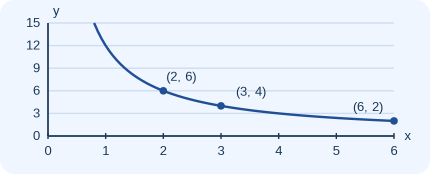
A decreasing curve passes through (2, 6), (3, 4) and (6, 2). The axes do not meet the curve.

Each plotted pair has product 12. A larger positive input makes the output smaller.

Worked example

Find the constant of proportionality

yy is inversely proportional to xx. When x=2x=2, y=2y=2. Find the positive constant of proportionality kk in y=kxy=\frac{k}{x}.

  1. The symbols y∝1xy\propto \frac{1}{x} mean y=kxy=\frac{k}{x} for a fixed multiplier kk.

  2. Use x=2x=2 and y=2y=2.

  3. Multiply yy by the transformed value of xx. k=2×2=4k=2\times2=4.

  4. The model is y=4xy=\frac{4}{x}.

Your turn

yy is inversely proportional to xx. When x=7x=7, y=1314y=\frac{13}{14}. Find the positive constant of proportionality kk in y=kxy=\frac{k}{x}.

Enter an exact value or round to 3 significant figures.

Worked example

Predict a new output

yy is inversely proportional to xx. When x=5x=5, y=125y=\frac{12}{5}. Find yy when x=16x=16. Give an exact answer.

Try it on paper first.

  1. The symbols y∝1xy\propto \frac{1}{x} mean y=kxy=\frac{k}{x} for a fixed multiplier kk.

  2. Use x=5x=5 and y=125y=\frac{12}{5}.

  3. Multiply yy by the transformed value of xx. k=125×5=12k=\frac{12}{5}\times5=12.

  4. y=1216=34y=\frac{12}{16}=\frac{3}{4}.

  5. The exact output is 34\frac{3}{4}.

Your turn

yy is inversely proportional to xx. When x=10x=10, y=1910y=\frac{19}{10}. Find yy when x=12x=12. Give an exact answer.

Enter an exact value or round to 3 significant figures.

Section 2 of 3 · Extension · about 8 min

How does the new factor affect the output?

The same value of kk connects every pair. A bigger denominator divides the constant into smaller values.

Worked example

Work backwards to a new input

yy is inversely proportional to xx. When x=12x=12, y=56y=\frac{5}{6}. Find the positive value of xx when y=57y=\frac{5}{7}. Give an exact answer.

  1. The symbols y∝1xy\propto \frac{1}{x} mean y=kxy=\frac{k}{x} for a fixed multiplier kk.

  2. Use x=12x=12 and y=56y=\frac{5}{6}.

  3. Multiply yy by the transformed value of xx. k=56×12=10k=\frac{5}{6}\times12=10.

  4. Rearrange to isolate the transformed input. x=10÷57=14x=10\div \frac{5}{7}=14.

  5. Undo the transformation to find the positive input. x=14x=14.

Your turn

yy is inversely proportional to xx. When x=4x=4, y=4y=4. Find the positive value of xx when y=83y=\frac{8}{3}. Give an exact answer.

Enter one number. Fractions and decimals are accepted.

Worked example

Use a scale factor to predict the change

yy is inversely proportional to xx. The initial pair is x=2x=2 and y=52y=\frac{5}{2}. The value of xx is then multiplied by 77. By what factor is yy multiplied?

Try it on paper first.

  1. The factor applying to the transformed input is 77.

  2. Since the transformed input is in the denominator, take its reciprocal.

  3. The resulting scale factor for yy is 17\frac{1}{7}.

Your turn

yy is inversely proportional to xx. The initial pair is x=7x=7 and y=2728y=\frac{27}{28}. The value of xx is then multiplied by 44. By what factor is yy multiplied?

Enter an exact value or round to 3 significant figures.

Section 3 of 3 · Extension · about 9 min

How do I distinguish a fixed product from a fixed ratio?

Direct proportion to x keeps the output-to-input ratio fixed. Inverse proportion to x keeps the product fixed.

Worked example

Recognise the correct equation

yy is inversely proportional to xx. When x=9x=9, y=1945y=\frac{19}{45}. Which equation uses the right type of proportion and the value of kk from the pair?

A. y=195 xy=\frac{19}{5\,x}   B. y=195 xy=\frac{19}{5}\,x   C. y=x+195y=x+\frac{19}{5}   D. y=245 xy=\frac{24}{5\,x}

  1. The symbols y∝1xy\propto \frac{1}{x} mean y=kxy=\frac{k}{x} for a fixed multiplier kk.

  2. Use x=9x=9 and y=1945y=\frac{19}{45}.

  3. Multiply yy by the transformed value of xx. k=1945×9=195k=\frac{19}{45}\times9=\frac{19}{5}.

  4. Substitute the value of kk into the matching model. y=195 xy=\frac{19}{5\,x}.

Your turn

yy is inversely proportional to xx. When x=14x=14, y=38y=\frac{3}{8}. Which equation uses the right type of proportion and the value of kk from the pair?

Equation

Worked example

Use the constant to complete a table

yy is inversely proportional to xx. Find the missing value of yy in the last row. Give an exact answer.

xxyy
1212712\frac{7}{12}
1111711\frac{7}{11}
1313Missing value

Try it on paper first.

  1. The symbols y∝1xy\propto \frac{1}{x} mean y=kxy=\frac{k}{x} for a fixed multiplier kk.

  2. Use x=12x=12 and y=712y=\frac{7}{12}.

  3. Multiply yy by the transformed value of xx. k=712×12=7k=\frac{7}{12}\times12=7.

  4. The middle row gives the same constant. Use it again with the last input.

  5. y=713=713y=\frac{7}{13}=\frac{7}{13}.

Your turn

yy is inversely proportional to xx. Find the missing value of yy in the last row. Give an exact answer.

xxyy
4444
55165\frac{16}{5}
66Missing value

Enter an exact value or round to 3 significant figures.

Worked examples

Practise the method

Core practice

Question 1 of 5

0 / 5 checked in this collection

Question list

Core practice

Fresh variants

Exam-style

Find the constant of proportionality

1 mark

yy is inversely proportional to xx. When x=2x=2, y=538y=\frac{53}{8}. Find the positive constant of proportionality kk in y=kxy=\frac{k}{x}.

Enter an exact value or round to 3 significant figures.

Full answer-format guide

Exact numbers: 3/2, sqrt(5), 2-sqrt(3), pi/6, 3*pi/2. Sets: {1,4}. Intervals: (3,5]; a round bracket excludes the endpoint. Infinity: inf; union: U; no solutions: empty. Separate coordinate pairs or triples with semicolons. Expressions: 2x^2+3x-1; equations: x^2=3x+1 or the polynomial equal to zero. Factors: x-1 ; x+2. Parameter fraction: numerator ; denominator. List integer answers individually.

Review the method

Progress stays in this browser. Create an account to save it or sign in.

Extra practice from this lesson

Find the constant of proportionality

yy is inversely proportional to xx. When x=12x=12, y=16y=\frac{1}{6}. Find the positive constant of proportionality kk in y=kxy=\frac{k}{x}.

Enter one number. Fractions and decimals are accepted.

Predict a new output

yy is inversely proportional to xx. When x=2x=2, y=32y=\frac{3}{2}. Find yy when x=4x=4. Give an exact answer.

Enter an exact value or round to 3 significant figures.

Work backwards to a new input

yy is inversely proportional to xx. When x=9x=9, y=349y=\frac{34}{9}. Find the positive value of xx when y=2y=2. Give an exact answer.

Enter one number. Fractions and decimals are accepted.

Use a scale factor to predict the change

yy is inversely proportional to xx. The initial pair is x=12x=12 and y=2936y=\frac{29}{36}. The value of xx is then multiplied by 14\frac{1}{4}. By what factor is yy multiplied?

Enter one number. Fractions and decimals are accepted.

Recognise the correct equation

yy is inversely proportional to xx. When x=6x=6, y=2318y=\frac{23}{18}. Which equation uses the right type of proportion and the value of kk from the pair?

Equation

Use the constant to complete a table

yy is inversely proportional to xx. Find the missing value of yy in the last row. Give an exact answer.

xxyy
9925\frac{2}{5}
1616940\frac{9}{40}
1313Missing value

Enter an exact value or round to 3 significant figures.

Apply it · original exam-style problems

Show your working on paper and compare it with the worked solution and marking guidance.

Come back to what needs practice

Quick revision sheet (A4)

Your review plan starts after your first check.