Worked example
Find the constant of proportionality
is directly proportional to . When , . Find the positive constant of proportionality in .
The symbols mean for a fixed multiplier .
Use and .
Divide by the transformed value of . .
The model is .
Translate direct proportion into an equation, determine the multiplier and use it to find another value.
Try the quick check →Section 1 of 3 · Extension · about 7 min
The symbol says there is a fixed multiplying relationship. It is not an equals sign.
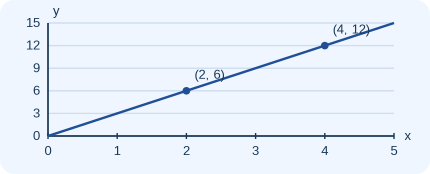
Doubling the input doubles the output along this line. Both labelled pairs have the same output-to-input ratio.
Worked example
is directly proportional to . When , . Find the positive constant of proportionality in .
The symbols mean for a fixed multiplier .
Use and .
Divide by the transformed value of . .
The model is .
Worked example
is directly proportional to . When , . Find when . Give an exact answer.
Try it on paper first.
The symbols mean for a fixed multiplier .
Use and .
Divide by the transformed value of . .
.
The exact output is .
Section 2 of 3 · Extension · about 8 min
The same is used for every related pair. Choose whether the new question gives the input or the output.
Worked example
is directly proportional to . When , . Find the positive value of when . Give an exact answer.
The symbols mean for a fixed multiplier .
Use and .
Divide by the transformed value of . .
Rearrange to isolate the transformed input. .
Undo the transformation to find the positive input. .
Worked example
is directly proportional to . The initial pair is and . The value of is then multiplied by . By what factor is multiplied?
Try it on paper first.
The factor applying to the transformed input is .
The transformed input is multiplied by a constant, so the same factor applies to the output.
The resulting scale factor for is .
Section 3 of 3 · Extension · about 9 min
Direct proportion to gives a graph through the origin when zero is included. The table can check the same fact at non-zero inputs.
Worked example
is directly proportional to . When , . Which equation uses the right type of proportion and the value of from the pair?
A. B. C. D.
The symbols mean for a fixed multiplier .
Use and .
Divide by the transformed value of . .
Substitute the value of into the matching model. .
Worked example
is directly proportional to . Find the missing value of in the last row. Give an exact answer.
| Missing value |
Try it on paper first.
The symbols mean for a fixed multiplier .
Use and .
Divide by the transformed value of . .
The middle row gives the same constant. Use it again with the last input.
.
Question 1 of 5
0 / 5 checked in this collection
is directly proportional to . When , . Find the positive constant of proportionality in .
Progress stays in this browser. Create an account to save it or sign in.
Show your working on paper and compare it with the worked solution and marking guidance.
Your review plan starts after your first check.