Worked example
Exchange pounds for euros
At a counter, £1 buys €1.30. An organiser changes £265 into euros. How many euros does the organiser receive?
For every pound the organiser receives €1.30. Multiply the pounds by .
gives €344.50.
Read an exchange quote, choose the operation for each direction and compare prices in a common currency.
Try the quick check →Section 1 of 3 · Core · about 7 min
The quote £1 = €1.23 tells you what one pound buys. Check which currency is on the one side of the quote.
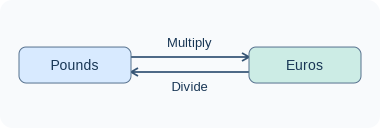
With a quote of euros per pound, multiply pounds to get euros. Divide euros to get pounds.
Test your operation on one pound first. It must produce €1.23. Then scale up to the amount in the question.
Worked example
At a counter, £1 buys €1.30. An organiser changes £265 into euros. How many euros does the organiser receive?
For every pound the organiser receives €1.30. Multiply the pounds by .
gives €344.50.
Worked example
A bureau quotes €1 = £0.83. An exhibitor exchanges €264 for pounds. How many pounds does the exhibitor receive?
Try it on paper first.
This quote starts with one euro. So each euro buys £0.83.
Multiply the euros by . The exhibitor receives £219.12.
Section 2 of 3 · Core · about 8 min
If you already have euros, ask how many groups of the quoted euro amount you can make.
If £1 buys more than €1, the number of pounds will be smaller than the number of euros for the same amount of money. Check the size and write the requested precision.
Worked example
A collector has €414. Use the exchange rate £1 = €1.47. Calculate the value in pounds to the nearest penny.
One pound uses €1.47. Divide the euros by euros per pound.
The calculation is . Round that result to get £281.63.
Worked example
At a counter, £1 buys €1.51. An organiser changes £328 into euros. How many euros does the organiser receive?
Try it on paper first.
For every pound the organiser receives €1.51. Multiply the pounds by .
gives €495.28.
Section 3 of 3 · Core · about 10 min
Work out which currency each fee is charged in and when it applies. Express both prices in one currency before deciding which is cheaper.
When comparing prices, put both in the currency requested in the question. Subtract the lower full value from the higher full value, then round the difference.
Worked example
A customer hands over £277 to buy euros. The bureau first keeps a fee of £3.06. It converts the remaining pounds at £1 = €1.11. How many euros does the customer receive to the nearest cent?
Take the fee from the pounds. That leaves £273.94 for the exchange.
Multiply this by euros per pound. The customer receives €304.07 after rounding.
Worked example
A case costs £48.15 from one seller and €55.97 from another. Use £1 = €1.15 and ignore fees. How much less does the cheaper case cost, in pounds to the nearest penny?
Try it on paper first.
Convert €55.97 to pounds by dividing by . Keep the full value for the subtraction.
The price in pounds is cheaper. Subtract the lower value in pounds from the higher one. The difference is £0.52.
Question 1 of 5
0 / 5 checked in this collection
At a counter, £1 buys €1.13. An organiser changes £214 into euros. How many euros does the organiser receive?
Progress stays in this browser. Create an account to save it or sign in.
Show your working on paper and compare it with the worked solution and marking guidance.
Your review plan starts after your first check.