Maths4UBETA

Work with annual compound interest

Apply a fixed annual multiplier, separate interest from balance and compare simple and compound accounts.

Try the quick check →
Lesson 4 of 4

Section 1 of 3 · Core · about 8 min

What changes when interest is compounded?

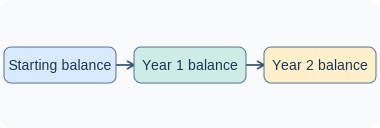
The balance at the end of year one includes the first interest payment. That new balance is the starting point for year two.

The starting balance flows to the year one balance. The year one balance then flows to the year two balance.

Each new balance is used to calculate the next year's interest.

Practise the method

At 4%, a £650 deposit earns £26.00 in year one and grows to £676.00. The second year starts with £676.00 and earns £27.04.

£650 at 4% a year, compounded annually
YearStartInterestEnd
1£650.00£26.00£676.00
2£676.00£27.04£703.04

Worked example

Find a balance with annual compounding

A library fund saves £5595 at 5.85.8% interest, compounded annually. Calculate its balance after 3 full years to the nearest penny.

  1. Each year the current balance is multiplied by 1.0581.058.

  2. Apply that multiplier 3 times. The calculation 5595×1.05835595\times 1.058^{3} gives £6626.09 to the nearest penny.

Your turn

A library fund saves £5620 at 5.95.9% interest, compounded annually. Calculate its balance after 4 full years to the nearest penny.

Give the amount in the currency shown.

Worked example

Find just the interest from an annual balance

A tool library puts £5695 into an account paying 6.26.2% compound interest per year. How much interest is earned in 2 full years? Give the answer to the nearest penny.

Try it on paper first.

  1. The annual multiplier is 1.0621.062. Multiply the deposit by this multiplier raised to the power 2.

  2. The balance rounds to £6423.07. Subtract the original deposit from the full balance and round the interest to £728.07.

Your turn

A tool library puts £5720 into an account paying 6.36.3% compound interest per year. How much interest is earned in 3 full years? Give the answer to the nearest penny.

Give the amount in the currency shown.

Section 2 of 3 · Core · about 9 min

How do I find the balance or just the interest?

The same factor is applied once per full year when the rate and compounding period stay the same.

Practise the method

Enter the multiplier in brackets with the exponent. Keep the full balance for the subtraction and round the amount requested at the end.

Worked example

Find just the interest from an annual balance

A tool library puts £6020 into an account paying 7.57.5% compound interest per year. How much interest is earned in 5 full years? Give the answer to the nearest penny.

  1. The annual multiplier is 1.0751.075. Multiply the deposit by this multiplier raised to the power 5.

  2. The balance rounds to £8642.49. Subtract the original deposit from the full balance and round the interest to £2622.49.

Your turn

A tool library puts £6045 into an account paying 7.67.6% compound interest per year. How much interest is earned in 6 full years? Give the answer to the nearest penny.

Give the amount in the currency shown.

Worked example

Find a balance with annual compounding

A library fund saves £6120 at 7.97.9% interest, compounded annually. Calculate its balance after 4 full years to the nearest penny.

Try it on paper first.

  1. Each year the current balance is multiplied by 1.0791.079.

  2. Apply that multiplier 4 times. The calculation 6120×1.07946120\times 1.079^{4} gives £8295.40 to the nearest penny.

Your turn

A library fund saves £6145 at 88% interest, compounded annually. Calculate its balance after 5 full years to the nearest penny.

Give the amount in the currency shown.

Section 3 of 3 · Core · about 10 min

How do I compare two offers fairly?

The accounts can use different methods and may quote different rates. Compare balances for the same principal and term.

Practise the method

Work out both balances before choosing the higher one. Subtract using the full values if the question asks for a difference.

Worked example

Compare simple and compound interest

Two accounts each start with £6445 and both pay 3.33.3% per year. One pays simple interest. The other compounds annually. How much higher is the compound balance after 2 full years? Give the difference to the nearest penny.

  1. For simple interest add the same yearly amount to the starting balance. The simple balance rounds to £6870.37.

  2. For compound interest use the annual multiplier 1.0331.033 with exponent 2. The compound balance rounds to £6877.39.

  3. Subtract the simple balance from the full compound balance, then round. The difference is £7.02.

Your turn

Two accounts each start with £6470 and both pay 3.43.4% per year. One pays simple interest. The other compounds annually. How much higher is the compound balance after 3 full years? Give the difference to the nearest penny.

Give the amount in the currency shown.

Worked example

Compare accounts with different fixed rates

A project has £13170 to save for 3 full years. Account A pays 3.53.5% simple interest per year. Account B pays 3.43.4% compounded annually. Find the difference between the balances to the nearest penny.

Try it on paper first.

  1. Account A earns the same amount each year. Its ending balance rounds to £14552.85.

  2. Calculate Account B using the multiplier 1.0341.034 a total of 3 times. Its ending balance rounds to £14559.53.

  3. The compound-interest account has the higher balance. Subtract the lower full value and round the difference to £6.68.

Your turn

A project has £13220 to save for 4 full years. Account A pays 3.63.6% simple interest per year. Account B pays 3.13.1% compounded annually. Find the difference between the balances to the nearest penny.

Give the amount in the currency shown.

Worked examples

Practise the method

Core practice

Question 1 of 5

0 / 5 checked in this collection

Question list

Core practice

Fresh variants

Exam-style

Find a balance with annual compounding

1 mark

A library fund saves £2770 at 6.36.3% interest, compounded annually. Calculate its balance after 5 full years to the nearest penny.

Give the amount in the currency shown.

Full answer-format guide

Exact numbers: 3/2, sqrt(5), 2-sqrt(3), pi/6, 3*pi/2. Sets: {1,4}. Intervals: (3,5]; a round bracket excludes the endpoint. Infinity: inf; union: U; no solutions: empty. Separate coordinate pairs or triples with semicolons. Expressions: 2x^2+3x-1; equations: x^2=3x+1 or the polynomial equal to zero. Factors: x-1 ; x+2. Parameter fraction: numerator ; denominator. List integer answers individually.

Review the method

Progress stays in this browser. Create an account to save it or sign in.

Extra practice from this lesson

Find a balance with annual compounding

A library fund saves £5795 at 6.66.6% interest, compounded annually. Calculate its balance after 6 full years to the nearest penny.

Give the amount in the currency shown.

Find just the interest from an annual balance

A tool library puts £5870 into an account paying 6.96.9% compound interest per year. How much interest is earned in 4 full years? Give the answer to the nearest penny.

Give the amount in the currency shown.

Find just the interest from an annual balance

A tool library puts £6220 into an account paying 2.42.4% compound interest per year. How much interest is earned in 3 full years? Give the answer to the nearest penny.

Give the amount in the currency shown.

Find a balance with annual compounding

A library fund saves £6295 at 2.72.7% interest, compounded annually. Calculate its balance after 6 full years to the nearest penny.

Give the amount in the currency shown.

Compare simple and compound interest

Two accounts each start with £6645 and both pay 4.14.1% per year. One pays simple interest. The other compounds annually. How much higher is the compound balance after 5 full years? Give the difference to the nearest penny.

Give the amount in the currency shown.

Compare accounts with different fixed rates

A project has £13520 to save for 4 full years. Account A pays 3.63.6% simple interest per year. Account B pays 3.13.1% compounded annually. Find the difference between the balances to the nearest penny.

Give the amount in the currency shown.

Apply it · original exam-style problems

Show your working on paper and compare it with the worked solution and marking guidance.

Come back to what needs practice

Quick revision sheet (A4)

Your review plan starts after your first check.