Maths4UBETA

Factorising quadratics and cubics with a common factor (Extended)

Factorise monic and non-monic quadratics, then continue after extracting a common linear factor from a suitable cubic.

Try the quick check →
Lesson 7 of 8

Section 1 of 3 · Extension · about 7 min

Which two constants build a monic quadratic?

A product of two monic linear factors has a cross-term equal to the sum of their constants times the variable.
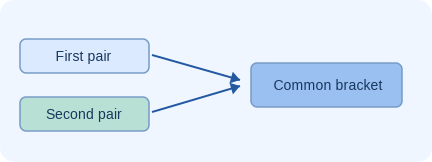
Four original terms form two groups. Arrows lead from both groups to the same bracket.

Split the middle term so the two groups have a common bracket.

Worked example

Factorise a quadratic

Factorise fully x2+17x−38x^{2} + 17 x - 38.

  1. Choose constants with product −38-38 and sum 1717. Those constants are −2-2 and 1919.

  2. Write the complete product. (x−2)(x+19)\left(x - 2\right)\left(x + 19\right).

Your turn

Factorise fully x2+42x+432x^{2} + 42 x + 432. Enter both monic brackets, with the smaller constant first. If they match, enter the same bracket twice.

Enter an expression in x; use ^ for powers and / for fractions.

Enter an expression in x; use ^ for powers and / for fractions.

Worked example

Factorise a quadratic

Factorise fully x2+14x+49x^{2} + 14 x + 49.

Try it on paper first.

  1. Choose constants with product 4949 and sum 1414. Those constants are 77 and 77.

  2. Write the complete product. (x+7)(x+7)\left(x + 7\right)\left(x + 7\right).

Your turn

Factorise fully x2−12x+36x^{2} - 12 x + 36. Enter both monic brackets, with the smaller constant first. If they match, enter the same bracket twice.

Enter an expression in x; use ^ for powers and / for fractions.

Enter an expression in x; use ^ for powers and / for fractions.

Section 2 of 3 · Extension · about 8 min

What changes when the leading coefficient exceeds one?

The non-monic case still has two cross-products. Their product can be calculated before those cross-products are known.

Worked example

Factorise a quadratic

Factorise fully 4x2+77x−4564 x^{2} + 77 x - 456.

  1. Find the pair −19-19 and 9696. Their sum is 7777 and their product is −1824-1824.

  2. Split the middle term, then group. 4x2−19x+96x−456=x(4x−19)+24(4x−19)4 x^{2}- 19 x+96 x-456=x\left(4 x - 19\right)+24\left(4 x - 19\right).

  3. Write the complete product. (x+24)(4x−19)\left(x + 24\right)\left(4 x - 19\right).

Your turn

Factorise fully 3x2−52x−3913 x^{2} - 52 x - 391. Enter the two primitive linear brackets with positive coefficients of x, smaller coefficient first.

Enter an expression in x; use ^ for powers and / for fractions.

Enter an expression in x; use ^ for powers and / for fractions.

Worked example

Factorise a quadratic

Factorise fully 6x2+67x+1616 x^{2} + 67 x + 161.

Try it on paper first.

  1. Find the pair 4646 and 2121. Their sum is 6767 and their product is 966966.

  2. Split the middle term, then group. 6x2+46x+21x+161=2x(3x+23)+7(3x+23)6 x^{2}+46 x+21 x+161=2 x\left(3 x + 23\right)+7\left(3 x + 23\right).

  3. Write the complete product. (2x+7)(3x+23)\left(2 x + 7\right)\left(3 x + 23\right).

Your turn

Factorise fully 6x2−29x−1106 x^{2} - 29 x - 110. Enter the two primitive linear brackets with positive coefficients of x, smaller coefficient first.

Enter an expression in x; use ^ for powers and / for fractions.

Enter an expression in x; use ^ for powers and / for fractions.

Section 3 of 3 · Extension · about 9 min

How can a cubic become a quadratic factorisation?

These cubics have no constant term. In the form considered here, taking out the common variable leaves a quadratic.

Worked example

Factorise a cubic with an irreducible quadratic part

Factorise fully 35x3+161x2+196x35 x^{3} + 161 x^{2} + 196 x.

  1. The greatest common monomial factor is 7x7 x.

  2. Dividing each term by the factor leaves 5x2+23x+285 x^{2} + 23 x + 28.

  3. For the middle-term method the two numbers must have product 140140 and sum 2323. The possible sums with the right sign are 141141, 7272, 3939, 3333, 2727, 2424.

  4. No integer middle-term split gives both the required sum and product for this bracket. The full factorisation is 7x(5x2+23x+28)7 x\left(5 x^{2} + 23 x + 28\right).

Your turn

Factorise fully 24x3+132x2+198x24 x^{3} + 132 x^{2} + 198 x. Give the largest common monomial with a positive coefficient, then the remaining expression.

Enter an expression in x; use ^ for powers and / for fractions.

Enter an expression in x; use ^ for powers and / for fractions.

Worked example

Factorise a cubic with a common factor

Factorise fully 48x3+232x2−880x48 x^{3} + 232 x^{2} - 880 x.

Try it on paper first.

  1. Extract 8x8 x to leave 6x2+29x−1106 x^{2} + 29 x - 110 inside the bracket.

  2. Find the pair 4444 and −15-15. Their sum is 2929 and their product is −660-660.

  3. Split the middle term, then group. 6x2+44x−15x−110=2x(3x+22)−5(3x+22)6 x^{2}+44 x- 15 x-110=2 x\left(3 x + 22\right)-5\left(3 x + 22\right).

  4. Write the complete product. 8x(2x−5)(3x+22)8 x\left(2 x - 5\right)\left(3 x + 22\right).

Your turn

Factorise fully 42x3+413x2+770x42 x^{3} + 413 x^{2} + 770 x. First enter the largest positive common monomial factor. Enter the two primitive linear brackets with positive coefficients of x, smaller coefficient first.

Enter an expression in x; use ^ for powers and / for fractions.

Enter an expression in x; use ^ for powers and / for fractions.

Enter an expression in x; use ^ for powers and / for fractions.

Worked examples

Practise the method

Core practice

Question 1 of 5

0 / 5 checked in this collection

Question list

Core practice

Fresh variants

Exam-style

Factorise a quadratic

2 marks

Factorise fully x2+26x+160x^{2} + 26 x + 160. Enter both monic brackets, with the smaller constant first. If they match, enter the same bracket twice.

Enter an expression in x; use ^ for powers and / for fractions.

Enter an expression in x; use ^ for powers and / for fractions.

Full answer-format guide

Exact numbers: 3/2, sqrt(5), 2-sqrt(3), pi/6, 3*pi/2. Sets: {1,4}. Intervals: (3,5]; a round bracket excludes the endpoint. Infinity: inf; union: U; no solutions: empty. Separate coordinate pairs or triples with semicolons. Expressions: 2x^2+3x-1; equations: x^2=3x+1 or the polynomial equal to zero. Factors: x-1 ; x+2. Parameter fraction: numerator ; denominator. List integer answers individually.

Review the method

Progress stays in this browser. Create an account to save it or sign in.

Extra practice from this lesson

Factorise a quadratic

Factorise fully x2+6x−391x^{2} + 6 x - 391. Enter both monic brackets, with the smaller constant first. If they match, enter the same bracket twice.

Enter an expression in x; use ^ for powers and / for fractions.

Enter an expression in x; use ^ for powers and / for fractions.

Factorise a quadratic

Factorise fully x2+10x+25x^{2} + 10 x + 25. Enter both monic brackets, with the smaller constant first. If they match, enter the same bracket twice.

Enter an expression in x; use ^ for powers and / for fractions.

Enter an expression in x; use ^ for powers and / for fractions.

Factorise a quadratic

Factorise fully 2x2+61x+3742 x^{2} + 61 x + 374. Enter the two primitive linear brackets with positive coefficients of x, smaller coefficient first.

Enter an expression in x; use ^ for powers and / for fractions.

Enter an expression in x; use ^ for powers and / for fractions.

Factorise a quadratic

Factorise fully 6x2+29x−1106 x^{2} + 29 x - 110. Enter the two primitive linear brackets with positive coefficients of x, smaller coefficient first.

Enter an expression in x; use ^ for powers and / for fractions.

Enter an expression in x; use ^ for powers and / for fractions.

Factorise a cubic with an irreducible quadratic part

Factorise fully 15x3−105x2+190x15 x^{3} - 105 x^{2} + 190 x. Give the largest common monomial with a positive coefficient, then the remaining expression.

Enter an expression in x; use ^ for powers and / for fractions.

Enter an expression in x; use ^ for powers and / for fractions.

Factorise a cubic with a common factor

Factorise fully 36x3−186x2−360x36 x^{3} - 186 x^{2} - 360 x. First enter the largest positive common monomial factor. Enter the two primitive linear brackets with positive coefficients of x, smaller coefficient first.

Enter an expression in x; use ^ for powers and / for fractions.

Enter an expression in x; use ^ for powers and / for fractions.

Enter an expression in x; use ^ for powers and / for fractions.

Apply it · original exam-style problems

Show your working on paper and compare it with the worked solution and marking guidance.

Come back to what needs practice

Quick revision sheet (A4)

Your review plan starts after your first check.