Maths4UBETA

Factorising through grouping and identities (Extended)

Recognise a shared bracket, a difference of two squares and a perfect square trinomial.

Try the quick check →
Lesson 6 of 8

Section 1 of 3 · Extension · about 7 min

How can four terms hide a repeated bracket?

Recognise a repeated group as a factor, in the same way that a repeated letter can be a factor.
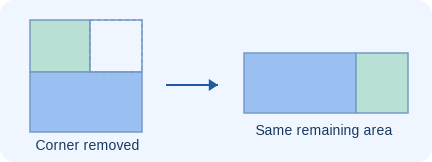
A square has a smaller corner square removed, leaving a shaded L-shaped area.

A large square minus a smaller square leaves an area that can be rearranged into a rectangle.

Worked example

Factorise a repeated bracket

Factorise fully by grouping 2xy−x+16y−82 x y- x+16 y-8.

  1. Arrange the terms into two groups with the same bracket left inside.

  2. x(2y−1)+8(2y−1)x\left(2 y - 1\right)+8\left(2 y - 1\right).

  3. Take out that common bracket as a single factor. (x+8)(2y−1)\left(x + 8\right)\left(2 y - 1\right).

Your turn

Factorise fully by grouping 2xy+25x+14y+1752 x y+25 x+14 y+175. Enter the factor involving x first and the factor involving y second. Give each a positive leading coefficient.

Enter an expression in x; use ^ for powers and / for fractions.

Enter an expression in y; use ^ for powers and / for fractions.

Worked example

Factorise a repeated bracket

Factorise fully by grouping ax+6bx+7ay+42bya x+6 b x+7 a y+42 b y.

Try it on paper first.

  1. Arrange the terms into two groups with the same bracket left inside.

  2. x(a+6b)+7y(a+6b)x\left(a + 6 b\right)+7 y\left(a + 6 b\right).

  3. Take out that common bracket as a single factor. (a+6b)(x+7y)\left(a + 6 b\right)\left(x + 7 y\right).

Your turn

Factorise fully by grouping ax+5bx−6ay−30bya x+5 b x- 6 a y- 30 b y. Enter the factor involving a and b first, then the factor involving x and y.

Enter an expression in a, b; use ^ for powers and / for fractions.

Enter an expression in x, y; use ^ for powers and / for fractions.

Section 2 of 3 · Extension · about 8 min

What tells me to use a difference of squares?

The two cross-products in the factorisation cancel. That is why the result contains only the two squares.

Worked example

Factorise a difference of two squares

Factorise fully 49x2−625y249 x^{2} - 625 y^{2}.

  1. Identify the two squares (7x)2\left(7 x\right)^2 and (25y)2\left(25 y\right)^2.

  2. Use U2−V2=(U+V)(U−V)U^2-V^2=(U+V)(U-V).

  3. The factors are (7x+25y)(7x−25y)\left(7 x + 25 y\right)\left(7 x - 25 y\right).

Your turn

Factorise fully 36x2−625y236 x^{2} - 625 y^{2}. Enter the sum factor first, then the difference factor. Both start with the positive x term.

Enter an expression in x, y; use ^ for powers and / for fractions.

Enter an expression in x, y; use ^ for powers and / for fractions.

Worked example

Factorise a difference of two squares

Factorise fully 25x2−4925 x^{2} - 49.

Try it on paper first.

  1. Identify the two squares (5x)2\left(5 x\right)^2 and (7)2\left(7\right)^2.

  2. Use U2−V2=(U+V)(U−V)U^2-V^2=(U+V)(U-V).

  3. The factors are (5x+7)(5x−7)\left(5 x + 7\right)\left(5 x - 7\right).

Your turn

Factorise fully 16x2−4916 x^{2} - 49. Enter the sum factor first, then the difference factor. Both start with the positive x term.

Enter an expression in x; use ^ for powers and / for fractions.

Enter an expression in x; use ^ for powers and / for fractions.

Section 3 of 3 · Extension · about 9 min

How can I recognise a square trinomial?

Both outer terms are squares. A negative middle term indicates a difference inside the bracket.

Worked example

Spot a perfect square trinomial

Factorise as a square 81x2+342xy+361y281 x^{2} + 342 x y + 361 y^{2}.

  1. The matching squares are (9x)2\left(9 x\right)^2 and (19y)2\left(19 y\right)^2.

  2. The cross term must be twice the product. Here 2(9x)(19y)=342xy2\left(9 x\right)\left(19 y\right)=342 x y.

  3. So the factorised form is (9x+19y)2\left(9 x + 19 y\right)^2.

Your turn

Factorise as a square 64x2+400xy+625y264 x^{2} + 400 x y + 625 y^{2}. Enter the bracket before squaring. Its x coefficient must be positive.

Enter an expression in x, y; use ^ for powers and / for fractions.

Worked example

Spot a perfect square trinomial

Factorise as a square 49x2−336x+57649 x^{2} - 336 x + 576.

Try it on paper first.

  1. The matching squares are (7x)2\left(7 x\right)^2 and (−24)2\left(-24\right)^2.

  2. The cross term must be twice the product. Here 2(7x)(−24)=−336x2\left(7 x\right)\left(-24\right)=- 336 x.

  3. So the factorised form is (7x−24)2\left(7 x - 24\right)^2.

Your turn

Factorise as a square 36x2−276x+52936 x^{2} - 276 x + 529. Enter the bracket before squaring. Its x coefficient must be positive.

Enter an expression in x; use ^ for powers and / for fractions.

Worked examples

Practise the method

Core practice

Question 1 of 5

0 / 5 checked in this collection

Question list

Core practice

Fresh variants

Exam-style

Factorise a repeated bracket

2 marks

Factorise fully by grouping 2xy+17x+12y+1022 x y+17 x+12 y+102. Enter the factor involving x first and the factor involving y second. Give each a positive leading coefficient.

Enter an expression in x; use ^ for powers and / for fractions.

Enter an expression in y; use ^ for powers and / for fractions.

Full answer-format guide

Exact numbers: 3/2, sqrt(5), 2-sqrt(3), pi/6, 3*pi/2. Sets: {1,4}. Intervals: (3,5]; a round bracket excludes the endpoint. Infinity: inf; union: U; no solutions: empty. Separate coordinate pairs or triples with semicolons. Expressions: 2x^2+3x-1; equations: x^2=3x+1 or the polynomial equal to zero. Factors: x-1 ; x+2. Parameter fraction: numerator ; denominator. List integer answers individually.

Review the method

Progress stays in this browser. Create an account to save it or sign in.

Extra practice from this lesson

Factorise a repeated bracket

Factorise fully by grouping 2xy+23x+12y+1382 x y+23 x+12 y+138. Enter the factor involving x first and the factor involving y second. Give each a positive leading coefficient.

Enter an expression in x; use ^ for powers and / for fractions.

Enter an expression in y; use ^ for powers and / for fractions.

Factorise a repeated bracket

Factorise fully by grouping ax+4bx+5ay+20bya x+4 b x+5 a y+20 b y. Enter the factor involving a and b first, then the factor involving x and y.

Enter an expression in a, b; use ^ for powers and / for fractions.

Enter an expression in x, y; use ^ for powers and / for fractions.

Factorise a difference of two squares

Factorise fully 25x2−529y225 x^{2} - 529 y^{2}. Enter the sum factor first, then the difference factor. Both start with the positive x term.

Enter an expression in x, y; use ^ for powers and / for fractions.

Enter an expression in x, y; use ^ for powers and / for fractions.

Factorise a difference of two squares

Factorise fully 9x2−259 x^{2} - 25. Enter the sum factor first, then the difference factor. Both start with the positive x term.

Enter an expression in x; use ^ for powers and / for fractions.

Enter an expression in x; use ^ for powers and / for fractions.

Spot a perfect square trinomial

Factorise as a square 49x2+238xy+289y249 x^{2} + 238 x y + 289 y^{2}. Enter the bracket before squaring. Its x coefficient must be positive.

Enter an expression in x, y; use ^ for powers and / for fractions.

Spot a perfect square trinomial

Factorise as a square 25x2−220x+48425 x^{2} - 220 x + 484. Enter the bracket before squaring. Its x coefficient must be positive.

Enter an expression in x; use ^ for powers and / for fractions.

Apply it · original exam-style problems

Show your working on paper and compare it with the worked solution and marking guidance.

Come back to what needs practice

Quick revision sheet (A4)

Your review plan starts after your first check.