Maths4UBETA

Solve linear inequalities (Extended)

Isolate a variable and reverse the inequality exactly when multiplying or dividing by a negative.

Try the quick check →
Lesson 3 of 6

Section 1 of 3 · Core · about 7 min

Which operations preserve the direction?

Add or subtract the same amount on both sides to keep the comparison true for the same values. A positive scale factor also preserves order.

Worked example

Solve an inequality with a positive coefficient

Solve 2x+3≤62x+3\leq 6. Give the whole solution.

  1. Subtract 33 from both sides to get 2x≤32x\leq 3.

  2. Divide by positive 22. The inequality sign keeps the same direction.

  3. Write the final range as x≤32x\leq \frac{3}{2}.

Your turn

Solve 3x+4<2323x+4\lt \frac{23}{2}. Give the whole solution.

Give the complete set: {1, 4} for separate values, (1, 5] for an interval, U for union or empty for no real solutions. Use sqrt(...) for exact roots.

Worked example

Solve an inequality with brackets

Solve 3(x−2)≥−323\left(x-2\right)\geq -\frac{3}{2}. Give the whole solution.

Try it on paper first.

  1. Divide both sides by 33 to isolate the bracket and get x−2≥−12x-2\geq -\frac{1}{2}.

  2. Add 22 to both sides.

  3. Write the final range as x≥32x\geq \frac{3}{2}.

Your turn

Solve 4(x−3)<−44\left(x-3\right)\lt -4. Give the whole solution.

Give the complete set: {1, 4} for separate values, (1, 5] for an interval, U for union or empty for no real solutions. Use sqrt(...) for exact roots.

Section 2 of 3 · Core · about 8 min

Why does a negative multiplier reverse the sign?

On the number line, multiplying by −1 reflects the values about zero. The order changes even when the original two numbers were both positive.
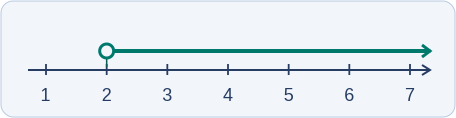
A number line has a open circle at 2, with an arrow extending to the right.

A strict lower bound at 2 leaves 2 out and keeps all larger values.

Worked example

Reverse the sign when dividing by a negative

Solve −2x+4<1-2x+4\lt 1. Give the whole solution.

  1. Subtract 44 to get −2x<−3-2x\lt -3.

  2. Divide by −2-2. Reverse the inequality sign because the divisor is negative.

  3. Write the final range as x>32x\gt \frac{3}{2}.

Your turn

Solve −3x+5≥−1-3x+5\geq -1. Give the whole solution.

Give the complete set: {1, 4} for separate values, (1, 5] for an interval, U for union or empty for no real solutions. Use sqrt(...) for exact roots.

Worked example

Collect variable terms from both sides

Solve 2x+163≤4x+22x+\frac{16}{3}\leq 4x+2. Give the whole solution.

Try it on paper first.

  1. Subtract 2x2x from both sides and then subtract 22. The result is 103≤2x\frac{10}{3}\leq 2x.

  2. Divide by positive 22. Rewriting with xx first requires swapping the sides and the written direction.

  3. Write the final range as x≥53x\geq \frac{5}{3}.

Your turn

Solve 3x+9>6x+33x+9\gt 6x+3. Give the whole solution.

Give the complete set: {1, 4} for separate values, (1, 5] for an interval, U for union or empty for no real solutions. Use sqrt(...) for exact roots.

Section 3 of 3 · Core · about 8 min

How do I solve with variables on both sides?

If x appears twice, bring the variable terms together and the numbers together. Keep each whole side of the inequality consistent.

Worked example

Clear a positive denominator

Solve 3x−22≥2\frac{3x-2}{2}\geq 2. Give the whole solution.

  1. Multiply by 22 to get 3x−2≥43x-2\geq 4. Keep the sign because the denominator is positive.

  2. Add 22 and then divide by 33.

  3. Write the final range as x≥2x\geq 2.

Your turn

Solve 4x−33<3\frac{4x-3}{3}\lt 3. Give the whole solution.

Give the complete set: {1, 4} for separate values, (1, 5] for an interval, U for union or empty for no real solutions. Use sqrt(...) for exact roots.

Worked example

Find when one expression is smaller

For what values of xx is 2x+72x+7 less than 4x+34x+3?

Try it on paper first.

  1. ‘Less than’ gives 2x+7<4x+32x+7\lt 4x+3.

  2. Subtract 2x+32x+3. This gives 4<2x4\lt 2x. Divide by 2 and rewrite with x first: x>2x\gt 2.

Your turn

For what values of xx is 3x+103x+10 less than 5x+45x+4?

Give the complete set: {1, 4} for separate values, (1, 5] for an interval, U for union or empty for no real solutions. Use sqrt(...) for exact roots.

Worked examples

Practise the method

Core practice

Question 1 of 5

0 / 5 checked in this collection

Question list

Core practice

Fresh variants

Exam-style

Solve an inequality with a positive coefficient

1 mark

Solve 5x+6>5725x+6\gt \frac{57}{2}. Give the whole solution.

Give the complete set: {1, 4} for separate values, (1, 5] for an interval, U for union or empty for no real solutions. Use sqrt(...) for exact roots.

Full answer-format guide

Exact numbers: 3/2, sqrt(5), 2-sqrt(3), pi/6, 3*pi/2. Sets: {1,4}. Intervals: (3,5]; a round bracket excludes the endpoint. Infinity: inf; union: U; no solutions: empty. Separate coordinate pairs or triples with semicolons. Expressions: 2x^2+3x-1; equations: x^2=3x+1 or the polynomial equal to zero. Factors: x-1 ; x+2. Parameter fraction: numerator ; denominator. List integer answers individually.

Review the method

Progress stays in this browser. Create an account to save it or sign in.

Extra practice from this lesson

Solve an inequality with a positive coefficient

Solve 4x+5≥194x+5\geq 19. Give the whole solution.

Give the complete set: {1, 4} for separate values, (1, 5] for an interval, U for union or empty for no real solutions. Use sqrt(...) for exact roots.

Solve an inequality with brackets

Solve 5(x−4)>−1525\left(x-4\right)\gt -\frac{15}{2}. Give the whole solution.

Give the complete set: {1, 4} for separate values, (1, 5] for an interval, U for union or empty for no real solutions. Use sqrt(...) for exact roots.

Reverse the sign when dividing by a negative

Solve −4x+6≤−4-4x+6\leq -4. Give the whole solution.

Give the complete set: {1, 4} for separate values, (1, 5] for an interval, U for union or empty for no real solutions. Use sqrt(...) for exact roots.

Collect variable terms from both sides

Solve 4x+403<8x+44x+\frac{40}{3}\lt 8x+4. Give the whole solution.

Give the complete set: {1, 4} for separate values, (1, 5] for an interval, U for union or empty for no real solutions. Use sqrt(...) for exact roots.

Clear a positive denominator

Solve 5x−44≤4\frac{5x-4}{4}\leq 4. Give the whole solution.

Give the complete set: {1, 4} for separate values, (1, 5] for an interval, U for union or empty for no real solutions. Use sqrt(...) for exact roots.

Find when one expression is smaller

For what values of xx is 4x+134x+13 less than 6x+56x+5?

Give the complete set: {1, 4} for separate values, (1, 5] for an interval, U for union or empty for no real solutions. Use sqrt(...) for exact roots.

Apply it · original exam-style problems

Show your working on paper and compare it with the worked solution and marking guidance.

Come back to what needs practice

Quick revision sheet (A4)

Your review plan starts after your first check.