Maths4UBETA

Bounded intervals and integer solutions

Read two endpoint types, write one chained range and identify the integers it contains.

Try the quick check →
Lesson 2 of 6

Section 1 of 3 · Core · about 7 min

How do I read two boundaries together?

A segment shows values between two endpoints. Each circle tells you separately whether its own endpoint is included.

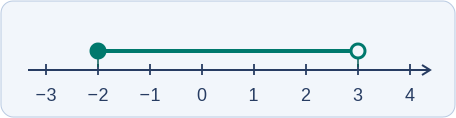
A number line has a filled circle at -2 and a open circle at 3, joined by a segment.

The highlighted range starts at an included endpoint and ends at an excluded endpoint.

Worked example

Read a bounded solution from a number line

Give the single inequality in x shown on the number line.
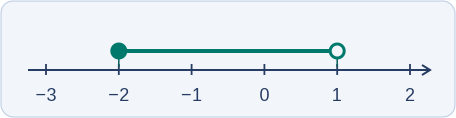
A number line has a filled circle at -2 and a open circle at 1, joined by a segment.

  1. Read left to right between −2-2 and 11. The segment requires both conditions.

  2. The left boundary is included. The right boundary is excluded. Write −2≤x<1-2\leq x\lt 1.

Your turn

Give the single inequality in x shown on the number line.

A number line has a open circle at -3 and a filled circle at 1, joined by a segment.

Give the complete set: {1, 4} for separate values, (1, 5] for an interval, U for union or empty for no real solutions. Use sqrt(...) for exact roots.

Worked example

Translate two limits into one inequality

A reading xx is at least −1-1 and less than 44. Write its range.

Try it on paper first.

  1. The lower condition is x≥−1x\geq -1. The upper one is x<4x\lt 4.

  2. Join both with the smaller boundary first to obtain −1≤x<4-1\leq x\lt 4.

Your turn

A reading xx is greater than 00 and at most 66. Write its range.

Give the complete set: {1, 4} for separate values, (1, 5] for an interval, U for union or empty for no real solutions. Use sqrt(...) for exact roots.

Section 2 of 3 · Core · about 7 min

What does ‘and’ mean for a range?

A value must satisfy both conditions joined by ‘and’. It lies in the common part of the two rays.

Worked example

Combine two inequalities using and

Write one inequality to show that x≥−4x\geq -4 and x<−1x\lt -1.

  1. Start at the left boundary −4-4. Rewrite the lower condition with this number first.

  2. Follow the number line to the right boundary −1-1. Keep both endpoint conditions: −4≤x<−1-4\leq x\lt -1.

Your turn

Write one inequality to show that x>−2x\gt -2 and x≤2x\leq 2.

Give the complete set: {1, 4} for separate values, (1, 5] for an interval, U for union or empty for no real solutions. Use sqrt(...) for exact roots.

Worked example

List the integer values within bounds

List every integer xx that satisfies 1≤x<61\leq x\lt 6.

Try it on paper first.

  1. Start with the smallest allowed integer, 11. Walk right one integer at a time.

  2. Stop at 55. The complete list is {1,2,3,4,5}\left\{1, 2, 3, 4, 5\right\}.

Your turn

List every integer xx that satisfies −1<x≤5-1\lt x\leq 5.

Give the complete set: {1, 4} for separate values, (1, 5] for an interval, U for union or empty for no real solutions. Use sqrt(...) for exact roots.

Section 3 of 3 · Core · about 7 min

How do I list only the allowed integers?

A range normally includes real numbers. When an answer asks for integers, select only the whole-number points that satisfy the range.

Worked example

Check each candidate against both bounds

From −4,−3,−1,1,2-4,\quad -3,\quad -1,\quad 1,\quad 2, give every value that satisfies −3≤x<1-3\leq x\lt 1.

  1. The first and last candidates lie outside the interval. −1-1 lies strictly inside it.

  2. Test the endpoints against their own signs. The allowed candidates are {−3,−1}\left\{-3, -1\right\}.

Your turn

From −2,−1,32,4,5-2,\quad -1,\quad \frac{3}{2},\quad 4,\quad 5, give every value that satisfies −1<x≤4-1\lt x\leq 4.

Give the complete set: {1, 4} for separate values, (1, 5] for an interval, U for union or empty for no real solutions. Use sqrt(...) for exact roots.

Worked example

Choose the two endpoints for a bounded segment

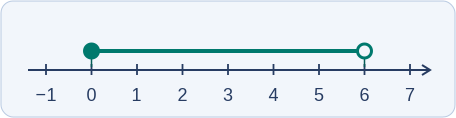
For 0≤x<60\leq x\lt 6, which circles are needed at the two boundaries?

  1. Both circles filled
  2. Left circle filled, right open
  3. Left circle open, right filled
  4. Both circles open

Try it on paper first.

  1. Left circle filled, right open. Join them with a segment.

    A number line has a filled circle at 0 and a open circle at 6, joined by a segment.

  2. Join the two boundary values because every real value between them satisfies both conditions.

Your turn

For −4<x≤−1-4\lt x\leq -1, which circles are needed at the two boundaries?

Choose circle types

Worked examples

Practise the method

Core practice

Question 1 of 5

0 / 5 checked in this collection

Question list

Core practice

Fresh variants

Exam-style

Read a bounded solution from a number line

1 mark

Give the single inequality in x shown on the number line.

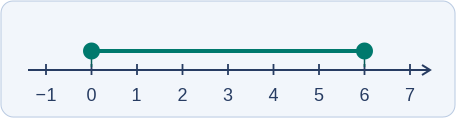
A number line has a filled circle at 0 and a filled circle at 6, joined by a segment.

Give the complete set: {1, 4} for separate values, (1, 5] for an interval, U for union or empty for no real solutions. Use sqrt(...) for exact roots.

Full answer-format guide

Exact numbers: 3/2, sqrt(5), 2-sqrt(3), pi/6, 3*pi/2. Sets: {1,4}. Intervals: (3,5]; a round bracket excludes the endpoint. Infinity: inf; union: U; no solutions: empty. Separate coordinate pairs or triples with semicolons. Expressions: 2x^2+3x-1; equations: x^2=3x+1 or the polynomial equal to zero. Factors: x-1 ; x+2. Parameter fraction: numerator ; denominator. List integer answers individually.

Review the method

Progress stays in this browser. Create an account to save it or sign in.

Extra practice from this lesson

Read a bounded solution from a number line

Give the single inequality in x shown on the number line.

A number line has a open circle at -1 and a open circle at 4, joined by a segment.

Give the complete set: {1, 4} for separate values, (1, 5] for an interval, U for union or empty for no real solutions. Use sqrt(...) for exact roots.

Translate two limits into one inequality

A reading xx is greater than −4-4 and less than −1-1. Write its range.

Give the complete set: {1, 4} for separate values, (1, 5] for an interval, U for union or empty for no real solutions. Use sqrt(...) for exact roots.

Combine two inequalities using and

Write one inequality to show that x>1x\gt 1 and x<6x\lt 6.

Give the complete set: {1, 4} for separate values, (1, 5] for an interval, U for union or empty for no real solutions. Use sqrt(...) for exact roots.

List the integer values within bounds

List every integer xx that satisfies −2<x<1-2\lt x\lt 1.

Give the complete set: {1, 4} for separate values, (1, 5] for an interval, U for union or empty for no real solutions. Use sqrt(...) for exact roots.

Check each candidate against both bounds

From −1,0,3,6,7-1,\quad 0,\quad 3,\quad 6,\quad 7, give every value that satisfies 0<x<60\lt x\lt 6.

Give the complete set: {1, 4} for separate values, (1, 5] for an interval, U for union or empty for no real solutions. Use sqrt(...) for exact roots.

Choose the two endpoints for a bounded segment

For −2<x<2-2\lt x\lt 2, which circles are needed at the two boundaries?

Choose circle types

Apply it · original exam-style problems

Show your working on paper and compare it with the worked solution and marking guidance.

Come back to what needs practice

Quick revision sheet (A4)

Your review plan starts after your first check.