Maths4UBETA

Powers of products, zero and negative indices

Apply an outer power to an entire bracket and use reciprocals to write positive indices.

Try the quick check →
Lesson 2 of 5

Section 1 of 3 · Core · about 7 min

What exactly does an outside index act on?

A whole bracket raised to a power behaves as one base. Read the brackets before deciding what the outside index applies to.

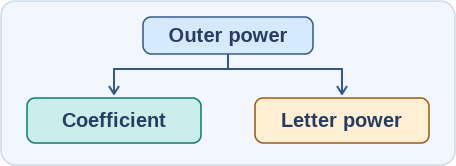
An outer power is connected by arrows to both the coefficient and the letter factor inside a bracket.

Both factors are inside the repeated group. Apply the exponent to each one.

Worked example

Raise every factor inside the brackets

Assume all letters used as bases are positive. Write (2x3)2\left(2x^{3}\right)^{2} as cxpcx^{p}. Give cc and pp.

  1. Repeat the entire product inside the brackets 22 times.

  2. The numerical factor becomes 22=42^{2}=4. The two powers on the letter combine to 3×2=63\times 2=6.

  3. The simplified expression is 4x64x^{6}. In the requested form, c=4c=4, p=6p=6.

Your turn

Assume all letters used as bases are positive. Write (3x4)3\left(3x^{4}\right)^{3} as cxpcx^{p}. Give cc and pp.

Enter one number. Fractions and decimals are accepted.

Enter one number. Fractions and decimals are accepted.

Worked example

Apply a zero index to a whole base

Find the value of (3x2)0\left(3x^{2}\right)^{0} for x≠0x\ne0.

Try it on paper first.

  1. The entire base is 3x23x^{2}. It is nonzero because x≠0x\ne0.

  2. Any nonzero base raised to the power zero has value 1.

Your turn

Find the value of (4x3)0\left(4x^{3}\right)^{0} for x≠0x\ne0.

Enter one number. Fractions and decimals are accepted.

Section 2 of 3 · Core · about 6 min

Why does a zero exponent give one?

Dividing a nonzero power by itself gives one. The quotient law also gives the difference of two identical indices, which is zero.

Worked example

Simplify a quotient before raising it

Assume all letters used as bases are positive. Write (2x32x)3\left(\frac{2x^{3}}{2x}\right)^{3} as cxpcx^{p}. Give cc and pp.

  1. Inside the bracket the coefficients cancel. The quotient of letters becomes x2x^{2}.

  2. Then apply the outside power. The indices multiply to 2×3=62\times 3=6.

  3. The simplified expression is x6x^{6}. In the requested form, c=1c=1, p=6p=6.

Your turn

Assume all letters used as bases are positive. Write (3x43x)4\left(\frac{3x^{4}}{3x}\right)^{4} as cxpcx^{p}. Give cc and pp.

Enter one number. Fractions and decimals are accepted.

Enter one number. Fractions and decimals are accepted.

Worked example

Move only the factor with a negative index

Assume all letters used as bases are positive. Write 2x−22x^{-2} as cxp\frac{c}{x^{p}}. Give cc and pp. Use positive indices in the final expression.

Try it on paper first.

  1. The minus sign applies only to the index of xx.

  2. Use x−2=1x2x^{-2}=\frac{1}{x^{2}} and keep the original coefficient 22.

  3. The simplified expression is 2x2\frac{2}{x^{2}}. In the requested form, c=2c=2, p=2p=2.

Your turn

Assume all letters used as bases are positive. Write 3x−33x^{-3} as cxp\frac{c}{x^{p}}. Give cc and pp. Use positive indices in the final expression.

Enter one number. Fractions and decimals are accepted.

Enter one number. Fractions and decimals are accepted.

Section 3 of 3 · Core · about 8 min

Which factor moves when the exponent is negative?

A negative exponent makes a reciprocal of the matching positive power. The scope may be one letter or a whole bracket.

Worked example

Take the reciprocal of a powered bracket

Assume all letters used as bases are positive. Write (2x2)−2\left(2x^{2}\right)^{-2} as cxp\frac{c}{x^{p}}. Give cc and pp. Use positive indices in the final expression.

  1. First write the reciprocal of the square of the whole bracket.

  2. The square in the denominator is 4x44x^{4}. The coefficient in the requested template is 14\frac{1}{4}.

  3. The simplified expression is 14x4\frac{1}{4x^{4}}. In the requested form, c=14c=\frac{1}{4}, p=4p=4.

Your turn

Assume all letters used as bases are positive. Write (3x3)−2\left(3x^{3}\right)^{-2} as cxp\frac{c}{x^{p}}. Give cc and pp. Use positive indices in the final expression.

Enter an exact value or round to 3 significant figures.

Enter one number. Fractions and decimals are accepted.

Worked example

Write a quotient using positive indices

Assume all letters used as bases are positive. Write 3x2y−22x5y\frac{3x^{2}y^{-2}}{2x^{5}y} as cxpyq\frac{c}{x^{p}y^{q}}. Give cc, pp and qq. Use positive indices in the final expression.

Try it on paper first.

  1. Subtract the denominator's indices to get −3-3 for xx and −3-3 for yy.

  2. Move both letter factors into the denominator with positive indices. Keep the reduced numerical factor 32\frac{3}{2}.

  3. The simplified expression is 32x3y3\frac{3}{2x^{3}y^{3}}. In the requested form, c=32c=\frac{3}{2}, p=3p=3, q=3q=3.

Your turn

Assume all letters used as bases are positive. Write 4x3y−33x6y\frac{4x^{3}y^{-3}}{3x^{6}y} as cxpyq\frac{c}{x^{p}y^{q}}. Give cc, pp and qq. Use positive indices in the final expression.

Enter an exact value or round to 3 significant figures.

Enter one number. Fractions and decimals are accepted.

Enter one number. Fractions and decimals are accepted.

Worked examples

Practise the method

Core practice

Question 1 of 5

0 / 5 checked in this collection

Question list

Core practice

Fresh variants

Exam-style

Raise every factor inside the brackets

1 mark

Assume all letters used as bases are positive. Write (5x6)3\left(5x^{6}\right)^{3} as cxpcx^{p}. Give cc and pp.

Enter one number. Fractions and decimals are accepted.

Enter one number. Fractions and decimals are accepted.

Full answer-format guide

Exact numbers: 3/2, sqrt(5), 2-sqrt(3), pi/6, 3*pi/2. Sets: {1,4}. Intervals: (3,5]; a round bracket excludes the endpoint. Infinity: inf; union: U; no solutions: empty. Separate coordinate pairs or triples with semicolons. Expressions: 2x^2+3x-1; equations: x^2=3x+1 or the polynomial equal to zero. Factors: x-1 ; x+2. Parameter fraction: numerator ; denominator. List integer answers individually.

Review the method

Progress stays in this browser. Create an account to save it or sign in.

Extra practice from this lesson

Raise every factor inside the brackets

Assume all letters used as bases are positive. Write (4x5)2\left(4x^{5}\right)^{2} as cxpcx^{p}. Give cc and pp.

Enter one number. Fractions and decimals are accepted.

Enter one number. Fractions and decimals are accepted.

Apply a zero index to a whole base

Find the value of (5x4)0\left(5x^{4}\right)^{0} for x≠0x\ne0.

Enter one number. Fractions and decimals are accepted.

Simplify a quotient before raising it

Assume all letters used as bases are positive. Write (4x54x)5\left(\frac{4x^{5}}{4x}\right)^{5} as cxpcx^{p}. Give cc and pp.

Enter one number. Fractions and decimals are accepted.

Enter one number. Fractions and decimals are accepted.

Move only the factor with a negative index

Assume all letters used as bases are positive. Write 4x−44x^{-4} as cxp\frac{c}{x^{p}}. Give cc and pp. Use positive indices in the final expression.

Enter one number. Fractions and decimals are accepted.

Enter one number. Fractions and decimals are accepted.

Take the reciprocal of a powered bracket

Assume all letters used as bases are positive. Write (4x4)−2\left(4x^{4}\right)^{-2} as cxp\frac{c}{x^{p}}. Give cc and pp. Use positive indices in the final expression.

Enter an exact value or round to 3 significant figures.

Enter one number. Fractions and decimals are accepted.

Write a quotient using positive indices

Assume all letters used as bases are positive. Write 5x4y−44x7y\frac{5x^{4}y^{-4}}{4x^{7}y} as cxpyq\frac{c}{x^{p}y^{q}}. Give cc, pp and qq. Use positive indices in the final expression.

Enter an exact value or round to 3 significant figures.

Enter one number. Fractions and decimals are accepted.

Enter one number. Fractions and decimals are accepted.

Apply it · original exam-style problems

Show your working on paper and compare it with the worked solution and marking guidance.

Come back to what needs practice

Quick revision sheet (A4)

Your review plan starts after your first check.