Cambridge IGCSE Mathematics (0580) · Indices II · Quick revision
Powers of products, zero and negative indices
Repeat the complete bracket
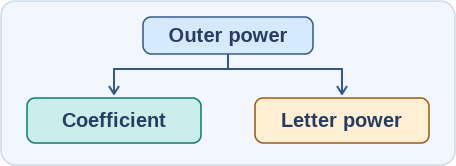
Use . The outer power acts on the coefficient as well as the letter. If the bracket contains a quotient, simplify the quotient first when possible.
Cancel the same nonzero powers
For a nonzero base , . If a bracket has exponent zero, first identify the whole bracket as the base.
Use a reciprocal and retain scope
Compare and . For a quotient, subtract the indices first and then convert any remaining negative power to a reciprocal.
Example
for . Square the whole bracket and take its reciprocal.
Check yourself
- Simplify .
- Use positive indices for , where .
Answers and .