Worked example
Read a unit fractional index as a root
Work out the exact value of .
The denominator 3 names the root. Rewrite the expression as .
The positive number gives when raised to the power . So the root is .
Read the root and power in a fractional index and find exact values for positive numerical bases.
Try the quick check →Section 1 of 4 · Extension · about 6 min
With a positive base, a fractional index whose numerator is 1 asks for a root. Check the small number that tells you which root to take.
Read the denominator and write the radical. Find the positive value that gives the original base when raised to that denominator.
Worked example
Work out the exact value of .
The denominator 3 names the root. Rewrite the expression as .
The positive number gives when raised to the power . So the root is .
Worked example
Work out the exact value of .
Try it on paper first.
The denominator 3 names the root. Rewrite the expression as .
The positive number gives when raised to the power . So the root is .
Section 2 of 4 · Extension · about 7 min
The two numbers in a fractional index have different jobs. Taking the root first can keep the arithmetic much smaller.
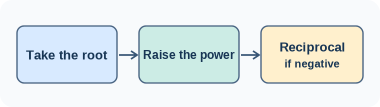
For a negative fractional index, take the reciprocal after using both parts of the fraction.
Find the root using the denominator. Write that result before raising it to the numerator power. Check that you carried out both steps.
Worked example
Work out the exact value of .
The denominator 2 gives . Taking the root first keeps the number small.
The numerator 3 says to raise that root to the power . This gives .
Worked example
Work out the exact value of .
Try it on paper first.
The denominator 3 gives . Taking the root first keeps the number small.
The numerator 2 says to raise that root to the power . This gives .
Section 3 of 4 · Extension · about 7 min
A negative fractional index combines the root-and-power method with the negative-index rule. The sign acts on the whole value found using the positive index.
Work out the root, apply the numerator power, then put the result under 1. If the bases match, the quotient rule also works with fractional indices. For example, .
Worked example
Work out the exact value of .
Use the positive index first. The square root of is .
Raise the root to the power to get . The original index was negative, so the answer is the reciprocal .
Worked example
Work out the exact value of .
Try it on paper first.
Use the positive index first. The cube root of is .
Raise the root to the power to get . The original index was negative, so the answer is the reciprocal .
Section 4 of 4 · Extension · about 7 min
When a whole fraction is inside brackets, both numerator and denominator are part of the base. A root can act on both if their individual roots can be found.
Take the appropriate root of the numerator and denominator. Raise this fraction to the numerator power of the index. Only take a reciprocal if the original index was negative.
Worked example
Work out the exact value of .
The denominator of the index is 3. Take that root of both the numerator and denominator of the base. The root is .
Raise the root to the power , giving . Take its reciprocal to get .
Worked example
Work out the exact value of .
Try it on paper first.
The denominator of the index is 2. Take that root of both the numerator and denominator of the base. The root is .
Raise the root to the power , giving . Take its reciprocal to get .
Question 1 of 5
0 / 5 checked in this collection
Work out the exact value of .
Progress stays in this browser. Create an account to save it or sign in.
Show your working on paper and compare it with the worked solution and marking guidance.
Your review plan starts after your first check.