Cambridge IGCSE Mathematics (0580) · Indices I · Quick revision
Fractional indices (Extended)
What root does the denominator give?
for . Squaring the square root or cubing the cube root takes you back to the base.
Read the denominator and write the radical. Find the positive value that gives the original base when raised to that denominator.
Which comes first, the root or the power?
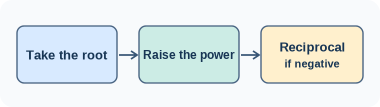
. The denominator gives the root. The numerator gives the power of that root.
Find the root using the denominator. Write that result before raising it to the numerator power. Check that you carried out both steps.
Where does the reciprocal belong?
for . Use the reciprocal as the final step.
Work out the root, apply the numerator power, then put the result under 1. If the bases match, the quotient rule also works with fractional indices. For example, .
What if the base is already a fraction?
For positive , . The following power then acts on both parts of that fraction.
Take the appropriate root of the numerator and denominator. Raise this fraction to the numerator power of the index. Only take a reciprocal if the original index was negative.