Maths4UBETA

Finding an exponential model from data (Extended)

Use consecutive readings to recover a per-period multiplier, work back to an initial value and compare additive and exponential forecasts.

Try the quick check →
Lesson 3 of 4

Section 1 of 3 · Extension · about 7 min

How can a table reveal the multiplier?

With equally spaced measurements, use a ratio to test for a constant factor. Use a difference to test for an additive model.

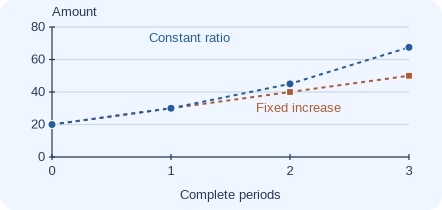
An additive path and a path with a constant ratio start at twenty and agree at thirty after one period. The path with a constant ratio is higher at periods two and three.

Both models start at 2020. Adding 1010 and multiplying by 1.51.5 agree after one step.

Worked example

Recover the multiplier from paired readings

The table gives three readings at equal intervals. Each reading is multiplied by the same number to get the next one. Find that multiplier.

Elapsed intervalsReading
00125125
11135135
22145.8145.8
  1. Divide a later reading by the immediately preceding reading.

  2. 135125=1.08\frac{135}{125}=1.08.

  3. The next pair confirms the same factor. 145.8135=1.08\frac{145.8}{135}=1.08.

Your turn

The table gives three readings at equal intervals. Each reading is multiplied by the same number to get the next one. Find that multiplier.

Elapsed intervalsReading
0010001000
1111201120
221254.41254.4

Enter an exact value or round to 3 significant figures.

Worked example

Recover the multiplier from paired readings

The table gives three readings at equal intervals. Each reading is multiplied by the same number to get the next one. Find that multiplier.

Elapsed intervalsReading
0013251325
1110601060
22848848

Try it on paper first.

  1. Divide a later reading by the immediately preceding reading.

  2. 10601325=0.8\frac{1060}{1325}=0.8.

  3. The next pair confirms the same factor. 8481060=0.8\frac{848}{1060}=0.8.

Your turn

The table gives three readings at equal intervals. Each reading is multiplied by the same number to get the next one. Find that multiplier.

Elapsed intervalsReading
0022002200
1116721672
221270.721270.72

Enter an exact value or round to 3 significant figures.

Section 2 of 3 · Extension · about 8 min

How do I recover the amount at time zero?

A later reading has already had the multiplier applied once per completed period. The same equation can run backwards if the factor is positive.

Worked example

Recover the initial value from a later reading

The model for a measure multiplies its value by 1.161.16 every hour. At the end of 22 hours its value is 908.28908.28 units. What was the value at the start, measured in units?

  1. The original value was multiplied by 1.1621.16^{2}.

  2. Undo that factor. 908.281.162=675\frac{908.28}{1.16^{2}}=675 units.

  3. Substituting the original into the forward model recovers 908.28908.28 units.

Your turn

The model for a measure multiplies its value by 1.181.18 every hour. At the end of 22 hours its value is 2158.222158.22 units. What was the value at the start, measured in units?

Enter one number. Fractions and decimals are accepted.

Worked example

Recover the initial value from a later reading

The model for a measure multiplies its value by 0.720.72 every hour. At the end of 33 hours its value is 699.84699.84 units. What was the value at the start, measured in units?

Try it on paper first.

  1. The original value was multiplied by 0.7230.72^{3}.

  2. Undo that factor. 699.840.723=1875\frac{699.84}{0.72^{3}}=1875 units.

  3. Substituting the original into the forward model recovers 699.84699.84 units.

Your turn

The model for a measure multiplies its value by 0.680.68 every hour. At the end of 33 hours its value is 864.688864.688 units. What was the value at the start, measured in units?

Enter one number. Fractions and decimals are accepted.

Section 3 of 3 · Extension · about 9 min

How are rate, factor and fixed change different?

An exponential predictor keeps its multiplier. An additive predictor keeps its change in units. You can compare two results at the same time.

Worked example

Infer a rate from two consecutive readings

Under an exponential model, a reading is 784784 at the end of hour 22 and 627.2627.2 at the end of hour 33. Find the percentage decrease per hour.

  1. Divide the later reading by the earlier one to find one hour’s multiplier.

  2. 627.2784=0.8\frac{627.2}{784}=0.8.

  3. Its difference from 1 gives the fractional change. The decrease is 20%20\%.

Your turn

Under an exponential model, a reading is 1212.961212.96 at the end of hour 22 and 921.8496921.8496 at the end of hour 33. Find the percentage decrease per hour. Enter the number before the percent sign.

Give the percentage, for example 25% or 25.

Worked example

Compare a fixed increase with a proportional one

Two forecasts start at 24252425 units. Forecast A adds 873873 units every month. Forecast B grows by 36%36\% each month. How many units higher is forecast B after 33 months? Give the exact difference.

Try it on paper first.

  1. The additive model increases by the same amount every month. 2425+3×873=50442425+3\times873=5044.

  2. The other model uses the same multiplier each month. 2425×1.363=6099.98082425\times1.36^{3}=6099.9808.

  3. The difference is 6099.9808−5044=1055.98086099.9808-5044=1055.9808 units.

Your turn

Two forecasts start at 475475 units. Forecast A adds 190190 units every month. Forecast B grows by 40%40\% each month. How many units higher is forecast B after 22 months? Give the exact difference.

Enter the whole-number count.

Worked examples

Practise the method

Core practice

Question 1 of 5

0 / 5 checked in this collection

Question list

Core practice

Fresh variants

Exam-style

Recover the multiplier from paired readings

1 mark

The table gives three readings at equal intervals. Each reading is multiplied by the same number to get the next one. Find that multiplier.

Elapsed intervalsReading
00850850
1110881088
221392.641392.64

Enter an exact value or round to 3 significant figures.

Full answer-format guide

Exact numbers: 3/2, sqrt(5), 2-sqrt(3), pi/6, 3*pi/2. Sets: {1,4}. Intervals: (3,5]; a round bracket excludes the endpoint. Infinity: inf; union: U; no solutions: empty. Separate coordinate pairs or triples with semicolons. Expressions: 2x^2+3x-1; equations: x^2=3x+1 or the polynomial equal to zero. Factors: x-1 ; x+2. Parameter fraction: numerator ; denominator. List integer answers individually.

Review the method

Progress stays in this browser. Create an account to save it or sign in.

Extra practice from this lesson

Recover the multiplier from paired readings

The table gives three readings at equal intervals. Each reading is multiplied by the same number to get the next one. Find that multiplier.

Elapsed intervalsReading
0018751875
1121752175
2225232523

Enter an exact value or round to 3 significant figures.

Recover the multiplier from paired readings

The table gives three readings at equal intervals. Each reading is multiplied by the same number to get the next one. Find that multiplier.

Elapsed intervalsReading
00250250
11180180
22129.6129.6

Enter an exact value or round to 3 significant figures.

Recover the initial value from a later reading

The model for a measure multiplies its value by 1.21.2 every hour. At the end of 22 hours its value is 34923492 units. What was the value at the start, measured in units?

Enter one number. Fractions and decimals are accepted.

Recover the initial value from a later reading

The model for a measure multiplies its value by 0.640.64 every hour. At the end of 33 hours its value is 209.7152209.7152 units. What was the value at the start, measured in units?

Enter one number. Fractions and decimals are accepted.

Infer a rate from two consecutive readings

Under an exponential model, a reading is 77.7677.76 at the end of hour 22 and 55.987255.9872 at the end of hour 33. Find the percentage decrease per hour. Enter the number before the percent sign.

Give the percentage, for example 25% or 25.

Compare a fixed increase with a proportional one

Two forecasts start at 13501350 units. Forecast A adds 594594 units every month. Forecast B grows by 44%44\% each month. How many units higher is forecast B after 66 months? Give the exact difference.

Enter the whole-number count.

Apply it · original exam-style problems

Show your working on paper and compare it with the worked solution and marking guidance.

Come back to what needs practice

Quick revision sheet (A4)

Your review plan starts after your first check.