Maths4UBETA

Exponential growth over time (Extended)

Model a fixed percentage increase per time period and forecast a future amount using a power of the growth factor.

Try the quick check →
Lesson 1 of 4

Section 1 of 3 · Extension · about 7 min

Why does a multiplier become a power?

A forecast may say that a quantity grows by a fixed percentage per year, per week or per other interval. Apply the percentage to the latest amount at the start of that interval.

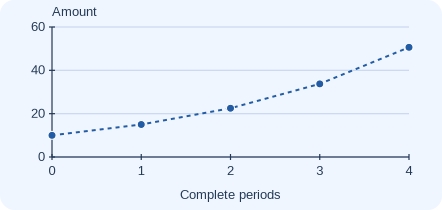
Five dots rise from ten at interval zero to just above fifty after four intervals.

The dots show 10×1.5k10\times1.5^k at complete intervals.

Worked example

Forecast a population several years ahead

A town has 36003600 residents at the beginning of the model. The population is modelled to grow by 1.6%1.6\% each year. Estimate the population at the end of 22 years. Give your answer to the nearest hundred.

  1. One year uses the multiplier 1.0161.016.

  2. 3600×1.0162≈3716.123600\times1.016^{2}\approx3716.12 before the final rounding.

  3. To the nearest hundred, this is 37003700 residents.

Your turn

A town has 78007800 residents at the beginning of the model. The population is modelled to grow by 5.5%5.5\% each year. Estimate the population at the end of 66 years. Give your answer to the nearest hundred.

Enter one number. Fractions and decimals are accepted.

Worked example

Match the exponent to the time interval

A storage forecast starts with 13251325 GB. The model increases this storage requirement by 24%24\% every two weeks. Find the modelled requirement, in GB, after 66 weeks. If rounding, use at least 3 significant figures.

Try it on paper first.

  1. There are 62=3\frac{6}{2}=3 complete two-week intervals.

  2. The storage is multiplied by 1.241.24 once per interval.

  3. 1325×1.243=2526.27681325\times1.24^{3}=2526.2768 GB.

Your turn

A storage forecast starts with 22002200 GB. The model increases this storage requirement by 8%8\% every two weeks. Find the modelled requirement, in GB, after 66 weeks. If rounding, use at least 3 significant figures.

Enter an exact value or round to 3 significant figures.

Section 2 of 3 · Extension · about 8 min

What do the three parts of the equation tell me?

The number outside the power gives the initial value. The base gives the change per period. The exponent says how many times that change has happened.

Worked example

Read the growth rate from the factor

The forecast for a settlement is P(k)=6240×1.032kP(k)=6240\times1.032^k, where kk counts years since the start. Find the annual percentage increase in the model.

  1. The factor multiplying the population each year is 1.0321.032.

  2. The part in excess of 1 is 1.032−1=0.0321.032-1=0.032.

  3. The increase per year is 3.2%3.2\%.

Your turn

The forecast for a settlement is P(k)=10440×1.082kP(k)=10440\times1.082^k, where kk counts years since the start. Find the annual percentage increase in the model. Enter the number before the percent sign.

Give the percentage, for example 25% or 25.

Worked example

Use the equation at an elapsed time

A garden’s forecast area, in square metres, is A(k)=12000×1.082kA(k)=12000\times1.082^k, where kk is the number of years after planting. Work out the area after 66 years to the nearest square metre.

Try it on paper first.

  1. Substitute k=6k=6 and raise only the multiplier to this power.

  2. 12000×1.0826≈1925512000\times1.082^{6}\approx19255 square metres to the stated precision.

Your turn

A garden’s forecast area, in square metres, is A(k)=16200×1.032kA(k)=16200\times1.032^k, where kk is the number of years after planting. Work out the area after 55 years to the nearest square metre.

Enter the whole-number count.

Section 3 of 3 · Extension · about 9 min

How do I read the date and answer the quantity asked for?

The starting date is period zero. A question may ask for the complete forecast at a later date, or only the increase from the starting amount.

Worked example

Find the additional amount over several periods

Moisture in a prepared sample has starting mass 980980 g. For this test the model increases the mass by 5.5%5.5\% each day. By how many grams does the modelled mass increase over 22 days? If rounding, use at least 3 significant figures.

  1. Compute the final mass. 980×1.0552=1090.7645980\times1.055^{2}=1090.7645 g.

  2. Subtract the starting mass to find the increase.

  3. 1090.7645−980=110.76451090.7645-980=110.7645 g.

Your turn

Moisture in a prepared sample has starting mass 16801680 g. For this test the model increases the mass by 1.6%1.6\% each day. By how many grams does the modelled mass increase over 33 days? If rounding, use at least 3 significant figures.

Enter an exact value or round to 3 significant figures.

Worked example

Set the starting date to period zero

At the end of 20272027, a seed library records 24402440 packets. It expects the stock to grow by 8%8\% per year. Find the modelled number at the end of 20312031, to the nearest packet.

Try it on paper first.

  1. The first date is period zero. The number of full years is 2031−2027=42031-2027=4.

  2. 2440×1.084≈33202440\times1.08^{4}\approx3320 packets to the stated precision.

Your turn

At the end of 20312031, a seed library records 880880 packets. It expects the stock to grow by 16%16\% per year. Find the modelled number at the end of 20342034, to the nearest packet.

Enter the whole-number count.

Worked examples

Practise the method

Core practice

Question 1 of 5

0 / 5 checked in this collection

Question list

Core practice

Fresh variants

Exam-style

Forecast a population several years ahead

1 mark

A town has 70807080 residents at the beginning of the model. The population is modelled to grow by 9.6%9.6\% each year. Estimate the population at the end of 55 years. Give your answer to the nearest hundred.

Enter one number. Fractions and decimals are accepted.

Full answer-format guide

Exact numbers: 3/2, sqrt(5), 2-sqrt(3), pi/6, 3*pi/2. Sets: {1,4}. Intervals: (3,5]; a round bracket excludes the endpoint. Infinity: inf; union: U; no solutions: empty. Separate coordinate pairs or triples with semicolons. Expressions: 2x^2+3x-1; equations: x^2=3x+1 or the polynomial equal to zero. Factors: x-1 ; x+2. Parameter fraction: numerator ; denominator. List integer answers individually.

Review the method

Progress stays in this browser. Create an account to save it or sign in.

Extra practice from this lesson

Forecast a population several years ahead

A town has 1200012000 residents at the beginning of the model. The population is modelled to grow by 1.6%1.6\% each year. Estimate the population at the end of 55 years. Give your answer to the nearest hundred.

Enter one number. Fractions and decimals are accepted.

Match the exponent to the time interval

A storage forecast starts with 250250 GB. The model increases this storage requirement by 24%24\% every two weeks. Find the modelled requirement, in GB, after 66 weeks. If rounding, use at least 3 significant figures.

Enter an exact value or round to 3 significant figures.

Read the growth rate from the factor

The forecast for a settlement is P(k)=14640×1.032kP(k)=14640\times1.032^k, where kk counts years since the start. Find the annual percentage increase in the model. Enter the number before the percent sign.

Give the percentage, for example 25% or 25.

Use the equation at an elapsed time

A garden’s forecast area, in square metres, is A(k)=6840×1.082kA(k)=6840\times1.082^k, where kk is the number of years after planting. Work out the area after 44 years to the nearest square metre.

Enter the whole-number count.

Find the additional amount over several periods

Moisture in a prepared sample has starting mass 120120 g. For this test the model increases the mass by 5.5%5.5\% each day. Find the modelled increase in grams over 44 days. If rounding, use at least 3 significant figures.

Enter an exact value or round to 3 significant figures.

Set the starting date to period zero

At the end of 20282028, a seed library records 15801580 packets. It expects the stock to grow by 8%8\% per year. Find the modelled number at the end of 20352035, to the nearest packet.

Enter the whole-number count.

Apply it · original exam-style problems

Show your working on paper and compare it with the worked solution and marking guidance.

Come back to what needs practice

Quick revision sheet (A4)

Your review plan starts after your first check.