Maths4UBETA

Sketch curves using stationary points

Combine the turning points, their types and the y-intercept into a sketch that shows the direction of each branch.

Try the quick check →
Lesson 5 of 5

Section 1 of 3 · Core · about 8 min

Which points should I put on the sketch first?

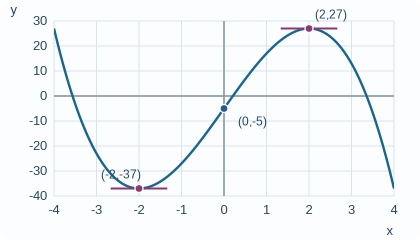
Cubic curve with horizontal tangents at (-2,-37) and (2,27). Its marked y-intercept is (0,-5).

Plot the two turns and the y-intercept. Join them with a smooth curve in the correct directions.

Practise the method

Find the stationary x-values from the derivative and their heights from the original formula. Use x=0x=0 in the original equation for the y-intercept.

Worked example

Find the point where the sketch meets the y-axis

For a sketch of y=−2x3+24x−5y=-2x^3+24x-5, find the y-intercept. Give its coordinates.

  1. On the y-axis, x=0x=0. Substitute into the original equation.

  2. Every power of x vanishes. The constant gives y=−5y=-5.

  3. The resulting coordinates are (0,−5)(0,-5).

Your turn

For a sketch of y=3x3−81x−4y=3x^3-81x-4, find the y-intercept. Give its coordinates.

Enter a point as (1, 2) or x = 1, y = 2. Separate complete pairs with commas or semicolons.

Worked example

Find the two stationary points of a cubic

Find all stationary points of y=−3x3+81x−9y=-3x^3+81x-9. Give both coordinate pairs.

Try it on paper first.

  1. Set dydx=−9x2+81\frac{\mathrm{d}y}{\mathrm{d}x}=-9x^2+81 to zero. The equation reduces to x2=9x^2=9.

  2. Both x=−3x=-3 and x=3x=3 work. Substitute both into the equation for y separately.

  3. The resulting coordinates are (−3,−171),(3,153)(-3,-171),\quad (3,153).

Your turn

Find all stationary points of y=4x3−192x−8y=4x^3-192x-8. Give both coordinate pairs.

Enter a point as (1, 2) or x = 1, y = 2. Separate complete pairs with commas or semicolons.

Section 2 of 3 · Core · about 9 min

Which way should the curve go between the turns?

Practise the method

An upward curve that turns down makes a local maximum. The next turn can reverse the direction again. Mark both types before joining the points with a smooth graph.

Worked example

Choose an order for the turning points

The equation is y=x3−3x+3y=x^3-3x+3. The two turning points occur at x=−1x=-1 and x=1x=1 from left to right. Which order must the sketch show?

  1. The graph falls throughout.
  2. Maximum, then minimum
  3. Minimum, then maximum
  4. The graph rises throughout.
  1. The derivative has one sign between the two roots and the opposite sign outside. The graph goes up, then down, then up.

  2. The turn order is maximum, then minimum.

Your turn

The equation is y=2x3−24x+4y=2x^3-24x+4. The two turning points occur at x=−2x=-2 and x=2x=2 from left to right. Which order must the sketch show?

Choose one answer

Worked example

Find the point where the sketch meets the y-axis

For a sketch of y=−x3+3x+10y=-x^3+3x+10, find the y-intercept. Give its coordinates.

Try it on paper first.

  1. On the y-axis, x=0x=0. Substitute into the original equation.

  2. Every power of x vanishes. The constant gives y=10y=10.

  3. The resulting coordinates are (0,10)(0,10).

Your turn

For a sketch of y=2x3−24x+11y=2x^3-24x+11, find the y-intercept. Give its coordinates.

Enter a point as (1, 2) or x = 1, y = 2. Separate complete pairs with commas or semicolons.

Section 3 of 3 · Core · about 9 min

How can I check the completed sketch?

Practise the method

Label the stationary coordinates and name the types. A sketch does not require a table of many values, but it must show their relative positions and the local shape correctly.

Worked example

Find the height of the local maximum

A sketch of y=2x3−24x+6y=2x^3-24x+6 has turning points at x=±2x=\pm 2. Find the y-value of the local maximum.

  1. The second derivative is 12x12x. It is negative at x=−2x=-2, so this x gives the local maximum.

  2. Substitute that x into the original equation to get y=38y=38.

Your turn

A sketch of y=−3x3+81x+7y=-3x^3+81x+7 has turning points at x=±3x=\pm 3. Find the y-value of the local maximum.

Enter one number. Fractions and decimals are accepted.

Worked example

Choose an order for the turning points

The equation is y=4x3−192x−5y=4x^3-192x-5. The two turning points occur at x=−4x=-4 and x=4x=4 from left to right. Which order must the sketch show?

  1. Maximum, then minimum
  2. Minimum, then maximum
  3. The graph rises throughout.
  4. The graph falls throughout.

Try it on paper first.

  1. The derivative has one sign between the two roots and the opposite sign outside. The graph goes up, then down, then up.

  2. The turn order is maximum, then minimum.

Your turn

The equation is y=x3−3x−4y=x^3-3x-4. The two turning points occur at x=−1x=-1 and x=1x=1 from left to right. Which order must the sketch show?

Choose one answer

Worked examples

Practise the method

Core practice

Question 1 of 5

0 / 5 checked in this collection

Question list

Core practice

Fresh variants

Exam-style

Find the point where the sketch meets the y-axis

1 mark

For a sketch of y=−4x3+192x−7y=-4x^3+192x-7, find the y-intercept. Give its coordinates.

Enter a point as (1, 2) or x = 1, y = 2. Separate complete pairs with commas or semicolons.

Full answer-format guide

Exact numbers: 3/2, sqrt(5), 2-sqrt(3), pi/6, 3*pi/2. Sets: {1,4}. Intervals: (3,5]; a round bracket excludes the endpoint. Infinity: inf; union: U; no solutions: empty. Separate coordinate pairs or triples with semicolons. Expressions: 2x^2+3x-1; equations: x^2=3x+1 or the polynomial equal to zero. Factors: x-1 ; x+2. Parameter fraction: numerator ; denominator. List integer answers individually.

The checker checks final answers only. Compare your explanation, sketch and method with the worked solution; method marks need review.

Review the method

Progress stays in this browser. Create an account to save it or sign in.

Extra practice from this lesson

Find the point where the sketch meets the y-axis

For a sketch of y=−4x3+192x+1y=-4x^3+192x+1, find the y-intercept. Give its coordinates.

Enter a point as (1, 2) or x = 1, y = 2. Separate complete pairs with commas or semicolons.

Find the two stationary points of a cubic

Find all stationary points of y=2x3−24x−2y=2x^3-24x-2. Give both coordinate pairs.

Enter a point as (1, 2) or x = 1, y = 2. Separate complete pairs with commas or semicolons.

Choose an order for the turning points

The equation is y=3x3−81x+9y=3x^3-81x+9. The two turning points occur at x=−3x=-3 and x=3x=3 from left to right. Which order must the sketch show?

Choose one answer

Find the point where the sketch meets the y-axis

For a sketch of y=4x3−192x−6y=4x^3-192x-6, find the y-intercept. Give its coordinates.

Enter a point as (1, 2) or x = 1, y = 2. Separate complete pairs with commas or semicolons.

Find the height of the local maximum

A sketch of y=4x3−192x+12y=4x^3-192x+12 has turning points at x=±4x=\pm 4. Find the y-value of the local maximum.

Enter one number. Fractions and decimals are accepted.

Choose an order for the turning points

The equation is y=3x3−81x+2y=3x^3-81x+2. The two turning points occur at x=−3x=-3 and x=3x=3 from left to right. Which order must the sketch show?

Choose one answer

Apply it · original exam-style problems

Show your working on paper and compare it with the worked solution and marking guidance.

Come back to what needs practice

Quick revision sheet (A4)

Your review plan starts after your first check.