Maths4UBETA

Classify maxima and minima

Use gradient signs or the second derivative to classify a stationary point as a local maximum or minimum.

Try the quick check →
Lesson 4 of 5

Section 1 of 3 · Core · about 8 min

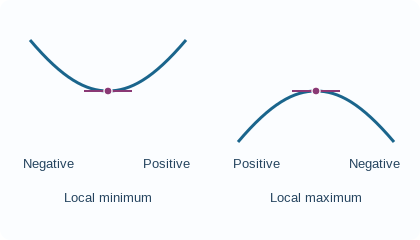
What does the graph do on either side?

The minimum has negative gradient on its left and positive gradient on its right. The maximum has positive gradient on its left and negative gradient on its right. Both have horizontal tangents.

Read the gradient signs from left to right and use them to identify the turn.

Practise the method

Positive to negative gives a local maximum. Negative to positive gives a local minimum. The horizontal tangent at the point itself has gradient zero in both cases.

Classifying a stationary point by gradient signs
To the leftTo the rightNature
PositiveNegativeMaximum
NegativePositiveMinimum

Worked example

Recognise a turn from gradient signs

The curve is smooth near x=8x=8. At this stationary point its tangent is horizontal. The gradient is −2-2 just before it and 55 just after it. What is the nature of the point?

  1. Local minimum
  2. Local maximum
  3. The y-coordinate is zero.
  4. The gradient data cannot distinguish the two cases.
  1. The signed gradients go from negative to positive.

  2. That means the curve turns at a local minimum.

Your turn

The curve is smooth near x=9x=9. At this stationary point its tangent is horizontal. The gradient is 33 just before it and −6-6 just after it. What is the nature of the point?

Choose one answer

Worked example

Test the gradient on both sides

The curve y=−3x3+81x+1y=-3x^3+81x+1 has a stationary point at x=−3x=-3. Use the signs of the gradients just to either side. What is the nature of this stationary point?

  1. The point is an x-intercept because its gradient is zero.
  2. The information is insufficient to decide.
  3. Local minimum
  4. Local maximum

Try it on paper first.

  1. Differentiate to find dydx=−9x2+81\frac{\mathrm{d}y}{\mathrm{d}x}=-9x^2+81.

  2. At −72-\frac{7}{2} the gradient is −1174-\frac{117}{4}. At −52-\frac{5}{2} it is 994\frac{99}{4}.

  3. The graph changes from decreasing to increasing. Therefore it is a local minimum.

Your turn

The curve y=4x3−192x+2y=4x^3-192x+2 has a stationary point at x=4x=4. Use the signs of the gradients just to either side. What is the nature of this stationary point?

Choose one answer

Section 2 of 3 · Core · about 9 min

How do I use the first derivative to justify a turn?

Practise the method

Substitute each test value into dydx\frac{\mathrm{d}y}{\mathrm{d}x}. Record the two signs and say whether the curve changes from rising to falling or falling to rising.

Worked example

Test the gradient on both sides

The curve y=2x3−24x+12y=2x^3-24x+12 has a stationary point at x=2x=2. Use the signs of the gradients just to either side. What is the nature of this stationary point?

  1. The information is insufficient to decide.
  2. Local minimum
  3. Local maximum
  4. The point is an x-intercept because its gradient is zero.
  1. Differentiate to find dydx=6x2−24\frac{\mathrm{d}y}{\mathrm{d}x}=6x^2-24.

  2. At 32\frac{3}{2} the gradient is −212-\frac{21}{2}. At 52\frac{5}{2} it is 272\frac{27}{2}.

  3. The graph changes from decreasing to increasing. Therefore it is a local minimum.

Your turn

The curve y=−3x3+81x+13y=-3x^3+81x+13 has a stationary point at x=−3x=-3. Use the signs of the gradients just to either side. What is the nature of this stationary point?

Choose one answer

Worked example

Recognise a turn from gradient signs

The curve is smooth near x=6x=6. At this stationary point its tangent is horizontal. The gradient is 22 just before it and −6-6 just after it. What is the nature of the point?

  1. Local minimum
  2. The y-coordinate is zero.
  3. The gradient data cannot distinguish the two cases.
  4. Local maximum

Try it on paper first.

  1. The signed gradients go from positive to negative.

  2. That means the curve turns at a local maximum.

Your turn

The curve is smooth near x=7x=7. At this stationary point its tangent is horizontal. The gradient is −3-3 just before it and 77 just after it. What is the nature of the point?

Choose one answer

Section 3 of 3 · Core · about 10 min

How can the second derivative distinguish the two?

Practise the method

At the stationary x-value, a positive d2ydx2\frac{\mathrm{d}^{2}y}{\mathrm{d}x^{2}} indicates a local minimum and a negative value indicates a local maximum. If it gives zero, check the first derivative on both sides or use a sketch.

Worked example

Use the second derivative at a stationary point

The curve y=−3x3+81x+2y=-3x^3+81x+2 has a stationary point at x=−3x=-3. Use the second derivative. What is the nature of this stationary point?

  1. The point is an x-intercept because its gradient is zero.
  2. The information is insufficient to decide.
  3. Local minimum
  4. Local maximum
  1. The first derivative is −9x2+81-9x^2+81. Differentiate it again to get d2ydx2=−18x\frac{\mathrm{d}^{2}y}{\mathrm{d}x^{2}}=-18x.

  2. At the stationary x-value this is 5454. Its sign gives a local minimum.

Your turn

The curve y=4x3−192x+3y=4x^3-192x+3 has a stationary point at x=4x=4. Use the second derivative. What is the nature of this stationary point?

Choose one answer

Worked example

Evaluate the second derivative

For y=−4x3+192xy=-4x^3+192x, find the value of d2ydx2\frac{\mathrm{d}^{2}y}{\mathrm{d}x^{2}} at x=4x=4.

Try it on paper first.

  1. First obtain dydx=−12x2+192\frac{\mathrm{d}y}{\mathrm{d}x}=-12x^2+192. Differentiate this to get d2ydx2=−24x\frac{\mathrm{d}^{2}y}{\mathrm{d}x^{2}}=-24x.

  2. Substitute x=4x=4 into the second derivative. Its value is −96-96.

Your turn

For y=x3−3x+1y=x^3-3x+1, find the value of d2ydx2\frac{\mathrm{d}^{2}y}{\mathrm{d}x^{2}} at x=−5x=-5.

Enter one number. Fractions and decimals are accepted.

Worked examples

Practise the method

Core practice

Question 1 of 5

0 / 5 checked in this collection

Question list

Core practice

Fresh variants

Exam-style

Recognise a turn from gradient signs

1 mark

The curve is smooth near x=6x=6. At this stationary point its tangent is horizontal. The gradient is 55 just before it and −4-4 just after it. What is the nature of the point?

Choose one answer

Choose one option. Explain your reasoning on paper.

Review the method

Progress stays in this browser. Create an account to save it or sign in.

Extra practice from this lesson

Recognise a turn from gradient signs

The curve is smooth near x=−3x=-3. At this stationary point its tangent is horizontal. The gradient is −3-3 just before it and 44 just after it. What is the nature of the point?

Choose one answer

Test the gradient on both sides

The curve y=2x3−24x+8y=2x^3-24x+8 has a stationary point at x=2x=2. Use the signs of the gradients just to either side. What is the nature of this stationary point?

Choose one answer

Test the gradient on both sides

The curve y=4x3−192x−5y=4x^3-192x-5 has a stationary point at x=4x=4. Use the signs of the gradients just to either side. What is the nature of this stationary point?

Choose one answer

Recognise a turn from gradient signs

The curve is smooth near x=−4x=-4. At this stationary point its tangent is horizontal. The gradient is −4-4 just before it and 66 just after it. What is the nature of the point?

Choose one answer

Use the second derivative at a stationary point

The curve y=−x3+3x+8y=-x^3+3x+8 has a stationary point at x=−1x=-1. Use the second derivative. What is the nature of this stationary point?

Choose one answer

Evaluate the second derivative

For y=3x3−81x+7y=3x^3-81x+7, find the value of d2ydx2\frac{\mathrm{d}^{2}y}{\mathrm{d}x^{2}} at x=−1x=-1.

Enter one number. Fractions and decimals are accepted.

Apply it · original exam-style problems

Show your working on paper and compare it with the worked solution and marking guidance.

Come back to what needs practice

Quick revision sheet (A4)

Your review plan starts after your first check.