Maths4UBETA

Upper and lower bounds of a measurement

Core and Extended. Find lower and upper bounds by halving the spacing between rounded readings.

Try the quick check →
Lesson 1 of 4

Section 1 of 3 · Core · about 7 min

How low could the reading have been?

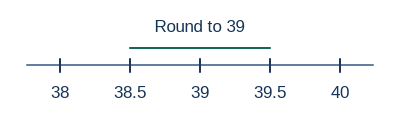
First imagine the previous reading on a number line. The point halfway between it and the given reading is the lower cut-off.

Number line from 38 to 40, with half steps at 38.5 and 39.5.

The two midpoints mark the edges of the band.

Worked example

Find the lower end of a rounded length

A roll of fabric measures 29 m to the nearest metre. Give the lower bound in metres.

  1. The spacing between readings is 1 m. Half that spacing is 0.5 m.

  2. Start at the recorded length and move down by 0.5 m: 29−0.529-0.5.

  3. The answer is 28.528.5.

Your turn

A roll of fabric measures 47 m to the nearest metre. Give the lower bound in metres.

Enter an exact value or round to 3 significant figures.

Worked example

Find the lower end of a rounded length

A roll of fabric measures 38 m to the nearest metre. Give the lower bound in metres.

Try it on paper first.

  1. The spacing between readings is 1 m. Half that spacing is 0.5 m.

  2. Start at the recorded length and move down by 0.5 m: 38−0.538-0.5.

  3. The answer is 37.537.5.

Your turn

A roll of fabric measures 56 m to the nearest metre. Give the lower bound in metres.

Enter an exact value or round to 3 significant figures.

Section 2 of 3 · Core · about 7 min

Where does the next reading begin?

The midpoint above the recorded value is where the next rounding band begins. The measurement can approach this cutoff from below.

Worked example

Find the upper end of a rounded length

A roll of fabric measures 32 m to the nearest metre. Give the upper bound in metres.

  1. The spacing between readings is 1 m. Half that spacing is 0.5 m.

  2. Start at the recorded length and move up by 0.5 m: 32+0.532+0.5.

  3. The answer is 32.532.5.

Your turn

A roll of fabric measures 50 m to the nearest metre. Give the upper bound in metres.

Enter an exact value or round to 3 significant figures.

Worked example

Find the upper end of a rounded length

A roll of fabric measures 41 m to the nearest metre. Give the upper bound in metres.

Try it on paper first.

  1. The spacing between readings is 1 m. Half that spacing is 0.5 m.

  2. Start at the recorded length and move up by 0.5 m: 41+0.541+0.5.

  3. The answer is 41.541.5.

Your turn

A roll of fabric measures 59 m to the nearest metre. Give the upper bound in metres.

Enter an exact value or round to 3 significant figures.

Section 3 of 3 · Core · about 7 min

What changes with decimal places?

Find the last place recorded on the scale. A measurement to two decimal places has one hundredth between possible readings.

Worked example

Read the scale before halving

A scale shows 2.84 kg, rounded to 2 decimal places. Give the lower bound in kilograms.

  1. Two decimal places means the spacing is 0.01 kg.

  2. Half the spacing is 0.005 kg.

  3. Subtract from the reading: 2.84−0.0052.84-0.005.

  4. The answer is 2.8352.835.

Your turn

A scale shows 3.26 kg, rounded to 2 decimal places. Give the lower bound in kilograms.

Enter an exact value or round to 3 significant figures.

Worked example

Read the scale before halving

A scale shows 3.05 kg, rounded to 2 decimal places. Give the lower bound in kilograms.

Try it on paper first.

  1. Two decimal places means the spacing is 0.01 kg.

  2. Half the spacing is 0.005 kg.

  3. Subtract from the reading: 3.05−0.0053.05-0.005.

  4. The answer is 3.0453.045.

Your turn

A scale shows 3.47 kg, rounded to 2 decimal places. Give the lower bound in kilograms.

Enter an exact value or round to 3 significant figures.

Worked examples

Practise the method

Core practice

Question 1 of 5

0 / 5 checked in this collection

Question list

Core practice

Fresh variants

Exam-style

Find the lower end of a rounded length

1 mark

A roll of fabric measures 95 m to the nearest metre. Give the lower bound in metres.

Enter an exact value or round to 3 significant figures.

Full answer-format guide

Exact numbers: 3/2, sqrt(5), 2-sqrt(3), pi/6, 3*pi/2. Sets: {1,4}. Intervals: (3,5]; a round bracket excludes the endpoint. Infinity: inf; union: U; no solutions: empty. Separate coordinate pairs or triples with semicolons. Expressions: 2x^2+3x-1; equations: x^2=3x+1 or the polynomial equal to zero. Factors: x-1 ; x+2. Parameter fraction: numerator ; denominator. List integer answers individually.

Review the method

Progress stays in this browser. Create an account to save it or sign in.

Extra practice from this lesson

A roll of fabric measures 68 m to the nearest metre. Give the lower bound in metres.

Enter an exact value or round to 3 significant figures.

A roll of fabric measures 71 m to the nearest metre. Give the lower bound in metres.

Enter an exact value or round to 3 significant figures.

A roll of fabric measures 74 m to the nearest metre. Give the upper bound in metres.

Enter an exact value or round to 3 significant figures.

A roll of fabric measures 77 m to the nearest metre. Give the upper bound in metres.

Enter an exact value or round to 3 significant figures.

A scale shows 3.89 kg, rounded to 2 decimal places. Give the lower bound in kilograms.

Enter an exact value or round to 3 significant figures.

A scale shows 3.96 kg, rounded to 2 decimal places. Give the lower bound in kilograms.

Enter an exact value or round to 3 significant figures.

Apply it · original exam-style problems

Show your working on paper and compare it with the worked solution and marking guidance.

Come back to what needs practice

Quick revision sheet (A4)

Your review plan starts after your first check.