Maths4UBETA

Bounds of rates and guaranteed decisions (Extended)

Extended (E1.10). Use the bounds of distance and time to find a speed limit, then apply bounds to a fit decision.

Try the quick check →
Lesson 4 of 4

Section 1 of 3 · Core · about 7 min

How can a journey be as slow as possible?

For the slowest journey, pick a distance near the smallest allowed value and a time near the largest. The denominator works in the opposite direction to the numerator.

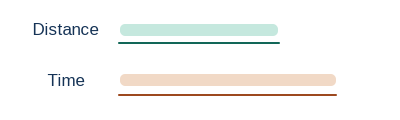
The distance and time bars show the short distance and long time used for a low speed.

Use the lower distance and the upper time to get a lower bound for speed.

Worked example

Find the lower bound of a speed

A robot travels 58 m to the nearest metre in 11 s to the nearest second. Find the lower bound of average speed in metres per second. Give your answer exactly.

  1. The speed is distance divided by time. Use distance 57.557.5 m and time 11.511.5 s.

  2. Divide 57.511.5\frac{57.5}{11.5}, then give the exact result.

  3. The answer is 55.

Your turn

A robot travels 88 m to the nearest metre in 11 s to the nearest second. Find the lower bound of average speed in metres per second. Give your answer exactly.

Enter one number. Fractions and decimals are accepted.

Worked example

Find the lower bound of a speed

A robot travels 73 m to the nearest metre in 14 s to the nearest second. Find the lower bound of average speed in metres per second. Give your answer exactly.

Try it on paper first.

  1. The speed is distance divided by time. Use distance 72.572.5 m and time 14.514.5 s.

  2. Divide 72.514.5\frac{72.5}{14.5}, then give the exact result.

  3. The answer is 55.

Your turn

A robot travels 103 m to the nearest metre in 14 s to the nearest second. Find the lower bound of average speed in metres per second. Give your answer exactly.

Enter one number. Fractions and decimals are accepted.

Section 2 of 3 · Core · about 7 min

How can a journey be as fast as possible?

For the highest speed, combine a long distance with a short time. Check both pieces of rounding information before dividing.

Worked example

Find the upper bound of a speed

A robot travels 63 m to the nearest metre in 12 s to the nearest second. Find the upper bound of average speed in metres per second. Give your answer exactly.

  1. The speed is distance divided by time. Use distance 63.563.5 m and time 11.511.5 s.

  2. Divide 63.511.5\frac{63.5}{11.5}, then give the exact result.

  3. The answer is 12723\frac{127}{23}.

Your turn

A robot travels 93 m to the nearest metre in 12 s to the nearest second. Find the upper bound of average speed in metres per second. Give your answer exactly.

Enter one number. Fractions and decimals are accepted.

Worked example

Find the upper bound of a speed

A robot travels 78 m to the nearest metre in 9 s to the nearest second. Find the upper bound of average speed in metres per second. Give your answer exactly.

Try it on paper first.

  1. The speed is distance divided by time. Use distance 78.578.5 m and time 8.58.5 s.

  2. Divide 78.58.5\frac{78.5}{8.5}, then give the exact result.

  3. The answer is 15717\frac{157}{17}.

Your turn

A robot travels 108 m to the nearest metre in 9 s to the nearest second. Find the upper bound of average speed in metres per second. Give your answer exactly.

Enter one number. Fractions and decimals are accepted.

Section 3 of 3 · Core · about 7 min

Can I promise that it will fit?

Test the situation that puts the most demand on the space. A rounded total below the space limit alone cannot justify a guarantee.

Worked example

Make a guaranteed fit decision

A tray is exactly 42 cm long. Two bars measured to the nearest centimetre are 26 cm and 16 cm long. Are they guaranteed to fit end to end?

Give Yes or No and explain your answer.

  1. The total bar length is less than 4343 cm, because each bar is below its own upper bound.

  2. Some allowed totals are above 42 cm, so the fit is uncertain.

Your turn

A tray is exactly 60 cm long. Two bars measured to the nearest centimetre are 38 cm and 22 cm long. Are they guaranteed to fit end to end?

Guaranteed to fit

Worked example

Make a guaranteed fit decision

A tray is exactly 52 cm long. Two bars measured to the nearest centimetre are 32 cm and 19 cm long. Are they guaranteed to fit end to end?

Give Yes or No and explain your answer.

Try it on paper first.

  1. The total bar length is less than 5252 cm, because each bar is below its own upper bound.

  2. The total is always less than 52 cm, so both bars fit.

Your turn

A tray is exactly 70 cm long. Two bars measured to the nearest centimetre are 44 cm and 25 cm long. Are they guaranteed to fit end to end?

Guaranteed to fit

Worked examples

Practise the method

Core practice

Question 1 of 5

0 / 5 checked in this collection

Question list

Core practice

Fresh variants

Exam-style

Find the lower bound of a speed

1 mark

A robot travels 168 m to the nearest metre in 9 s to the nearest second. Find the lower bound of average speed in metres per second. Give your answer exactly.

Enter one number. Fractions and decimals are accepted.

Full answer-format guide

Exact numbers: 3/2, sqrt(5), 2-sqrt(3), pi/6, 3*pi/2. Sets: {1,4}. Intervals: (3,5]; a round bracket excludes the endpoint. Infinity: inf; union: U; no solutions: empty. Separate coordinate pairs or triples with semicolons. Expressions: 2x^2+3x-1; equations: x^2=3x+1 or the polynomial equal to zero. Factors: x-1 ; x+2. Parameter fraction: numerator ; denominator. List integer answers individually.

Review the method

Progress stays in this browser. Create an account to save it or sign in.

Extra practice from this lesson

A robot travels 123 m to the nearest metre in 12 s to the nearest second. Find the lower bound of average speed in metres per second. Give your answer exactly.

Enter one number. Fractions and decimals are accepted.

A robot travels 128 m to the nearest metre in 13 s to the nearest second. Find the lower bound of average speed in metres per second. Give your answer exactly.

Enter one number. Fractions and decimals are accepted.

A robot travels 133 m to the nearest metre in 14 s to the nearest second. Find the upper bound of average speed in metres per second. Give your answer exactly.

Enter one number. Fractions and decimals are accepted.

A robot travels 138 m to the nearest metre in 9 s to the nearest second. Find the upper bound of average speed in metres per second. Give your answer exactly.

Enter one number. Fractions and decimals are accepted.

A tray is exactly 88 cm long. Two bars measured to the nearest centimetre are 56 cm and 31 cm long. Are they guaranteed to fit end to end?

Guaranteed to fit

A tray is exactly 90 cm long. Two bars measured to the nearest centimetre are 58 cm and 32 cm long. Are they guaranteed to fit end to end?

Guaranteed to fit

Apply it · original exam-style problems

Show your working on paper and compare it with the worked solution and marking guidance.

Come back to what needs practice

Quick revision sheet (A4)

Your review plan starts after your first check.