Maths4UBETA

Multi-stage models and inverse problems

Connect parameter recovery, integer design limits and reward decisions without importing Statistics 2 rules.

Try the quick check →
Lesson 5 of 5

Study sessions

Answer the checkpoints in a session without a hint before moving on.

  1. Reverse a repeated-event probability · 13 min

    Recover the probability for one observation before finding a normal cutoff.

    0 of 1 checkpoints answered independently
  2. Identify the model for a mixed group · 17 min

    Distinguish independent type choices from a common type shared across a batch.

    0 of 1 checkpoints answered independently
  3. Recover missing model parameters · 29 min

    Solve inverse normal and corrected approximation problems, then check the candidate solutions.

    0 of 3 checkpoints answered independently
  4. Check a multi-stage model · 12 min

    Check that a derived probability or mixing weight is feasible in the original model.

    0 of 1 checkpoints answered independently

Section 1 of 5 · Core · about 13 min

Which one-observation probability produced the repeated event?

Let X1,…,XnX_1,\ldots,X_n be independent observations from the same N(μ,σ2)\mathrm{N}(\mu,\sigma^2) model, with positive integer nn and σ>0\sigma>0. Write F(c)=P(Xi≤c)F(c)=P(X_i\le c). Independence and the common cumulative probability give

P(all n readings are at most c)=[F(c)]n.P(\text{all }n\text{ readings are at most }c)=[F(c)]^n.

If this batch probability is AA, with 0<A<10<A<1, recover F(c)=A1nF(c)=A^{\frac{1}{n}}. If instead the probability of at least one exceedance is BB, recover

F(c)=(1−B)1n,c=μ+σΦ−1 ⁣((1−B)1n).F(c)=(1-B)^{\frac{1}{n}},\qquad c=\mu+\sigma\Phi^{-1}\!\left((1-B)^{\frac{1}{n}}\right).

Complement first when needed, undo the repeated-trial power, then apply the normal inverse. Do not pass the original batch probability directly to the normal inverse.

Worked example

Invert the repeated event before finding the normal cutoff

Four independent readings each follow N(100,225)\mathrm{N}(100,225). Choose a cutoff cc so that the probability at least one reading exceeds it is 0.200.20. Find cc to two decimal places. Use an unrounded calculator inverse, or the supplied intermediate quantile 1.6048956001.604895600 after deriving the required single-reading cumulative probability.

  1. Let F(c)=P(X≤c)F(c)=P(X\le c) for one reading. The complement of at least one exceedance is that all four readings are at most the cutoff. Independence gives

    1−[F(c)]4=0.20.1-[F(c)]^4=0.20.
  2. Recover the one-reading lower cumulative probability before using the normal inverse:

    [F(c)]4=0.80,F(c)=0.8014≈0.9457416090.[F(c)]^4=0.80,\qquad F(c)=0.80^{\frac{1}{4}}\approx0.9457416090.
  3. The standard deviation is fifteen. Thus

    c−10015=Φ−1 ⁣(0.8014)≈1.604895600,\frac{c-100}{15}=\Phi^{-1}\!\left(0.80^{\frac{1}{4}}\right)\approx1.604895600,c=100+15Φ−1 ⁣(0.8014)≈124.0734340≈124.07.c=100+15\Phi^{-1}\!\left(0.80^{\frac{1}{4}}\right)\approx124.0734340\approx124.07.
  4. Back-substitute the unrounded cutoff: its one-reading lower probability is approximately 0.94574160900.9457416090, whose fourth power is 0.800.80. The complement is the required 0.200.20. Passing 0.200.20 directly to the normal inverse would invert the batch event as though it described one reading.
Find the cutoff from four independent readings

Each reading follows N(100,225)\mathrm{N}(100,225). The chance that at least one of the four readings exceeds the cutoff cc is 0.200.20.

  1. The probability all four are at most cc is 1−0.20=0.801-0.20=0.80.
  2. Write F(c)=P(X≤c)F(c)=P(X\leq c). Independence gives F(c)4=0.80F(c)^4=0.80, so F(c)=0.804≈0.9457416090F(c)=\sqrt[4]{0.80}\approx0.9457416090.
  3. Invert the standard normal distribution: z=Φ−1(F(c))≈1.6048956002z=\Phi^{-1}(F(c))\approx1.6048956002.
  4. Return to the reading scale: c=100+15z≈124.07c=100+15z\approx124.07. Round after using the unrounded value of zz.

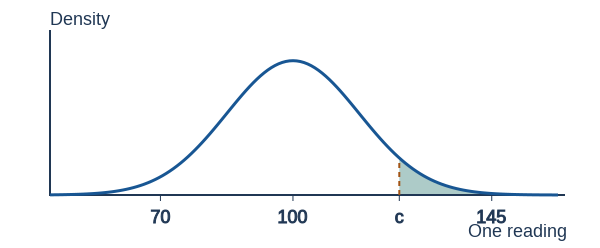
The shaded area is the chance of a single reading above cc, which is 1−F(c)≈0.05431-F(c)\approx0.0543.

Normal density centred at 100. The right tail above the cutoff at about 124.07 is shaded.

Four independent normal readings with mean one hundred and variance two hundred and twenty-five have a 20% chance of at least one exceedance. The all-below probability is 0.8, the single-reading cumulative probability is its fourth root, and the resulting cutoff is approximately 124.07.

Your turn

Three independent observations each follow N(60,16)\mathrm{N}(60,16). Their probability of all being at most cc is 0.7290.729. Choose the correct calculation order, then find the single-observation lower cumulative probability exactly and the cutoff to two decimal places. For a table method use z0.90≈1.282z_{0.90}\approx1.282.

Correct order of inverse operations

Enter an exact number, for example 3/2 or 2-sqrt(3).

Round as requested in the label, or enter your calculator value. Decimal or fraction input is accepted.

Precision convention. Use an unrounded calculator inverse, or an explicitly supplied intermediate quantile. For the stated table routes, use the supplied three-decimal-place quantile and preserve it through the parameter calculation; checks accept its propagated final rounding. Mixture-count questions supply seven-decimal-place component probabilities and require those values throughout the downstream calculation. Report probabilities to four decimal places and cutoffs or normal parameters to two, unless an exact answer is requested.

Section 2 of 5 · Core · about 17 min

Is the type chosen anew for each reading or once for the whole batch?

If type AA is chosen with probability ww and type BB with probability 1−w1-w, find the desired normal area separately within each component. If the component event probabilities are qAq_A and qBq_B, the single-measurement mixture event probability is

q=wqA+(1−w)qB.q=wq_A+(1-w)q_B.

This weights areas from disjoint type branches. It does not average normal parameters to create a substitute normal distribution.

Worked example

Weight component areas, then repeat fresh type selections

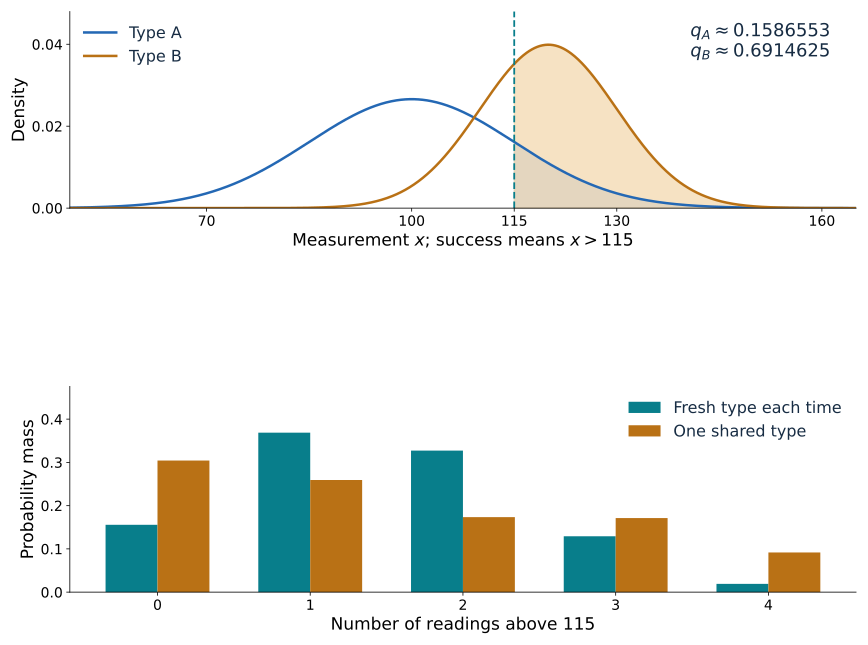
For each measurement independently, choose type AA with probability 0.60.6 or type BB with probability 0.40.4. Type AA measurements follow N(100,225)\mathrm{N}(100,225); type BB measurements follow N(120,100)\mathrm{N}(120,100). Measurements are generated independently conditional on their independently chosen types. Find the probability a measurement exceeds one hundred and fifteen, and the probability exactly two of four such measurements do so. Use the supplied component working probabilities qA=0.1586553q_A=0.1586553 and qB=0.6914625q_B=0.6914625, retaining them throughout; report probabilities to four decimal places.

  1. Standardise within each component, using its own mean and standard deviation:

    qA,0=1−Φ ⁣(115−10015)=1−Φ(1),q_{A,0}=1-\Phi\!\left(\frac{115-100}{15}\right)=1-\Phi(1),qB,0=1−Φ ⁣(115−12010)=1−Φ(−0.5).q_{B,0}=1-\Phi\!\left(\frac{115-120}{10}\right)=1-\Phi(-0.5).

    The supplied component probabilities approximate these two areas.

  2. The type branches are disjoint, so weight their event probabilities:

    q0=0.6qA,0+0.4qB,0.q_0=0.6q_{A,0}+0.4q_{B,0}.

    Using the instructed working probabilities,

    q =0.6⋅0.1586553+0.4⋅0.6914625=0.37177818≈0.3718.q\ =0.6\cdot0.1586553+0.4\cdot0.6914625=0.37177818\approx0.3718.
  3. Fresh independent type selection and measurement generation on every trial produce independent success indicators with the same unconditional probability. Let KK count the exceedances among the four measurements. Its true count model is K∼B(4,q0)K\sim\mathrm{B}(4,q_0), so

    P(K=2)=(42)q02(1−q0)2≈(42)(0.37177818)2(0.62822182)2≈0.3273.P(K=2)=\binom{4}{2}q_0^2(1-q_0)^2\approx\binom{4}{2}(0.37177818)^2(0.62822182)^2\approx0.3273.
  4. Averaging the two normal means and variances and treating the result as one normal distribution does not produce this event calculation. A mixture need not be normal; first find each component area, then weight the areas.

Worked example

One shared type creates a mixture of batch-count models

Instead, choose one type for the whole four-measurement batch: type AA has prior probability 0.60.6, with measurements from N(100,225)\mathrm{N}(100,225); type BB has prior probability 0.40.4, with measurements from N(120,100)\mathrm{N}(120,100). Conditional on the selected type, generate four independent measurements. Let KK count those exceeding one hundred and fifteen. Find the probability all four exceed and the posterior probability that the batch was type AA, given all four exceeded. Use qA=0.1586553q_A=0.1586553, qB=0.6914625q_B=0.6914625 as working component probabilities throughout. Report probabilities to four decimal places.

  1. Let qA,0q_{A,0} and qB,0q_{B,0} be the exact within-type exceedance probabilities. Independence is conditional on the shared type. Within each branch, all four exceedances have probability equal to that component probability raised to the fourth power. Weight the complete branch events:

    P(K=4)=0.6qA,04+0.4qB,04≈0.6⋅(0.1586553)4+0.4⋅(0.6914625)4≈0.0918.P(K=4)=0.6q_{A,0}^4+0.4q_{B,0}^4\approx0.6\cdot(0.1586553)^4+0.4\cdot(0.6914625)^4\approx0.0918.
  2. For comparison, fresh type choice on every measurement uses q0=0.6qA,0+0.4qB,0q_0=0.6q_{A,0}+0.4q_{B,0} and would give

    P(K=4)=q04≈(0.37177818)4≈0.0191.P(K=4)=q_0^4\approx(0.37177818)^4\approx0.0191.

    Both designs have the same one-measurement mixture probability, but they have different batch probabilities because the type-sharing structure differs.

  3. The posterior numerator is the joint probability of choosing type AA and observing all four exceedances. Its denominator includes both possible type branches:

    P(A∣K=4)=0.6qA,040.6qA,04+0.4qB,04≈0.0041403134≈0.0041.P(A\mid K=4)=\frac{0.6q_{A,0}^4}{0.6q_{A,0}^4+0.4q_{B,0}^4}\approx0.0041403134\approx0.0041.
  4. The denominator is positive. The evidence strongly favours type BB, whose per-measurement exceedance probability is much larger. A shared type does not give the fresh-choice binomial model in this example; the full count distribution is a weighted mixture of the two conditional binomial distributions.

Two type-selection procedures use type A with probability zero point six and type B with probability zero point four. Type A is normal with mean one hundred and variance two hundred and twenty-five; type B is normal with mean one hundred and twenty and variance one hundred. At cutoff one hundred and fifteen, their exceedance probabilities differ. For four fresh independent choices, weight the two one-reading areas before forming a binomial count. For one shared type, first form the two conditional binomial count distributions and then weight them. The two procedures share a one-reading mixture probability but give different count probabilities.

The normal component tail areas give the weighted one-reading chance qˉ≈0.3718\bar q\approx0.3718. For four readings, P(K≥1)≈0.8442P(K\geq1)\approx0.8442 with fresh choices and 0.69570.6957 with one shared choice. Both expected counts are 4qˉ≈1.48714\bar q\approx1.4871.

The same two component normal areas can produce different four-reading count distributions. Fresh independent type selection uses a binomial model with the weighted one-reading probability; one type shared by the batch uses a weighted mixture of two conditional binomial models.

Your turn

Type AA has model N(10,4)\mathrm{N}(10,4); type BB has model N(14,9)\mathrm{N}(14,9). Their prior probabilities are 0.40.4 and 0.60.6. A success is a measurement above thirteen. Use the supplied working component probabilities qA=0.0668072q_A=0.0668072, qB=0.6305587q_B=0.6305587 throughout. Find the one-measurement mixture probability, then the probability all three measurements succeed when types are chosen independently afresh for each measurement, and when one type is shared by the batch. Measurements are generated independently conditional on their type choices. Give probabilities to four decimal places.

Give your answer to 4 decimal places.

Give your answer to 4 decimal places.

Give your answer to 4 decimal places.

For a shared type and a count of rr successes among nn readings, conditional independence gives

P(K=r)=w(nr)qAr(1−qA)n−r+(1−w)(nr)qBr(1−qB)n−r.P(K=r)=w\binom{n}{r}q_A^r(1-q_A)^{n-r}+(1-w)\binom{n}{r}q_B^r(1-q_B)^{n-r}.

For fresh independent type selection on every trial, use K∼B(n,q)K\sim\mathrm{B}(n,q) with the weighted event probability. These constructions can coincide in special cases, such as identical component event probabilities; the actual procedure determines which expression is justified.

Section 3 of 5 · Core · about 14 min

Which normal parameter is identified after the batch probability is inverted?

Once the repeated-event equation has been reduced to a one-observation condition P(X≤a)=αP(X\le a)=\alpha, use the familiar quantile relation

a=μ+σzα,zα=Φ−1(α).a=\mu+\sigma z_\alpha,\qquad z_\alpha=\Phi^{-1}(\alpha).

With known positive standard deviation, solve for the mean. With known mean and nonzero quantile, solve for the standard deviation and require it to be positive. If two distinct compound conditions recover two different percentile levels, form the two corresponding quantile equations and check that their cutoff order is consistent before solving.

Worked example

Recover an unknown mean from an all-below batch probability

Four independent observations each follow N(μ,16)\mathrm{N}(\mu,16). The probability all four are below thirty is 0.40960.4096. Find μ\mu to two decimal places. For a table method, use z0.80≈0.842z_{0.80}\approx0.842.

  1. Let a=P(X<30)a=P(X<30) for one observation. Independence gives

    a4=0.4096,a=0.8.a^4=0.4096,\qquad a=0.8.

    The nonnegative probability root is required.

  2. The standard deviation is four, so the recovered one-observation condition gives

    30−μ4=z0.80.\frac{30-\mu}{4}=z_{0.80}.
  3. μ=30−4z0.80≈26.63351507≈26.63.\mu=30-4z_{0.80}\approx26.63351507\approx26.63.

    The supplied table quantile gives μ≈30−4⋅0.842=26.632\mu\approx30-4\cdot0.842=26.632, which also reports 26.6326.63.

  4. The bound thirty must lie above the recovered mean because its lower cumulative probability is 80%. Back-substitution gives the original single-observation probability 0.80.8, then (0.8)4=0.4096(0.8)^4=0.4096 for the independent batch.

Your turn

Three independent observations each follow N(μ,9)\mathrm{N}(\mu,9). The probability all are below twenty-two is 0.5120.512. Find the single-observation lower cumulative probability exactly, and μ\mu to two decimal places. For a table method use z0.80≈0.842z_{0.80}\approx0.842.

Enter an exact number, for example 3/2 or 2-sqrt(3).

Round as requested in the label, or enter your calculator value. Decimal or fraction input is accepted.

Worked example

Recover a positive spread from a repeated upper-tail event

Three independent observations each follow N(50,σ2)\mathrm{N}(50,\sigma^2), with σ>0\sigma>0. The probability at least one exceeds fifty-six is 0.4880.488. Find σ\sigma to two decimal places. For a table method, use z0.80≈0.842z_{0.80}\approx0.842.

  1. Let a=P(X≤56)a=P(X\le56) for one observation. Complement the repeated upper-tail event:

    1−a3=0.488,a3=0.512,a=0.8.1-a^3=0.488,\qquad a^3=0.512,\qquad a=0.8.
  2. The cutoff fifty-six is therefore the 80th percentile of one observation:

    56−50σ=z0.80,σ=6z0.80.\frac{56-50}{\sigma}=z_{0.80},\qquad\sigma=\frac{6}{z_{0.80}}.
  3. σ≈7.129097699≈7.13.\sigma\approx7.129097699\approx7.13.

    The supplied table value gives σ≈60.842≈7.125890736\sigma\approx\frac{6}{0.842}\approx7.125890736, also reporting 7.137.13. The positive displacement and positive quantile give the required positive standard deviation.

  4. The second parameter of a reported normal model would be σ2\sigma^2, not σ\sigma. If a variance is requested, square the unrounded recovered spread. If the recovered cumulative probability had been one half at the known mean, the resulting median condition would not identify the spread.

Your turn

Two independent observations each follow N(40,σ2)\mathrm{N}(40,\sigma^2), with σ>0\sigma>0. The probability at least one exceeds forty-five is 0.360.36. Find σ\sigma to two decimal places, using a calculator or z0.80≈0.842z_{0.80}\approx0.842. Separately, would knowing only that both observations are below forty with probability 14\frac{1}{4} determine σ\sigma?

Round as requested in the label, or enter your calculator value. Decimal or fraction input is accepted.

Does the separate median-only batch condition determine the spread?

Section 4 of 5 · Core · about 15 min

Does an inverse normal-approximation root survive every original restriction?

In an inverse binomial approximation, the unknown parameter also appears in the matched normal mean or variance. First translate the discrete event with its continuity correction, then use the lower cumulative quantile. For corrected boundary bb, the working equation has the form

b−npnp(1−p)=zα.\frac{b-np}{\sqrt{np(1-p)}}=z_\alpha.

The positive square root, probability domain and sign remain part of this equation. Squaring may create candidates that do not satisfy it. A positive integer is required when the unknown is a trial count, and a probability must lie in its admissible range. The nondegenerate approximation also requires both strict checks np>5np>5 and n(1−p)>5n(1-p)>5.

Worked example

Reject the root introduced by squaring an inverse approximation

Let X∼B(n,12)X\sim\mathrm{B}(n,\frac{1}{2}), where nn is an unknown positive integer. An inverse normal-approximation calculation uses the prescribed working target P(X≤31)≈Φ(2)P(X\le31)\approx\Phi(2). Treat the normal quantile as exactly 22 within this approximation calculation; it is not obtained by inverting a rounded percentage. Find a candidate nn, check both strict suitability conditions, and reject any root that fails the original corrected equation.

  1. Match the mean and variance, then apply the continuity correction before solving:

    Y∼N ⁣(n2,n4),P(X≤31)≈P(Y<31.5).Y\sim\mathrm{N}\!\left(\frac{n}{2},\frac{n}{4}\right),\qquad P(X\le31)\approx P(Y<31.5).

    The prescribed lower-tail target requires

    31.5−n2n2=2,63−nn=2.\frac{31.5-\frac{n}{2}}{\frac{\sqrt{n}}{2}}=2,\qquad\frac{63-n}{\sqrt{n}}=2.
  2. The right side is positive and n>0\sqrt{n}>0, so the original equation requires n<63n<63. Squaring without this sign check produces

    (63−n)2=4n,n2−130n+3969=0,(63-n)^2=4n,\qquad n^2-130n+3969=0,(n−49)(n−81)=0.(n-49)(n-81)=0.
  3. Check both algebraic candidates in the unsquared corrected equation:

    63−4949=2,63−8181=−2.\frac{63-49}{\sqrt{49}}=2,\qquad\frac{63-81}{\sqrt{81}}=-2.

    Thus n=49n=49 is retained and n=81n=81 is rejected. The second candidate would match the opposite normal tail.

  4. The retained value is a positive integer, the event is within its possible count range, and

    np=492=24.5>5,n(1−p)=492=24.5>5.np=\frac{49}{2}=24.5>5,\qquad n(1-p)=\frac{49}{2}=24.5>5.
  5. The result is the candidate trial number in the prescribed normal-approximation equation. It does not assert that the exact binomial cumulative probability is exactly Φ(2)\Phi(2). With rounded empirical probabilities, integer candidates must instead be judged at the stated data and approximation precision.

Your turn

Let X∼B(n,12)X\sim\mathrm{B}(n,\frac{1}{2}), where nn is a positive integer. Use the prescribed normal-approximation target P(X≥18)≈1−Φ(2)P(X\ge18)\approx1-\Phi(2), treating z=2z=2 as the exact working standardised boundary in this approximation. Find the admissible integer candidate and the extraneous candidate obtained by squaring. State whether the retained candidate passes both strict approximation conditions.

Enter an exact number, for example 3/2 or 2-sqrt(3).

Enter an exact number, for example 3/2 or 2-sqrt(3).

Do both strict conditions hold for the retained candidate?

Section 5 of 5 · Core · about 12 min

Do the recovered parameters define one feasible and informative model chain?

A model chain can contain several different probabilities: a type prior, a conditional component area, an unconditional event probability, a repeated-event probability and a posterior. Give each its own meaning before combining them. At every step, keep probability values between zero and one, require positive conditioning denominators and standard deviations, and check independence only where the relevant product or binomial formula uses it.

Worked example

A compound probability may contain no information about a mixing weight

A batch uses type AA with unknown probability ww and type BB with probability 1−w1-w. Type AA has model N(40,4)\mathrm{N}(40,4); type BB has model N(40,36)\mathrm{N}(40,36). Choose one type for the batch, then generate three independent readings conditional on that type. The probability at least one reading exceeds forty is 78\frac{7}{8}. Can this observation determine ww?

  1. The threshold is the common mean of both normal models. Symmetry therefore gives

    P(X>40∣A)=P(X>40∣B)=12.P(X>40\mid A)=P(X>40\mid B)=\frac{1}{2}.
  2. Within either type, the probability at least one of the three readings exceeds the threshold is

    1−(12)3=78.1-\left(\frac{1}{2}\right)^3=\frac{7}{8}.
  3. Weighting the two branch probabilities gives

    P(at least one exceeds 40)=w⋅78+(1−w)⋅78=78P(\text{at least one exceeds }40)=w\cdot\frac{7}{8}+(1-w)\cdot\frac{7}{8}=\frac{7}{8}

    for every 0≤w≤10\le w\le1. The supplied event probability therefore leaves the mixing weight undetermined.

  4. At this particular threshold, the two component success probabilities coincide. Their conditional count models are both B(3,12)\mathrm{B}(3,\frac{1}{2}), so the shared-type count has that same binomial distribution. This does not make the two underlying normal populations identical, nor does it identify their mixing weight. A second informative threshold or other distinguishing evidence would be needed.

Your turn

At a common threshold, two normal component models have exact exceedance probabilities qA=15q_A=\frac{1}{5} and qB=35q_B=\frac{3}{5}. Choose type AA with probability ww, independently afresh for each measurement, and generate measurements independently given the choices. A proposal claims that at least one of two measurements exceeds the threshold with probability 0.960.96. Recover the implied one-measurement exceedance probability and the algebraic value of ww, then decide whether the proposal is feasible.

Enter an exact value or round to 3 significant figures.

Enter an exact value or round to 3 significant figures.

Is the proposed model feasible?

Worked examples

Practise the method

Core practice

Question 1 of 4

0 / 4 checked in this collection

Question list

Core practice

Fresh variants

Exam-style

Infer a count model before approximating

4 marks

A binomial X has mean 30 and variance 21. Recover its n and p, then give the exact continuity-corrected boundary and a normal approximation to P(X≥35)\mathrm P(X\ge 35).

Enter the value on its own or write n = … . Fractions and exact square roots are accepted.

Enter the value on its own or write p = … . Fractions and exact square roots are accepted.

Enter an exact number, for example 3/2 or 2-sqrt(3).

Give your answer to 4 decimal places.

Full answer-format guide

Exact numbers: 3/2, sqrt(5), 2-sqrt(3), pi/6, 3*pi/2. Sets: {1,4}. Intervals: (3,5]; a round bracket excludes the endpoint. Infinity: inf; union: U; no solutions: empty. Separate coordinate pairs or triples with semicolons. Expressions: 2x^2+3x-1; equations: x^2=3x+1 or the polynomial equal to zero. Factors: x-1 ; x+2. Parameter fraction: numerator ; denominator. List integer answers individually.

Review the method

Progress stays in this browser. Create an account to save it or sign in.

Extra practice from this lesson

Recover a single-event area from an all-success probability

Three independent measurements each have model X∼N(50,16)X\sim\mathrm{N}(50,16). The probability that all three are at most cc is 0.3430.343. Find the exact single-measurement probability q=P(X≤c)q=P(X\le c), the cutoff cc, and the exact probability that exactly two of the three are at most cc. Supplied standard score: z0.70≈0.524z_{0.70}\approx0.524.

Use a calculator or the supplied three-decimal standard score. Give the cutoff or mean to two decimal places, retaining the chosen score until final rounding. Both stated routes are accepted.

Enter an exact number, for example 3/2 or 2-sqrt(3).

Round as requested in the label, or enter your calculator value. Decimal or fraction input is accepted.

Enter an exact number, for example 3/2 or 2-sqrt(3).

Reverse an at-least-one event to find an unknown mean

Five independent measurements have a common normal distribution with unknown mean μ\mu and standard deviation 33. The probability that at least one exceeds 4040 is 0.672320.67232. Find the exact probability that one measurement exceeds 4040, estimate μ\mu, and find the exact probability that all five exceed 4040. Supplied standard score: z0.80≈0.842z_{0.80}\approx0.842.

Use a calculator or the supplied three-decimal standard score. Give the cutoff or mean to two decimal places, retaining the chosen score until final rounding. Both stated routes are accepted.

Enter an exact number, for example 3/2 or 2-sqrt(3).

Round as requested in the label, or enter your calculator value. Decimal or fraction input is accepted.

Enter an exact number, for example 3/2 or 2-sqrt(3).

Recover a mixture weight from a threshold probability

A measurement comes from type A with probability ww and type B with probability 1−w1-w. Type A has model N(40,16)\mathrm{N}(40,16); type B has model N(48,16)\mathrm{N}(48,16). The overall probability of exceeding 4444 is 0.600.60. For the mixture calculations use the supplied working tail probabilities a=0.1586553a=0.1586553 for type A and b=0.8413447b=0.8413447 for type B. Find ww and the probability of type B given an exceedance. Could an overall exceedance probability of 0.900.90 be achieved by changing only ww within [0,1][0,1]?

Give numerical weights and probabilities to four decimal places, retaining the supplied working values until final rounding.

Give your answer to 4 decimal places.

Give your answer to 4 decimal places.

Can changing only the weight give probability 0.90?

The time at which the type is chosen changes a batch probability

Type C measurements have model N(20,4)\mathrm{N}(20,4), and type D measurements have model N(24,9)\mathrm{N}(24,9). The type probabilities are 13\frac{1}{3} and 23\frac{2}{3}. Use the working probabilities a=0.1586553a=0.1586553 and b=0.7475075b=0.7475075 for exceeding 2222 under C and D respectively. In the fresh-type procedure, a type is chosen independently before each of three independent measurements. In the shared-type procedure, a type is chosen once for the batch; conditional on that type, the three measurements are independent. Find the single-measurement exceedance probability, the probability that all three exceed 2222 under each procedure, and the probability that the shared type was D given that all three exceeded 2222.

Give numerical weights and probabilities to four decimal places, retaining the supplied working values until final rounding.

Give your answer to 4 decimal places.

Give your answer to 4 decimal places.

Give your answer to 4 decimal places.

Give your answer to 4 decimal places.

An inverse median condition does not determine spread

Three independent measurements have common model N(μ,σ2)\mathrm{N}(\mu,\sigma^2), with σ>0\sigma>0. The probability that all three are at most 1010 is 18\frac{1}{8}. Find μ\mu, decide whether the standard deviation is uniquely determined, and decide whether the same model can also have probability 18\frac{1}{8} that all three are at most 1414.

Enter an exact number, for example 3/2 or 2-sqrt(3).

What is known about the standard deviation?
Can the second all-three probability also equal one eighth?

Recover the model first

A binomial variable has mean 2020 and variance 1212. Find the trial count.

Enter an exact number, for example 3/2 or 2-sqrt(3).

Round in the required direction

A design requires an integer cutoff at least as large as the calculated normal quantile 61.261.2. Find the smallest allowed cutoff.

Enter an exact number, for example 3/2 or 2-sqrt(3).

Connect the event to the payoff

A prize pays 66 pounds if a normal measurement exceeds its mean, otherwise nothing. Find the expected prize.

Enter an exact number, for example 3/2 or 2-sqrt(3).

Apply the parameter relation

For X∼N(μ,σ2)X\sim\mathrm N(\mu,\sigma^2), μ=5σ\mu=5\sigma. The value 3636 has z-score 11. Find the standard deviation.

Enter an exact number, for example 3/2 or 2-sqrt(3).

Apply it · original exam-style problems

Show your working on paper and compare it with the worked solution and marking guidance.

Start after this lesson

Recover a success probability from a signed approximation equation 12 marks

Let X∼B(100,p)X\sim\mathrm{B}(100,p), where 0<p<10<p<1. A continuity-corrected normal approximation is required to give P(X≤19)≈Φ(1)P(X\le19)\approx\Phi(1). Use the prescribed working standard score +1+1 exactly in the approximation equation; this avoids inverting a rounded decimal probability. Find the admissible estimate of pp, the other candidate produced by squaring, and the resulting normal mean and variance. Select the reason for rejecting the other candidate. Give the two probability candidates to four decimal places and the mean and variance to two decimal places. Check the original signed equation, the parameter domain and both strict suitability conditions.

Hint

The corrected boundary is 19.519.5. Before squaring, note the sign of 19.5−100p19.5-100p. Squaring loses that sign information, so every algebraic candidate must be substituted into the original equation.

Worked solution
  1. μ=100p,σ2=100p(1−p),19.5−100p100p(1−p)=1.\mu=100p,\qquad\sigma^2=100p(1-p),\qquad\frac{19.5-100p}{\sqrt{100p(1-p)}}=1.

    The denominator is positive, so the numerator must be positive. Thus an admissible candidate must satisfy p<0.195p<0.195.

  2. (19.5−100p)2=100p(1−p)(19.5-100p)^2=100p(1-p)10100p2−4000p+380.25=0.10100p^2-4000p+380.25=0.p=4000±63790020200.p=\frac{4000\pm\sqrt{637900}}{20200}.

    The candidates are approximately 0.15848087020.1584808702 and 0.23755873370.2375587337.

  3. The smaller candidate gives corrected standard score +1+1; the larger gives −1-1. Therefore the estimate is p≈0.1585p\approx0.1585, and 0.23760.2376 is rejected. Both lie between zero and one, so the probability domain alone would not remove the extraneous root.

  4. μ=100p≈15.85,σ2=100p(1−p)≈13.34.\mu=100p\approx15.85,\qquad\sigma^2=100p(1-p)\approx13.34.

    These calculations retain the unrounded admissible candidate.

  5. np≈15.8481>5,n(1−p)≈84.1519>5.np\approx15.8481>5,\qquad n(1-p)\approx84.1519>5.

    The strict suitability checks pass. The rejected candidate also passes those checks, but fails the original signed equation. The reported parameter is an estimate obtained from the prescribed normal approximation.

Marking guidance
  • 1 mark: use the corrected upper boundary.
  • 1 mark: write the normal mean and variance in terms of the unknown probability.
  • 1 mark: form the original signed standardisation equation.
  • 1 mark: identify the positive-numerator sign restriction.
  • 1 mark: square and form the quadratic.
  • 1 mark: obtain both algebraic candidates.
  • 1 mark: substitute into the signed equation and reject the wrong-sign candidate.
  • 1 mark: report the admissible probability at the requested accuracy.
  • 1 mark: calculate the normal mean from the unrounded candidate.
  • 1 mark: calculate the normal variance from the unrounded candidate.
  • 1 mark: check the probability domain and both strict suitability conditions.
  • 1 mark: identify the result as an inverse normal-approximation estimate rather than an exact binomial inversion.
Recover an integer trial count and reject a wrong-sign root 12 marks

Let X∼B(n,14)X\sim\mathrm{B}\left(n,\frac{1}{4}\right), where nn is an unknown positive integer. A continuity-corrected normal approximation is required to give P(X≤22)≈Φ(1)P(X\le22)\approx\Phi(1). Use the prescribed working standard score +1+1 exactly in the approximation equation. Find the corrected upper boundary, the admissible trial count, the rejected candidate produced by squaring, and the exact variance and standard deviation of the resulting normal approximation. Show the integer, sign and strict suitability checks.

Hint

The normal mean is n4\frac{n}{4}, variance 3n16\frac{3n}{16}, and standard deviation 3n4\frac{\sqrt{3n}}{4}. Apply the upper half-unit correction before forming the equation. Its unsquared left side must have the prescribed positive sign.

Worked solution
  1. P(X≤22)≈P(Y<22.5),Y∼N(n4,3n16).P(X\le22)\approx P(Y<22.5),\qquad Y\sim\mathrm{N}\left(\frac{n}{4},\frac{3n}{16}\right).22.5−n43n4=1⟹90−n=3n.\frac{22.5-\frac{n}{4}}{\frac{\sqrt{3n}}{4}}=1\quad\Longrightarrow\quad90-n=\sqrt{3n}.

    The original equation requires n<90n<90.

  2. (90−n)2=3n⟹n2−183n+8100=0(90-n)^2=3n\quad\Longrightarrow\quad n^2-183n+8100=0⟹(n−75)(n−108)=0.\Longrightarrow\quad(n-75)(n-108)=0.

    Both algebraic candidates are positive integers, so the integer check alone does not choose between them.

  3. For n=75n=75, the signed equation gives 90−75=15=22590-75=15=\sqrt{225}. For n=108n=108, it would require −18=18-18=18, which is false. Hence n=75n=75 is admissible and 108108 is rejected.

  4. np=754=18.75>5,n(1−p)=2254=56.25>5.np=\frac{75}{4}=18.75>5,\qquad n(1-p)=\frac{225}{4}=56.25>5.σ2=3⋅7516=22516,σ=154.\sigma^2=\frac{3\cdot75}{16}=\frac{225}{16},\qquad\sigma=\frac{15}{4}.

    The count cutoff lies inside the binomial support, the trial count is an integer, the standard deviation is positive and both strict suitability checks pass. These are the parameters selected by the prescribed approximation equation.

Marking guidance
  • 1 mark: apply the corrected upper boundary.
  • 1 mark: express the normal mean and variance in terms of the trial count.
  • 1 mark: use the positive standard deviation.
  • 1 mark: form the signed approximation equation.
  • 1 mark: identify the restriction that the trial count is less than ninety.
  • 1 mark: square and form the quadratic.
  • 1 mark: obtain both candidate trial counts.
  • 1 mark: verify that the candidates are positive integers.
  • 1 mark: substitute into the original equation and reject the wrong-sign root.
  • 1 mark: check both strict expected-count conditions.
  • 1 mark: obtain the exact normal variance.
  • 1 mark: obtain the positive exact standard deviation.

Come back to what needs practice

Quick revision sheet (A4)

Your review plan starts after your first check.

Question bank and saved work