Maths4UBETA

Labelled groups, unnamed divisions and rows of seats

Identify which group swaps create a new allocation, and distinguish numbered positions from group membership.

Try the quick check →
Lesson 4 of 5

Section 1 of 5 · Core · about 8 min

Does each group have a name or a job?

First say what one outcome records: each person’s destination, membership of unnamed groups, or exact seats. A group is labelled when its name, location or job matters. Swapping the whole membership of team X with team Y changes an assignment even if their sizes agree.

To assign nn distinct people to labelled groups of fixed sizes n1,…,nkn_1,\ldots,n_k, choose each group from the people still available. With nonnegative integer sizes summing to nn,

N=n!n1!n2!⋯nk!.N=\frac{n!}{n_1!n_2!\cdots n_k!}.

The factorials remove order inside each group. If rr people remain unassigned, the assigned sizes sum to n−rn-r and the denominator also includes r!r!. Their residual set is forced by the assignments; it is not interchangeable with an assigned team of the same size. Use 0!=10!=1 for an empty labelled group.

Worked example

Fill labelled groups from the people still available

Seven distinct people must form team X of size two, team Y of size two and team Z of size three. The team names matter, but there is no order within a team. Count the assignments.

  1. Choose the two people in X. From the remaining five, choose the two in Y. The remaining three form Z:

    N=(72)(52)(33)=21⋅10⋅1=210.N=\binom{7}{2}\binom{5}{2}\binom{3}{3}=21\cdot10\cdot1=210.
  2. The equivalent factorial expression is

    N=7!2! 2! 3!=210.N=\frac{7!}{2!\,2!\,3!}=210.

    Its denominator removes order inside each team. Swapping the entire memberships of X and Y still creates a different named assignment.
Your turn

From eight distinct people, assign two to team X, one to team Y and three to team Z. The remaining two are unassigned. No person can belong to more than one team. Count the assignments, ignoring order within each team.

Enter an exact number, for example 3/2 or 2-sqrt(3).

If capacities are not fixed, count destinations instead. For nn distinct objects, each independently assigned to any of k≥1k\ge1 labelled boxes, there are knk^n assignments when empty boxes are allowed. Requiring two named objects to share a box lets you assign them as one destination-unit, then assign the other objects.

For three boxes and n≥1n\ge1, exactly one used box gives three assignments. Exactly two used boxes gives (32)(2n−2)\binom{3}{2}(2^n-2): choose the two boxes, then exclude the two assignments using only one. Therefore all three boxes are used in

3n−3−(32)(2n−2)=3n−3⋅2n+33^n-3-\binom{3}{2}(2^n-2)=3^n-3\cdot2^n+3

assignments. These are destination choices, not fixed-capacity group counts.

Section 2 of 5 · Core · about 8 min

When may I forget group labels?

An unnamed division records a collection of nonempty groups, without ordering those groups. Count with temporary names, then determine how many name assignments describe each intended division. With no additional restrictions, prescribed positive group sizes give the following count when equal-size groups have no distinguishing roles. Let msm_s be the number of groups of size ss:

Nunnamed=n!n1!⋯nk! 1∏sms!.N_{\text{unnamed}}=\frac{n!}{n_1!\cdots n_k!}\,\frac{1}{\prod_s m_s!}.

The product means multiply one repeated-size factorial for each size. Different sizes already distinguish groups. In a restricted problem, first count the valid labelled allocations. Divide that valid count only when the restriction is unchanged by the forgotten label swaps and every intended outcome has the same number of valid labelled versions. Empty labelled boxes require their own destination model; do not treat repeated empty sets as nonempty groups in this division rule.

Divide seven people into two groups of two and one group of three.

Two different named allocations

GroupAllocation 1Allocation 2
XX{A,B}\{A,B\}{C,D}\{C,D\}
YY{C,D}\{C,D\}{A,B}\{A,B\}
ZZ{E,F,G}\{E,F,G\}{E,F,G}\{E,F,G\}

With the names removed, both give {{A,B},{C,D},{E,F,G}}\bigl\{\{A,B\},\{C,D\},\{E,F,G\}\bigr\}. Only the two pairs can exchange labels, so there are (72)(52)2!=2102=105\frac{\binom{7}{2}\binom{5}{2}}{2!}=\frac{210}{2}=105 unnamed divisions.

The two pairs can exchange temporary names, while the three-person group is identified by its size. Each unnamed division corresponds to exactly two named assignments.

Worked example

Remove only the repeated equal-size group labels

Divide seven distinct people into two unnamed pairs and one unnamed three-person group. Count the divisions. In a separate problem, divide six distinct people into three unnamed pairs.

  1. Temporarily name the two pairs X and Y and the triple Z. There are 210210 named assignments. Each unnamed division produces two such assignments by swapping X and Y; its triple is distinguished by size.

    N=7!2! 2! 3! 2!=105.N=\frac{7!}{2!\,2!\,3!\,2!}=105.
  2. For six people in three pairs, the temporary named-group count is

    6!(2!)3=90.\frac{6!}{(2!)^3}=90.

    Each unnamed division has 3!=63!=6 assignments of the three temporary names, giving

    N=6!(2!)3 3!=15.N=\frac{6!}{(2!)^3\,3!}=15.
  3. The first problem uses a factor 2!2!, not 3!3!. Only groups of the same size and with no distinguishing role can exchange their temporary names without changing the intended outcome.

Your turn

Eight distinct people are divided into groups of sizes two, two and four. First count assignments to named groups X, Y and Z of those respective sizes. Then count divisions in which all three groups are unnamed and only their memberships matter.

Enter an exact number, for example 3/2 or 2-sqrt(3).

Enter an exact number, for example 3/2 or 2-sqrt(3).

The model uses a separate smaller pool of six people divided into three pairs. Compare named assignments with unnamed divisions, then impose a condition that does not depend on the group names.

Section 3 of 5 · Core · about 12 min

Am I choosing row members or fixing seats?

Distinct fixed seats create a new outcome whenever two people exchange positions. For fully occupied rows of sizes n1,…,nkn_1,\ldots,n_k, choosing row memberships and then ordering each row gives

n!n1!⋯nk! n1!⋯nk!=n!.\frac{n!}{n_1!\cdots n_k!}\,n_1!\cdots n_k!=n!.

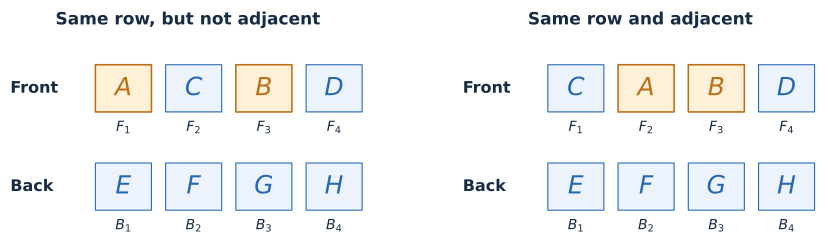
Equal-length rows are still different physical locations. Adjacency is within a row and stops at its boundary. To count two named people in the same row, add the permitted ordered seat pairs within each row. For adjacency, count only neighboring seat pairs, in both orders.

For eight people in two distinct rows of four seats, A and B share a row in seventeen thousand two hundred eighty seatings and are adjacent in eight thousand six hundred forty. Their conditional adjacency probability given a shared row is one half.

With eight people in two distinct rows of four seats, choose their shared row, its two other occupants, then both row orders. N(same row)=2(62)(4!)2=17280N(\text{same row})=2\binom{6}{2}(4!)^2=17280.

For adjacency, choose their row, one of its three neighbouring seat pairs and the order of the two people. N(adjacent)=2×3×2!×6!=8640N(\text{adjacent})=2\times3\times2!\times6!=8640.

P(adjacent∣same row)=864017280=12P(\text{adjacent}\mid\text{same row})=\frac{8640}{17280}=\frac12.

Two rows of four seats contain six neighboring seat pairs. The row break creates no extra adjacency. Same-row membership allows more seat pairs than adjacency does.

Worked example

Separate same-row membership from adjacency

Eight distinct people fill two distinct rows of four fixed seats. Count all seatings, those with A and B in the same row, and those with A and B adjacent within one row.

  1. All eight seats are distinct, so there are 8!=403208!=40320 seatings. Equivalently, choose the front-row members, then order both rows:

    (84)4!4!=40320.\binom{8}{4}4!4!=40320.
  2. For the same row, choose their row, choose two seats in that row, order A and B, then seat everyone else:

    N(S)=2(42)2!6!=17280.N(S)=2\binom{4}{2}2!6!=17280.
  3. Each row has three adjacent seat pairs. Choose the row and pair, order A and B, then fill the remaining six seats:

    N(J)=2⋅3⋅2!⋅6!=8640.N(J)=2\cdot3\cdot2!\cdot6!=8640.
  4. The last seat of one row and first seat of another are not adjacent. Treating the room as one eight-seat line would incorrectly create a seventh adjacent pair instead of the actual six.

If rr distinct people occupy rr of mm fixed seats, with 0≤r≤m0\le r\le m, choose the occupied positions and order the people:

(mr)r!=m!(m−r)!.\binom{m}{r}r!=\frac{m!}{(m-r)!}.

The m−rm-r empty positions are not differently named objects. For a single straight row, blocks and gaps can impose patterns of vacancies. A compact list of people with no specified empty positions is a different model; do not add vacant-seat choices unless seats exist in the question.

Worked example

Count vacancies without giving them artificial identities

Five distinct people occupy five of nine fixed positions in one straight row; the four remaining positions are empty. Count all seatings, those with all four empty positions consecutive, those with no adjacent empty positions, and those with exactly one adjacent empty pair while the other two empty positions are isolated from that pair and from each other.

  1. Choose the occupied positions and order the five people:

    N=(95)5!=9!4!=15120.N=\binom{9}{5}5!=\frac{9!}{4!}=15120.

    The four vacancies are identical as symbols; the physical positions are still distinct.

  2. If the four empty positions form one block, arrange that block with the five distinct people:

    N(one empty block)=6!=720.N(\text{one empty block})=6!=720.
  3. Arrange the five people first in 5!=1205!=120 orders. Their row has six gaps including both ends. For four isolated empty positions, choose four different gaps:

    N(isolated empties)=5!(64)=1800.N(\text{isolated empties})=5!\binom{6}{4}=1800.
  4. For exactly one adjacent empty pair, choose its gap, then two different remaining gaps for the two isolated empties:

    N(one pair and two singles)=5!⋅6(52)=7200.N(\text{one pair and two singles})=5!\cdot6\binom{5}{2}=7200.

    The pair is a maximal empty run of length two. Using the same gap for an extra vacancy would create a longer run; choosing two pair gaps would produce two adjacent pairs instead.

Your turn

Five distinct people, including K and L, occupy five of six fixed seats arranged in two distinct rows of three. One seat remains empty. Count all seatings. Then count those with K in the front row and L in the back row.

Enter an exact number, for example 3/2 or 2-sqrt(3).

Enter an exact number, for example 3/2 or 2-sqrt(3).

Section 4 of 5 · Core · about 10 min

How do named people and category blocks restrict a division?

Place required members or roles first, reduce the remaining capacities, then allocate the other people. For a same-group condition, split by every possible group when their capacities or roles differ. For a different-group condition, count the permitted group choices or subtract the same-group cases from the total.

A group can be uniquely identified by one of its members. When each team contains one specified mentor, anchoring the team containing mentor M already picks out that team. Do not divide an anchored construction by a group-swap factor again.

Worked example

Assign mentors before allocating the other members

Three distinct mentors and four distinct trainees form teams for named stations X, Y and Z. X needs three people; Y and Z need two each. Every station must have exactly one mentor. Count the assignments. Then count them if a specified mentor is fixed at each specified station.

  1. Assign the three mentors to the three named stations in 3!=63!=6 ways.

  2. X still needs two trainees. Y and Z each need one:

    Ntrainees=(42)(21)=6⋅2=12.N_{\text{trainees}}=\binom{4}{2}\binom{2}{1}=6\cdot2=12.
  3. N=3!(42)(21)=72.N=3!\binom{4}{2}\binom{2}{1}=72.

    Y and Z have equal capacities, but their station names still matter.

  4. When every mentor’s station is specified, the mentor-assignment factor becomes one. The count is therefore 1212, without another division by 3!3!.

Your turn

Two distinct mentors M and N and four distinct trainees form two teams of three, each containing one mentor. Count assignments to named stations East and West. Then count the teams when the group containing M and the group containing N are recorded only by their members, without station assignments.

Enter an exact number, for example 3/2 or 2-sqrt(3).

Enter an exact number, for example 3/2 or 2-sqrt(3).

For category blocks in several rows, first decide which complete blocks fit each row’s capacity. Then order those blocks within that row and order the distinct people inside each block. A block cannot cross a physical row boundary. If no collection of complete blocks fills the required capacities, that case contributes zero.

Worked example

Keep every category block inside one physical row

Eight distinct people belong to three disjoint categories: three painters, three musicians and two technicians. They fill one row of three fixed seats and a second row of five fixed seats. All members of each category must occupy consecutive seats within a single row. Count the seatings.

  1. The row of three must contain all three painters or all three musicians. It cannot contain just the two technicians, and it cannot take part of another category without splitting that category. There are two category choices for the short row.

  2. Order the short row in 3!3! ways. In the long row, the remaining triple and the technician pair form two distinguishable blocks. Choose their order, then order the people inside both blocks:

    N=2⋅3!⋅2!⋅3!⋅2!=288.N=2\cdot3!\cdot2!\cdot3!\cdot2!=288.
  3. A block must not cross the break between the rows. Counting arbitrary orders of three blocks in one continuous eight-seat line would include invalid seatings.

Section 5 of 5 · Core · about 9 min

Which count belongs in the conditional denominator?

A count ratio gives a probability only for equally likely elementary outcomes. State whether the random experiment is uniform over named allocations, unnamed divisions or fixed-seat arrangements. For fixed group sizes, forgetting names gives uniform unnamed divisions only when each division has the same number of named versions. Similarly, full seatings give uniform row-membership assignments when each assignment has the same number of within-row orders.

P(E∣F)=N(E∩F)N(F),N(F)>0.P(E\mid F)=\frac{N(E\cap F)}{N(F)},\qquad N(F)>0.

Use the same outcome model in both counts. For the earlier eight-person seating, adjacency J implies the same-row event S, so P(J∣S)=864017280=12P(J\mid S)=\frac{8640}{17280}=\frac{1}{2}. The probability of J without that condition instead uses all 4032040320 seatings.

Worked example

Separate the cases for four named people before conditioning

Eight distinct people, including A, B, C and D, fill two distinct rows of four fixed seats uniformly. Let S mean that A and B are in the same row. Find the probability that C and D are also in the same row, given S.

  1. Choose A and B’s common row, choose and order their seats, then arrange the other six people:

    N(S)=2(42)2!6!=17280.N(S)=2\binom{4}{2}2!6!=17280.

    In the desired event, the two named pairs may share a row or occupy opposite rows. These cases are disjoint.

  2. If all four named people are in one row, choose that row and order both rows:

    N1=2⋅4!⋅4!=1152.N_1=2\cdot4!\cdot4!=1152.
  3. If the two pairs occupy opposite rows, choose A and B’s row. Choose which two of the four other people join them; the remaining two join C and D. Then order both rows:

    N2=2(42)4!4!=6912.N_2=2\binom{4}{2}4!4!=6912.
  4. P(C and D same row∣S)=1152+691217280=806417280=715.P(\text{C and D same row}\mid S)=\frac{1152+6912}{17280}=\frac{8064}{17280}=\frac{7}{15}.

    Ignoring the all-four-in-one-row case would omit valid outcomes.

Your turn

Seven distinct people are seated uniformly in seven fixed seats: one row of three and one row of four. Let S mean that A and B sit in the same row, and J mean that they occupy adjacent seats within a row. Find the counts for S and J, and the probability of J given S.

Enter an exact number, for example 3/2 or 2-sqrt(3).

Enter an exact number, for example 3/2 or 2-sqrt(3).

Enter an exact value or round to 3 significant figures.

Worked examples

Practise the method

Core practice

Question 1 of 4

0 / 4 checked in this collection

Question list

Core practice

Fresh variants

Exam-style

Team names change the count

3 marks

Divide 6 different people into two teams of 3. Count named East/West allocations, unnamed divisions, and unnamed divisions with A and B in the same team.

Enter an exact number, for example 3/2 or 2-sqrt(3).

Enter an exact number, for example 3/2 or 2-sqrt(3).

Enter an exact number, for example 3/2 or 2-sqrt(3).

Full answer-format guide

Exact numbers: 3/2, sqrt(5), 2-sqrt(3), pi/6, 3*pi/2. Sets: {1,4}. Intervals: (3,5]; a round bracket excludes the endpoint. Infinity: inf; union: U; no solutions: empty. Separate coordinate pairs or triples with semicolons. Expressions: 2x^2+3x-1; equations: x^2=3x+1 or the polynomial equal to zero. Factors: x-1 ; x+2. Parameter fraction: numerator ; denominator. List integer answers individually.

Review the method

Progress stays in this browser. Create an account to save it or sign in.

Extra practice from this lesson

Only the two equal groups lose their names

Ten distinct people, including A and B, form groups of sizes 3,3,43,3,4, with no order inside a group. First count allocations to named groups Red, Blue and Green of those respective sizes. Then count divisions with no group names, and unnamed divisions in which A and B are together. Under a uniform choice of an unnamed division, find the probability that B is with A given that A is in the four-person group.

Enter an exact number, for example 3/2 or 2-sqrt(3).

Enter an exact number, for example 3/2 or 2-sqrt(3).

Enter an exact number, for example 3/2 or 2-sqrt(3).

Enter an exact value or round to 3 significant figures.

Named mentors can identify otherwise unnamed teams

Three distinct mentors M, N and O and six distinct trainees form three teams of three, each with one mentor. Count assignments to named stations East, West and North. Then remove the station names and count unnamed teams satisfying the same rule. Among the unnamed divisions, count those in which trainee A is with M and trainee B is with N. Under uniform selection of a valid unnamed division, find the probability B is with N given that A is with M.

Enter an exact number, for example 3/2 or 2-sqrt(3).

Enter an exact number, for example 3/2 or 2-sqrt(3).

Enter an exact number, for example 3/2 or 2-sqrt(3).

Enter an exact value or round to 3 significant figures.

Unequal row lengths change the conditional fraction

Nine distinct people fill three labelled rows containing respectively two, three and four numbered seats. Adjacency means consecutive positions within the same row; it never crosses between rows. Count all seating arrangements, those with A and B in the same row, and those with A and B adjacent. For a uniformly chosen seating, find the probability of adjacency given that A and B share a row.

Enter an exact number, for example 3/2 or 2-sqrt(3).

Enter an exact number, for example 3/2 or 2-sqrt(3).

Enter an exact number, for example 3/2 or 2-sqrt(3).

Enter an exact value or round to 3 significant figures.

Three empty places have three run patterns

Five distinct people occupy five of eight numbered seats in a single line. The three empty seats are indistinguishable. Count arrangements in which all empty seats form one consecutive block; in which no two empty seats are adjacent; and in which there is exactly one run of two empty seats and one separate empty seat. Under uniform selection of a seating arrangement, find the probability that no empties are adjacent given that they do not all form one block.

Enter an exact number, for example 3/2 or 2-sqrt(3).

Enter an exact number, for example 3/2 or 2-sqrt(3).

Enter an exact number, for example 3/2 or 2-sqrt(3).

Enter an exact value or round to 3 significant figures.

Free destinations differ from fixed group sizes

Five distinct parcels, including A and B, are independently assigned to one of three labelled boxes, each box having probability 13\frac{1}{3} for each parcel. There are no capacity limits and boxes may be empty. Count all assignments, assignments using exactly two boxes, and assignments using all three boxes. Find the probability that A and B are in the same box given that all three boxes are used.

Enter an exact number, for example 3/2 or 2-sqrt(3).

Enter an exact number, for example 3/2 or 2-sqrt(3).

Enter an exact number, for example 3/2 or 2-sqrt(3).

Enter an exact value or round to 3 significant figures.

Read the group labels

Split six different people into two groups of three. Give the number when the groups are named and when they are unnamed.

Enter an exact number, for example 3/2 or 2-sqrt(3).

Enter an exact number, for example 3/2 or 2-sqrt(3).

Only equal groups can swap

Divide eight different pupils into unnamed groups of sizes three, three and two. How many divisions are possible?

Enter an exact number, for example 3/2 or 2-sqrt(3).

Share a row

Seat five different pupils on six labelled seats in two rows of three. How many seatings put A and B in the same row?

Enter an exact number, for example 3/2 or 2-sqrt(3).

Seats may be empty

Four different pupils sit in six labelled seats. How many seatings are possible?

Enter an exact number, for example 3/2 or 2-sqrt(3).

Apply it · original exam-style problems

Show your working on paper and compare it with the worked solution and marking guidance.

Start after this lesson

Three named people identify the team cases 8 marks

Nine distinct people, including A, B and C, are divided uniformly into three unnamed teams of three. Count all divisions, those in which A, B and C occupy three different teams, and those in which exactly two of A, B and C are together while the third is in another team. Find the probability that A and B are together given that A and C are in different teams.

Hint

For three separate teams, their named members identify them. For exactly two names together, choose that pair, select its unnamed teammate, then split the six remaining people into two unnamed triples.

Worked solution
  1. Nall=(93)(63)3!=280.N_{\text{all}}=\frac{\binom{9}{3}\binom{6}{3}}{3!}=280.
  2. For separate teams, choose A’s two teammates from the six other people, then B’s two from the remaining four. C receives the remaining pair:

    Nseparate=(62)(42)=90.N_{\text{separate}}=\binom{6}{2}\binom{4}{2}=90.
  3. Choose which two named people share a team in three ways. Their third member is one of the six unnamed people. The remaining six divide into two unnamed triples:

    Nexactly two=3⋅6⋅(63)2!=180.N_{\text{exactly two}}=3\cdot6\cdot\frac{\binom{6}{3}}{2!}=180.
  4. If all three names are together, the other six form two unnamed triples in 1010 ways. Thus 90+180+10=28090+180+10=280.

  5. For A with B but separate from C, the count is 6⋅10=606\cdot10=60. A and C are together in 7⋅10=707\cdot10=70 divisions, because their teammate may be any of the other seven people.

    P(A with B∣A separate from C)=60280−70=27.P(\text{A with B}\mid\text{A separate from C})=\frac{60}{280-70}=\frac{2}{7}.
Marking guidance
  • 1 mark: remove the constant multiplicity of the three unnamed team labels.
  • 1 mark: obtain the total of 280 divisions.
  • 1 mark: anchor the three separate teams by A, B and C.
  • 1 mark: obtain 90 separate-team divisions.
  • 1 mark: select the unique pair of named people and count the exactly-two case.
  • 1 mark: identify the conditional numerator as 60.
  • 1 mark: form the denominator by excluding all A-and-C-together divisions.
  • 1 mark: obtain the conditional probability.
Two pairs may occupy one row or different rows 9 marks

Eight distinct people fill two labelled rows of four numbered seats, uniformly over all 8!8! arrangements. A, B, C and D are four different people. Let SS mean that A and B share a row and C and D share a row; the two pairs may be in the same row or different rows. Let JJ mean that A and B are adjacent and C and D are adjacent within their rows. Count SS and JJ. Find the probability that C and D share a row given that A and B share a row, and find P(J∣S)P(J\mid S).

Hint

Split both counts into two disjoint cases: all four named people occupy one row, or the named pairs occupy different rows. For adjacency within a full four-seat row, treat AB and CD as two distinct blocks, with two internal orders each.

Worked solution
  1. If both pairs occupy the same row, choose that row and arrange its four named people and the other row’s four people:

    N(Sone row)=2⋅4!⋅4!=1152.N(S_{\text{one row}})=2\cdot4!\cdot4!=1152.
  2. If the pairs occupy different rows, choose the row for A and B, choose their two ordered seats, choose the two ordered seats for C and D in the other row, then arrange the remaining people:

    N(Sdifferent rows)=2(4⋅3)24!=6912.N(S_{\text{different rows}})=2(4\cdot3)^2 4!=6912.

    Hence N(S)=1152+6912=8064N(S)=1152+6912=8064.

  3. For both adjacent pairs in one row, arrange the two blocks and their internal orders:

    N(Jone row)=2⋅2!⋅22⋅4!=384.N(J_{\text{one row}})=2\cdot2!\cdot2^2\cdot4!=384.
  4. For adjacent pairs in different rows, each row has three consecutive seat pairs and two orders within the selected pair:

    N(Jdifferent rows)=2(3⋅2)24!=1728.N(J_{\text{different rows}})=2(3\cdot2)^2 4!=1728.

    Hence N(J)=384+1728=2112N(J)=384+1728=2112. Adjacency does not cross a row boundary.

  5. A and B share a row in 2(4⋅3)6!=172802(4\cdot3)6!=17280 arrangements. Thus

    P(C,D same row∣A,B same row)=806417280=715.P(\text{C,D same row}\mid\text{A,B same row})=\frac{8064}{17280}=\frac{7}{15}.
  6. Every arrangement in JJ also satisfies SS, so

    P(J∣S)=21128064=1142.P(J\mid S)=\frac{2112}{8064}=\frac{11}{42}.

    The two conditional questions have different denominators because their given events differ.

Marking guidance
  • 1 mark: split the same-row event into both-pairs-in-one-row and pairs-in-different-rows cases.
  • 1 mark: count 1152 in the first case.
  • 1 mark: count 6912 in the second case and obtain the same-row total.
  • 1 mark: identify the two adjacency blocks and their internal orders.
  • 1 mark: count the one-row adjacency case.
  • 1 mark: count different-row adjacency using valid consecutive pairs and obtain 2112.
  • 1 mark: count the A-and-B-same-row conditioning event.
  • 1 mark: obtain the first conditional probability.
  • 1 mark: use S as the second denominator and obtain the final conditional probability.

Come back to what needs practice

Quick revision sheet (A4)

Your review plan starts after your first check.

Question bank and saved work