Worked example
Compare domains, ranges and axis crossings
State the domain, range and axis intercept of and of .
For , any real is allowed. The range is . Its -intercept is .
For , only is allowed. The range is all real . Its -intercept is .
Use the inverse functions and in equations, inequalities and graphs.
Try the quick check →Section 1 of 5 · Core · about 6 min
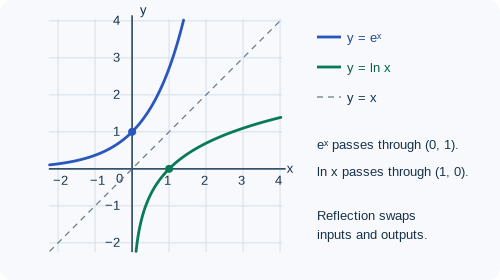
is a fixed positive constant greater than with approximate value . The natural logarithm is the inverse of . Every real exponent gives one positive output.
Worked example
State the domain, range and axis intercept of and of .
For , any real is allowed. The range is . Its -intercept is .
For , only is allowed. The range is all real . Its -intercept is .
Section 2 of 5 · Core · about 5 min
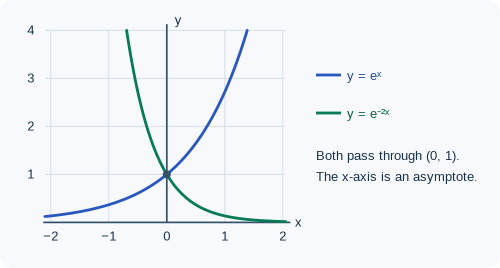
All curves pass through . For , the graph rises to the right and approaches at the left. For , the graph falls to the right and approaches at the right. When , the graph is the horizontal line .
Worked example
Describe the shape of and evaluate it at and .
As increases, decreases. Because increases with , the curve is decreasing.
At the output is , and at it is . Each extra unit of multiplies the output by , a fixed number between zero and one. The curve approaches on the right without reaching it.
Section 3 of 5 · Core · about 6 min
Read from the inner expression outwards. first takes an exponential, so the logarithm always gets a positive input. In , the logarithm acts first and requires . Apply the inverse relationship to the whole exponent or argument.
Worked example
Solve and then solve .
In the first equation the exponential already has positive output. Use to get .
In the second equation require . On that domain , so is allowed.
Worked example
Solve . Give the multiplier in .
Try it on paper first.
Exponentiate both sides to obtain .
Divide by to obtain . This satisfies the original positive argument.
Worked example
Solve .
The logarithm requires . Divide both sides by to get .
Equal natural logarithms have equal positive arguments, so and . This lies in the original domain.
Section 4 of 5 · Core · about 7 min
increases on its positive domain. Compare its arguments after recording their positivity. If you then divide by a negative coefficient of , reverse the inequality at that step.
Worked example
Solve .
Require , so .
Since the logarithm is increasing, , so . Combining the restrictions gives .
Section 5 of 5 · Core · about 5 min
The exponential term can approach zero while the constant outside it stays fixed.
Worked example
For , give the horizontal asymptote and the initial value.
As the negative exponent makes the exponential term tend to zero. The curve approaches .
At the exponential equals 1, so .
Question 1 of 4
0 / 4 checked in this collection
Evaluate and exactly.
Progress stays in this browser. Create an account to save it or sign in.
Show your working on paper and compare it with the worked solution and marking guidance.
Your review plan starts after your first check.