Maths4UBETA

Factor and remainder theorems

Evaluate at the zero of a linear divisor and use the result to solve polynomial problems.

Try the quick check →
Lesson 5 of 5

Section 1 of 4 · Core · about 10 min

Which value gives a linear remainder?

If you only need the remainder on division by ax+bax+b, find the input where the divisor is zero.

Worked example

Find a remainder without long division

Find the remainder on dividing P(x)=2x3−3x2+4x+2P(x)=2x^3-3x^2+4x+2 by 2x+12x+1.

  1. The divisor vanishes at x=−12x=-\frac12. The remainder equals P(−12)P\left(-\frac12\right).

  2. P(−12)=−14−34−2+2=−1.P\left(-\frac12\right)=-\frac14-\frac34-2+2=-1.
  3. The remainder is −1-1, so 2x+12x+1 is not a factor.

Your turn

Find the remainder when 4x3−8x2+2x+14x^3-8x^2+2x+1 is divided by 2x−12x-1.

Enter the expression on its own or write R(x) = … . Use ^ for powers and / to type fractions.

Worked example

Evaluate at a negative fractional root

Find the remainder when 2x3−x2+4x−52x^3-x^2+4x-5 is divided by 2x+12x+1.

  1. The divisor is zero at x=−12x=-\frac12. Evaluate the dividend at that input.

  2. The four terms give −14−14−2−5=−152-\frac14-\frac14-2-5=-\frac{15}2. This value is the constant remainder.

Your turn

Find the remainder when 3x3+2x−63x^3+2x-6 is divided by 3x−23x-2.

Enter an exact number, for example 3/2 or 2-sqrt(3).

Section 2 of 4 · Core · about 11 min

How do factor and remainder conditions determine coefficients?

ax+bax+b is a factor exactly when P(−ba)=0P\left(-\frac ba\right)=0. A nonzero specified remainder gives a different evaluation equation.

Worked example

Find two coefficients from two evaluations

Let P(x)=x3+ax2+bx+6P(x)=x^3+ax^2+bx+6. The factor x−1x-1 is given, and the remainder on division by x+2x+2 is 1212. Find aa and bb.

  1. P(1)=0P(1)=0 gives 1+a+b+6=01+a+b+6=0, so a+b=−7a+b=-7.

  2. P(−2)=12P(-2)=12 gives −8+4a−2b+6=12-8+4a-2b+6=12, so 2a−b=72a-b=7.

  3. Add the equations to obtain 3a=03a=0. Therefore a=0a=0, b=−7b=-7. Check: 1−7+6=01-7+6=0 and −8+14+6=12-8+14+6=12.

Your turn

Let P(x)=x3+ax2+bx−8P(x)=x^3+ax^2+bx-8. Given that x+1x+1 is a factor and division by x−2x-2 leaves remainder −6-6, find aa and bb.

Enter the value on its own or write a = … . Fractions and exact square roots are accepted.

Enter the value on its own or write b = … . Fractions and exact square roots are accepted.

Worked example

Solve a factor condition and a remainder condition together

Let P(x)=x3+ax2+bx+4P(x)=x^3+ax^2+bx+4. The polynomial has factor x+1x+1 and remainder 1818 on division by x−2x-2. Find a,ba,b.

  1. Set P(−1)=0P(-1)=0 to get a−b=−3a-b=-3. Set P(2)=18P(2)=18 to get 2a+b=32a+b=3.

  2. Add the equations to get 3a=03a=0. Hence a=0, b=3a=0,\ b=3.

Your turn

Let P(x)=x3+ax2+bx−1P(x)=x^3+ax^2+bx-1. The polynomial has factor x−1x-1 and remainder −21-21 on division by x+2x+2. Find a,ba,b.

Enter the value on its own or write a = … . Fractions and exact square roots are accepted.

Enter the value on its own or write b = … . Fractions and exact square roots are accepted.

Section 3 of 4 · Core · about 11 min

How does a known factor help solve a cubic?

Find or verify a linear factor, divide by it, and then solve the remaining factor. Keep the root from the first factor too.

Worked example

Verify a factor and solve the cubic

Verify that 2x−32x-3 is a factor of P(x)=2x3−9x2+x+12P(x)=2x^3-9x^2+x+12, then solve P(x)=0P(x)=0.

  1. Evaluate at x=32x=\frac32: P(32)=274−814+32+12=0P\left(\frac32\right)=\frac{27}{4}-\frac{81}{4}+\frac32+12=0. Hence 2x−32x-3 is a factor.

  2. Dividing by 2x−32x-3 gives x2−3x−4=(x+1)(x−4)x^2-3x-4=(x+1)(x-4).

  3. From P(x)=(2x−3)(x+1)(x−4)=0P(x)=(2x-3)(x+1)(x-4)=0, obtain x=−1x=-1, x=32x=\frac32 or x=4x=4.

Your turn

2x−12x-1 is a factor of 2x3+x2−13x+62x^3+x^2-13x+6. Find all real roots of 2x3+x2−13x+6=02x^3+x^2-13x+6=0.

Give every root, for example x = 1 or x = 4, or 1, 4. Use sqrt(...) for exact roots, or empty if there are none.

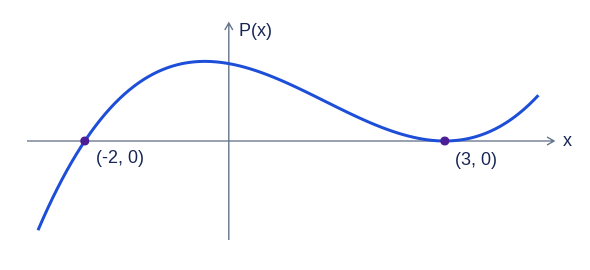
The cubic crosses the horizontal axis at minus two and touches it at three.
The factors of P(x)=(x−3)2(x+2)P(x)=(x-3)^2(x+2) show a crossing at x=−2x=-2 and contact without crossing at x=3x=3.

Worked example

Recognise a repeated factor in a cubic

Given that x−3x-3 is a factor of x3−4x2−3x+18x^3-4x^2-3x+18, solve the cubic equation and state the multiplicity of the root three.

  1. Division by x−3x-3 gives x2−x−6=(x−3)(x+2)x^2-x-6=(x-3)(x+2).

  2. The factorisation is (x−3)2(x+2)(x-3)^2(x+2). The distinct roots are −2-2 and 33, and three is a root of multiplicity two.

Your turn

Given factor x−1x-1, solve x3+x2−5x+3=0x^3+x^2-5x+3=0. Give all distinct roots and the multiplicity of the root one.

Give every root, for example x = 1 or x = 4, or 1, 4. Use sqrt(...) for exact roots, or empty if there are none.

Enter an exact number, for example 3/2 or 2-sqrt(3).

Section 4 of 4 · Core · about 7 min

Can two evaluations determine a linear remainder?

Dividing by a quadratic produces a remainder of degree at most one. If the divisor has two distinct real zeros, the dividend and remainder agree at both of them.

Worked example

Test a quadratic factor by two evaluations

Show that x2−x−2x^2-x-2 is a factor of P(x)=x4−x3−7x2+5x+10P(x)=x^4-x^3-7x^2+5x+10.

  1. Factor the divisor as (x−2)(x+1)(x-2)(x+1). Direct substitution gives P(2)=0P(2)=0 and P(−1)=0P(-1)=0.

  2. The remainder has degree at most one and vanishes at two distinct inputs. It is the zero polynomial, so the quadratic divisor is a factor.

Your turn

Find the remainder on division of P(x)=x3+3x2−x−13P(x)=x^3+3x^2-x-13 by x2+x−6x^2+x-6.

Enter the expression on its own or write R(x) = … . Use ^ for powers and / to type fractions.

Worked examples

Practise the method

Core practice

Question 1 of 4

0 / 4 checked in this collection

Question list

Core practice

Fresh variants

Exam-style

Choose the zero of each divisor

2 marks

Let P(x)=4x3−5x2+7x−3P(x)=4 x^{3} - 5 x^{2} + 7 x - 3. Find the separate remainders on division by 2x+12 x + 1 and by x−2x - 2.

Enter an exact number, for example 3/2 or 2-sqrt(3).

Enter an exact number, for example 3/2 or 2-sqrt(3).

Full answer-format guide

Exact numbers: 3/2, sqrt(5), 2-sqrt(3), pi/6, 3*pi/2. Sets: {1,4}. Intervals: (3,5]; a round bracket excludes the endpoint. Infinity: inf; union: U; no solutions: empty. Separate coordinate pairs or triples with semicolons. Expressions: 2x^2+3x-1; equations: x^2=3x+1 or the polynomial equal to zero. Factors: x-1 ; x+2. Parameter fraction: numerator ; denominator. List integer answers individually.

Review the method

Progress stays in this browser. Create an account to save it or sign in.

Extra practice from this lesson

Use a fractional evaluation point

Find the remainder on division of 4x2−3x+24x^2-3x+2 by 2x+32x+3.

Enter an exact number, for example 3/2 or 2-sqrt(3).

Use a non-monic factor to find a coefficient

Given that 2x−32x-3 is a factor of 2x2+ax−32x^2+ax-3, find aa.

Enter the value on its own or write a = … . Fractions and exact square roots are accepted.

Find all the roots after removing a factor

The cubic 2x3+3x2−11x−62x^3+3x^2-11x-6 has factor 2x+12x+1. Give all real roots.

Give every root, for example x = 1 or x = 4, or 1, 4. Use sqrt(...) for exact roots, or empty if there are none.

Find a linear remainder by evaluation

Find the remainder when x3−2x2−3x+11x^3-2x^2-3x+11 is divided by x2+x−2x^2+x-2.

Enter the expression on its own or write R(x) = … . Use ^ for powers and / to type fractions.

Apply it · original exam-style problems

Show your working on paper and compare it with the worked solution and marking guidance.

Come back to what needs practice

Quick revision sheet (A4)

Your review plan starts after your first check.