Maths4UBETA

Moments, support reactions and composite rods

Balance turning effects as well as forces, with every weight at its own centre.

Try the quick check →
Lesson 1 of 4

Section 1 of 5 · Core · about 5 min

Which distance belongs in a moment?

Turning effect depends on force and the perpendicular distance from the point to its line of action.

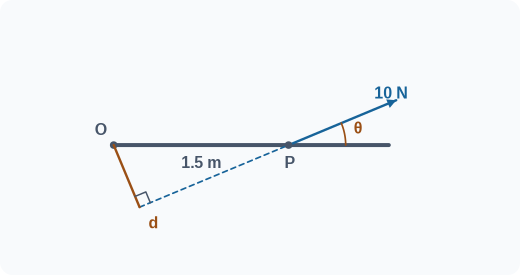
The line of the upward angled ten-newton force through P is extended backwards. The short segment from pivot O to the line is the perpendicular distance d.
About OO, use d=32sin⁡θd=\frac32\sin\theta metres, or the vertical component 10sin⁡θ10\sin\theta at a distance 32\frac32 metres.

Worked example

Use the perpendicular component

A horizontal bar extends to the right of a pivot. A force of 10 N10\,\mathrm N acts upwards and to the right at a point 32 m\frac{3}{2}\,\mathrm m from the pivot. The sine of the angle to the bar is 513\frac{5}{13}. Find the moment magnitude and sense.

  1. The upward component is 5013 N\frac{50}{13}\,\mathrm N. The horizontal component's line of action passes through the pivot.

  2. Moment is perpendicular force times horizontal separation. It is 7513 N m\frac{75}{13}\,\mathrm{N\,m} anticlockwise.

Your turn

A horizontal bar extends to the right of a pivot. A force of 13 N13\,\mathrm N acts upwards and to the right at a point 2 m2\,\mathrm m from the pivot. The sine of the angle to the bar is 35\frac{3}{5}. Find the moment magnitude and sense.

Enter an exact value or round to 3 significant figures.

Moment sense

Section 2 of 5 · Core · about 5 min

How can I remove one unknown reaction?

At rigid-body equilibrium both force totals are zero and the net moment about every point is zero.

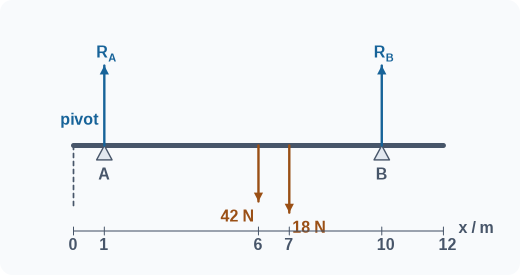
From the left datum, upward reactions at one and ten metres balance downward weights of forty-two newtons at six metres and eighteen newtons at seven metres.
From pivot AA, the horizontal moment arms are 0,5,6,90,5,6,9 metres for RA,42 N,18 N,RBR_A,42\,\mathrm N,18\,\mathrm N,R_B respectively.

Read positions from the left end, then subtract the pivot coordinate 11 from each. Taking anticlockwise moments about AA, 9RB−5(42)−6(18)=09R_B-5(42)-6(18)=0. The force RAR_A has zero arm.

Worked example

Balance moments about a support

A uniform horizontal bar of length 12 m12\,\mathrm m and weight 42 N42\,\mathrm N rests on point supports at 1 m1\,\mathrm m and 10 m10\,\mathrm m from its left end. A load of 18 N18\,\mathrm N acts at distance 7 m7\,\mathrm m from the left end. Find the two reactions.

  1. Its weight acts at 6 m6\,\mathrm m from the left end. Taking moments about the left support removes that reaction.

  2. Write RB(9)=210+18(x−1)R_B\left(9\right)=210+18\left(x-1\right) for load position xx.

  3. The load position is 7 m7\,\mathrm m, the left reaction is 743 N\frac{74}{3}\,\mathrm N and the right reaction is 1063 N\frac{106}{3}\,\mathrm N. The reactions add to 60 N60\,\mathrm N.

Your turn

A uniform horizontal bar of length 14 m14\,\mathrm m and weight 47 N47\,\mathrm N rests on point supports at 2 m2\,\mathrm m and 12 m12\,\mathrm m from its left end. A load of 20 N20\,\mathrm N acts at distance 8 m8\,\mathrm m from the left end. Find the two reactions.

Enter an exact value or round to 3 significant figures.

Enter an exact value or round to 3 significant figures.

Section 3 of 5 · Core · about 7 min

How can reactions reveal where the load acts?

Known support readings can locate an unknown force while its own line of action remains vertical.

Worked example

Infer the loading point from a measured reaction

A uniform horizontal bar of length 12 m12\,\mathrm m and weight 42 N42\,\mathrm N rests on point supports at 1 m1\,\mathrm m and 10 m10\,\mathrm m from its left end. The measured reaction at the right support is 1063 N\frac{106}{3}\,\mathrm N. A load of 18 N18\,\mathrm N is placed somewhere on the bar. Find the load position and the left reaction.

  1. Its weight acts at 6 m6\,\mathrm m from the left end. Taking moments about the left support removes that reaction.

  2. Write RB(9)=210+18(x−1)R_B\left(9\right)=210+18\left(x-1\right) for load position xx.

  3. The load position is 7 m7\,\mathrm m, the left reaction is 743 N\frac{74}{3}\,\mathrm N and the right reaction is 1063 N\frac{106}{3}\,\mathrm N. The reactions add to 60 N60\,\mathrm N.

Your turn

A uniform horizontal bar of length 14 m14\,\mathrm m and weight 47 N47\,\mathrm N rests on point supports at 2 m2\,\mathrm m and 12 m12\,\mathrm m from its left end. The measured reaction at the right support is 712 N\frac{71}{2}\,\mathrm N. A load of 20 N20\,\mathrm N is placed somewhere on the bar. Find the load position and the left reaction.

Enter an exact number, for example 3/2 or 2-sqrt(3).

Enter an exact value or round to 3 significant figures.

Worked example

Reject a load location outside the bar

A 12 m12\,\mathrm m uniform bar of weight 42 N42\,\mathrm N is supported at x=1x=1 and x=10x=10. A load of 18 N18\,\mathrm N sits on the bar. Could the right support reaction be 2 N2\,\mathrm N?

Try it on paper first.

  1. With pivot at x=1x=1, the weight of the uniform bar acts at x=6x=6, five metres to the right. Keeping x−1x-1 signed, 9(2)=5(42)+18(x−1)9(2)=5(42)+18(x-1).

  2. This gives x=−293 mx=-\frac{29}{3}\,\mathrm m, outside [0,12][0,12]. The reading cannot arise from a load anywhere on the bar.

Your turn

A uniform horizontal bar of length 18 m18\,\mathrm m and weight 57 N57\,\mathrm N rests on point supports at 4 m4\,\mathrm m and 16 m16\,\mathrm m from its left end. The measured reaction at the right support is 1434 N\frac{143}{4}\,\mathrm N. A load of 24 N24\,\mathrm N is placed somewhere on the bar. Find the load position and the left reaction.

Enter an exact number, for example 3/2 or 2-sqrt(3).

Enter an exact value or round to 3 significant figures.

Section 4 of 5 · Core · about 5 min

How does varying linear density change the centre?

Replace each section by its total mass acting at its own midpoint. Include attached point masses separately.

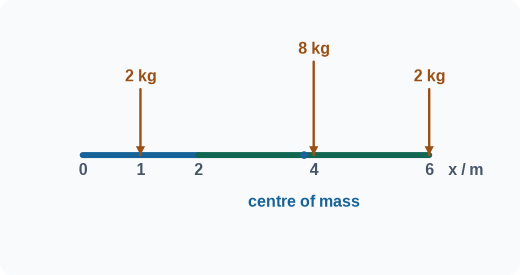
A two-metre first piece has mass two kilograms at x equals one. The next four metres have mass eight kilograms at x equals four. There is an extra mass of two kilograms at x equals six.
Replace each piece by a mass at its midpoint. Include the attached mass at x=6 mx=6\,\mathrm m as its own term.
PartMass (kg)Position (m)
First rod2211
Second rod8844
Attached mass2266

Worked example

Find the centre of a composite rod

A straight rod is made of two joined uniform sections. The first has length 22 m and linear density 11 kilogram per metre. The second has length 44 m and linear density 22 kilograms per metre. A point mass of 2 kg2\,\mathrm{kg} is attached at the far right end. Find the centre of mass from the left end.

  1. The section masses are 22 kg and 88 kg. Their centres lie at 11 m and 44 m from the same origin.

  2. Include the point mass at 66 m. Divide the total first moment by the total mass.

  3. The centre of mass is 236 m\frac{23}{6}\,\mathrm m from the left end.

Your turn

A straight rod is made of two joined uniform sections. The first has length 33 m and linear density 11 kilogram per metre. The second has length 66 m and linear density 22 kilograms per metre. A point mass of 3 kg3\,\mathrm{kg} is attached at the far right end. Find the centre of mass from the left end.

Enter an exact value or round to 3 significant figures.

Section 5 of 5 · Core · about 7 min

Which load positions keep both supports active?

A support under a bar can push up but cannot pull it down. Its reaction can drop to zero as a load reaches a boundary.

Worked example

Find the allowed load position

A uniform bar of length 1212 m and weight 24 N24\,\mathrm N is supported at distances 33 m and 99 m from its left end. A load of 16 N16\,\mathrm N is placed at position xx. What is the largest possible value of xx for equilibrium?

  1. The combined line of action is at xG=144+16x40x_G=\frac{144+16x}{40} from the left end.

  2. Both supporting reactions must be non-negative. This puts the line of action at or left of the right support, so x≤272x\le \frac{27}{2}. The left condition already holds at x=0x=0.

  3. Intersect this bound with the length of the bar. The maximum valid position is 12 m12\,\mathrm m from the left end.

Your turn

A uniform bar of length 1414 m and weight 32 N32\,\mathrm N is supported at distances 33 m and 1010 m from its left end. A load of 18 N18\,\mathrm N is placed at position xx. What is the largest possible value of xx for equilibrium?

Enter an exact number, for example 3/2 or 2-sqrt(3).

Worked example

Find the position where contact is just lost

A 16 m16\,\mathrm m uniform bar of weight 40 N40\,\mathrm N is supported at x=3x=3 and x=11x=11. A 40 N40\,\mathrm N load moves to the right of the last support. Find the greatest possible position.

Try it on paper first.

  1. At the threshold the left reaction is zero. About the right support, the bar weight produces 40(11−8)40(11-8) anticlockwise. The load at xx produces 40(x−11)40(x-11) clockwise.

  2. Equate the moments to get x=14 mx=14\,\mathrm m. The right reaction is 80 N80\,\mathrm N upward. The limiting position is on the bar, so it is attainable.

Your turn

A uniform bar of length 1818 m and weight 48 N48\,\mathrm N is supported at distances 33 m and 1212 m from its left end. A load of 22 N22\,\mathrm N is placed at position xx. What is the largest possible value of xx for equilibrium?

Enter an exact number, for example 3/2 or 2-sqrt(3).

Worked examples

Practise the method

Core practice

Question 1 of 4

0 / 4 checked in this collection

Question list

Core practice

Fresh variants

Exam-style

Both signed moments

2 marks

A force (4, 5)\left( 4, \ 5\right) N acts at (3, 2)\left( 3, \ 2\right) m. Give its signed moment about the origin and about (1, −1)\left( 1, \ -1\right) m. Anticlockwise is positive.

Enter an exact number, for example 3/2 or 2-sqrt(3).

Enter an exact number, for example 3/2 or 2-sqrt(3).

Full answer-format guide

Exact numbers: 3/2, sqrt(5), 2-sqrt(3), pi/6, 3*pi/2. Sets: {1,4}. Intervals: (3,5]; a round bracket excludes the endpoint. Infinity: inf; union: U; no solutions: empty. Separate coordinate pairs or triples with semicolons. Expressions: 2x^2+3x-1; equations: x^2=3x+1 or the polynomial equal to zero. Factors: x-1 ; x+2. Parameter fraction: numerator ; denominator. List integer answers individually.

Review the method

Progress stays in this browser. Create an account to save it or sign in.

Extra practice from this lesson

Use the perpendicular component

A horizontal bar extends to the right of a pivot. A force of 16 N16\,\mathrm N acts upwards and to the right at a point 52 m\frac{5}{2}\,\mathrm m from the pivot. The sine of the angle to the bar is 513\frac{5}{13}. Find the moment magnitude and sense.

Enter an exact value or round to 3 significant figures.

Moment sense

Balance moments about a support

A uniform horizontal bar of length 16 m16\,\mathrm m and weight 52 N52\,\mathrm N rests on point supports at 3 m3\,\mathrm m and 14 m14\,\mathrm m from its left end. A load of 22 N22\,\mathrm N acts at distance 9 m9\,\mathrm m from the left end. Find the two reactions.

Enter an exact value or round to 3 significant figures.

Enter an exact value or round to 3 significant figures.

Balance moments about a support

A uniform horizontal bar of length 20 m20\,\mathrm m and weight 62 N62\,\mathrm N rests on point supports at 5 m5\,\mathrm m and 18 m18\,\mathrm m from its left end. The measured reaction at the right support is 46613 N\frac{466}{13}\,\mathrm N. A load of 26 N26\,\mathrm N is placed somewhere on the bar. Find the load position and the left reaction.

Enter an exact number, for example 3/2 or 2-sqrt(3).

Enter an exact value or round to 3 significant figures.

Find the centre of a composite rod

A straight rod is made of two joined uniform sections. The first has length 44 m and linear density 11 kilogram per metre. The second has length 88 m and linear density 22 kilograms per metre. A point mass of 4 kg4\,\mathrm{kg} is attached at the far right end. Find the centre of mass from the left end.

Enter an exact value or round to 3 significant figures.

Find the allowed load position

A uniform bar of length 2020 m and weight 56 N56\,\mathrm N is supported at distances 33 m and 1313 m from its left end. A load of 24 N24\,\mathrm N is placed at position xx. What is the largest possible value of xx for equilibrium?

Enter an exact number, for example 3/2 or 2-sqrt(3).

Apply it · original exam-style problems

Show your working on paper and compare it with the worked solution and marking guidance.

Come back to what needs practice

Quick revision sheet (A4)

Your review plan starts after your first check.