Maths4UBETA

Oscillatory forcing, resonance and long-term behaviour

Distinguish a periodic response from its transient.

Try the quick check →
Lesson 4 of 5

Section 1 of 5 · Core · about 5 min

Why can a cosine input need both sine and cosine in its solution?

A derivative of a sine is a cosine, and the derivative of a cosine is a negative sine. The first derivative term couples their coefficients.

Worked example

Match sine and cosine as two separate coefficients

Find A and B in y=Acos⁡(x)+Bsin⁡(x)y=A \cos{\left(x \right)} + B \sin{\left(x \right)} as a particular integral of 3y(x)+2ddxy(x)+d2dx2y(x)=−10sin⁡(x)−2cos⁡(x)3 y{\left(x \right)} + 2 \frac{d}{d x} y{\left(x \right)} + \frac{d^{2}}{d x^{2}} y{\left(x \right)}=- 10 \sin{\left(x \right)} - 2 \cos{\left(x \right)}.

  1. A sine derivative produces a cosine and a cosine derivative produces a negative sine. Use both trial terms even if one input coefficient is zero.

  2. Substitute the full trial into the left side. Then equate its sine and cosine coefficients to the corresponding right-hand coefficients.

  3. The simultaneous equations give A=2A=2 and B=−3B=-3.

Your turn

Find A and B in y=Acos⁡(2x)+Bsin⁡(2x)y=A \cos{\left(2 x \right)} + B \sin{\left(2 x \right)} as a particular integral of 6y(x)+3ddxy(x)+d2dx2y(x)=4(4sin⁡(2x)−3cos⁡(2x))−42sin⁡(2x)−6cos⁡(2x)6 y{\left(x \right)} + 3 \frac{d}{d x} y{\left(x \right)} + \frac{d^{2}}{d x^{2}} y{\left(x \right)}=4 \left(4 \sin{\left(2 x \right)} - 3 \cos{\left(2 x \right)}\right) - 42 \sin{\left(2 x \right)} - 6 \cos{\left(2 x \right)}.

Enter the value on its own or write a = … . Fractions and exact square roots are accepted.

Enter the value on its own or write b = … . Fractions and exact square roots are accepted.

Section 2 of 5 · Core · about 5 min

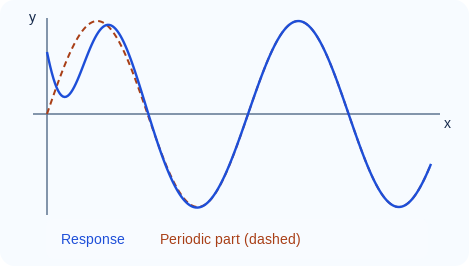
When does a periodic particular integral describe the long-term motion?

The long-run difference between the total solution and its periodic part is the complementary function.

Two curves on x and y axes: the solid total response and dashed sine particular integral. Their early difference decays, so the curves nearly coincide farther right.

The damped response closes in on the periodic particular integral.

Worked example

Predict whether a transient dies away

A solution is y=(−3sin⁡(2x)+2cos⁡(2x))e−x+3sin⁡(x)y=\left(- 3 \sin{\left(2 x \right)} + 2 \cos{\left(2 x \right)}\right) e^{- x} + 3 \sin{\left(x \right)}. Give the frequency of the periodic particular integral and decide whether that term approximates y with vanishing difference as x grows.

  1. The complementary term is (−3sin⁡(2x)+2cos⁡(2x))e−x\left(- 3 \sin{\left(2 x \right)} + 2 \cos{\left(2 x \right)}\right) e^{- x}. It is a sinusoidal combination multiplied by e−xe^{- x}.

  2. The envelope decays to zero, so the difference from the particular integral tends to zero.

  3. The particular integral is 3sin⁡(x)3 \sin{\left(x \right)}, with angular frequency 11.

Your turn

A solution is y=(−4sin⁡(3x)+3cos⁡(3x))ex+4sin⁡(2x)y=\left(- 4 \sin{\left(3 x \right)} + 3 \cos{\left(3 x \right)}\right) e^{x} + 4 \sin{\left(2 x \right)}. Give the frequency of the periodic particular integral and decide whether that term approximates y with vanishing difference as x grows.

Enter an exact number, for example 3/2 or 2-sqrt(3).

Does the difference tend to zero?

Section 3 of 5 · Core · about 7 min

Why is a supplied resonance trial multiplied by x?

An ordinary exponential trial fails if the forcing exponent is a simple auxiliary root, since its operator value is zero.

Worked example

Verify a supplied resonant trial with the right power of x

For −6y(x)−ddxy(x)+d2dx2y(x)=−10e−2x- 6 y{\left(x \right)} - \frac{d}{d x} y{\left(x \right)} + \frac{d^{2}}{d x^{2}} y{\left(x \right)}=- 10 e^{- 2 x}, use the supplied particular integral form Kxe−2xKx\mathrm e^{-2x}. Find K and the multiplicity of the matching auxiliary root.

  1. The forcing exponent is −2-2. It is a simple root. An unmodified trial at that exponent would be annihilated.

  2. Substituting the supplied form gives the surviving multiple (−5)K(-5)K of the forcing exponential.

  3. Match the coefficient to obtain K=2K=2.

Your turn

For −12y(x)−ddxy(x)+d2dx2y(x)=−21e−3x- 12 y{\left(x \right)} - \frac{d}{d x} y{\left(x \right)} + \frac{d^{2}}{d x^{2}} y{\left(x \right)}=- 21 e^{- 3 x}, use the supplied particular integral form Kxe−3xKx\mathrm e^{-3x}. Find K and the multiplicity of the matching auxiliary root.

Enter the value on its own or write k = … . Fractions and exact square roots are accepted.

Enter an exact number, for example 3/2 or 2-sqrt(3).

Worked example

Verify a supplied resonant trial with the right power of x

For −20y(x)−ddxy(x)+d2dx2y(x)=−36e−4x- 20 y{\left(x \right)} - \frac{d}{d x} y{\left(x \right)} + \frac{d^{2}}{d x^{2}} y{\left(x \right)}=- 36 e^{- 4 x}, use the supplied particular integral form Kxe−4xKx\mathrm e^{-4x}. Find K and the multiplicity of the matching auxiliary root.

Try it on paper first.

  1. The forcing exponent is −4-4. It is a simple root. An unmodified trial at that exponent would be annihilated.

  2. Substituting the supplied form gives the surviving multiple (−9)K(-9)K of the forcing exponential.

  3. Match the coefficient to obtain K=4K=4.

Your turn

For −30y(x)−ddxy(x)+d2dx2y(x)=−55e−5x- 30 y{\left(x \right)} - \frac{d}{d x} y{\left(x \right)} + \frac{d^{2}}{d x^{2}} y{\left(x \right)}=- 55 e^{- 5 x}, use the supplied particular integral form Kxe−5xKx\mathrm e^{-5x}. Find K and the multiplicity of the matching auxiliary root.

Enter the value on its own or write k = … . Fractions and exact square roots are accepted.

Enter an exact number, for example 3/2 or 2-sqrt(3).

Section 4 of 5 · Core · about 5 min

What changes when the matching root is repeated?

With repeated auxiliary roots, the pure exponential and its product with x both belong to the complementary function.

Worked example

Verify a supplied resonant trial with the right power of x

For 4y(x)+4ddxy(x)+d2dx2y(x)=4e−2x4 y{\left(x \right)} + 4 \frac{d}{d x} y{\left(x \right)} + \frac{d^{2}}{d x^{2}} y{\left(x \right)}=4 e^{- 2 x}, use the supplied particular integral form Kx2e−2xKx^2\mathrm e^{-2x}. Find K and the multiplicity of the matching auxiliary root.

  1. The forcing exponent is −2-2. It is a repeated root. An unmodified trial at that exponent would be annihilated.

  2. Substitute the supplied form. The surviving multiple of the forcing exponential is 2K2K in the repeated case.

  3. Match the coefficient to obtain K=2K=2.

Your turn

For 9y(x)+6ddxy(x)+d2dx2y(x)=6e−3x9 y{\left(x \right)} + 6 \frac{d}{d x} y{\left(x \right)} + \frac{d^{2}}{d x^{2}} y{\left(x \right)}=6 e^{- 3 x}, use the supplied particular integral form Kx2e−3xKx^2\mathrm e^{-3x}. Find K and the multiplicity of the matching auxiliary root.

Enter the value on its own or write k = … . Fractions and exact square roots are accepted.

Enter an exact number, for example 3/2 or 2-sqrt(3).

Section 5 of 5 · Core · about 7 min

How do I check a supplied oscillatory resonant form?

For an undamped oscillator, sine and cosine at the natural frequency are both homogeneous. The supplied test form can therefore include a factor of x.

Worked example

Differentiate a supplied resonant trigonometric form

Given Kxsin⁡(2x)Kx\sin(2x) as a particular integral of 4y(x)+d2dx2y(x)=12cos⁡(2x)4 y{\left(x \right)} + \frac{d^{2}}{d x^{2}} y{\left(x \right)}=12 \cos{\left(2 x \right)}, find K.

  1. Without the x factor, the sine at this frequency is a homogeneous solution.

  2. Differentiate the supplied product twice. The term still containing x cancels after adding the multiple of the original trial.

  3. The surviving term is 4Kcos⁡(2x)4K\cos(2x). Match it with the input to get K=3K=3.

Your turn

Given Kxsin⁡(3x)Kx\sin(3x) as a particular integral of 9y(x)+d2dx2y(x)=24cos⁡(3x)9 y{\left(x \right)} + \frac{d^{2}}{d x^{2}} y{\left(x \right)}=24 \cos{\left(3 x \right)}, find K.

Enter the value on its own or write k = … . Fractions and exact square roots are accepted.

Worked example

Differentiate a supplied resonant trigonometric form

Given Kxsin⁡(4x)Kx\sin(4x) as a particular integral of 16y(x)+d2dx2y(x)=40cos⁡(4x)16 y{\left(x \right)} + \frac{d^{2}}{d x^{2}} y{\left(x \right)}=40 \cos{\left(4 x \right)}, find K.

Try it on paper first.

  1. Without the x factor, the sine at this frequency is a homogeneous solution.

  2. Differentiate the supplied product twice. The term still containing x cancels after adding the multiple of the original trial.

  3. The surviving term is 8Kcos⁡(4x)8K\cos(4x). Match it with the input to get K=5K=5.

Your turn

Given Kxsin⁡(5x)Kx\sin(5x) as a particular integral of 25y(x)+d2dx2y(x)=60cos⁡(5x)25 y{\left(x \right)} + \frac{d^{2}}{d x^{2}} y{\left(x \right)}=60 \cos{\left(5 x \right)}, find K.

Enter the value on its own or write k = … . Fractions and exact square roots are accepted.

Worked examples

Practise the method

Core practice

Question 1 of 4

0 / 4 checked in this collection

Question list

Core practice

Fresh variants

Exam-style

All four coefficients of a forced oscillation

4 marks

Solve y′′+2y′+5y=10cos⁡(x)y^{\prime\prime}+2y^{\prime}+5y=10 \cos{\left(x \right)}, y(0)=0y(0)=0, y′(0)=1y^{\prime}(0)=1. Give U,V,A,B in y=Usin⁡x+Vcos⁡xy=U\sin x+V\cos x plus e−x(Acos⁡2x+Bsin⁡2x)e^{-x}(A\cos2x+B\sin2x).

Enter the complete form using all three fields: a(x − h)² + c.

Enter an exact number, for example 3/2 or 2-sqrt(3).

Enter an exact number, for example 3/2 or 2-sqrt(3).

Enter the value on its own or write a = … . Fractions and exact square roots are accepted.

Enter the value on its own or write b = … . Fractions and exact square roots are accepted.

Full answer-format guide

Exact numbers: 3/2, sqrt(5), 2-sqrt(3), pi/6, 3*pi/2. Sets: {1,4}. Intervals: (3,5]; a round bracket excludes the endpoint. Infinity: inf; union: U; no solutions: empty. Separate coordinate pairs or triples with semicolons. Expressions: 2x^2+3x-1; equations: x^2=3x+1 or the polynomial equal to zero. Factors: x-1 ; x+2. Parameter fraction: numerator ; denominator. List integer answers individually.

Review the method

Progress stays in this browser. Create an account to save it or sign in.

Extra practice from this lesson

Match sine and cosine as two separate coefficients

Find A and B in y=Acos⁡(3x)+Bsin⁡(3x)y=A \cos{\left(3 x \right)} + B \sin{\left(3 x \right)} as a particular integral of 11y(x)+4ddxy(x)+d2dx2y(x)=9(5sin⁡(3x)−4cos⁡(3x))−103sin⁡(3x)−16cos⁡(3x)11 y{\left(x \right)} + 4 \frac{d}{d x} y{\left(x \right)} + \frac{d^{2}}{d x^{2}} y{\left(x \right)}=9 \left(5 \sin{\left(3 x \right)} - 4 \cos{\left(3 x \right)}\right) - 103 \sin{\left(3 x \right)} - 16 \cos{\left(3 x \right)}.

Enter the value on its own or write a = … . Fractions and exact square roots are accepted.

Enter the value on its own or write b = … . Fractions and exact square roots are accepted.

Predict whether a transient dies away

A solution is y=(−5sin⁡(4x)+4cos⁡(4x))e−x+5sin⁡(3x)y=\left(- 5 \sin{\left(4 x \right)} + 4 \cos{\left(4 x \right)}\right) e^{- x} + 5 \sin{\left(3 x \right)}. Give the frequency of the periodic particular integral and decide whether that term approximates y with vanishing difference as x grows.

Enter an exact number, for example 3/2 or 2-sqrt(3).

Does the difference tend to zero?

Verify a supplied resonant trial with the right power of x

For −42y(x)−ddxy(x)+d2dx2y(x)=−78e−6x- 42 y{\left(x \right)} - \frac{d}{d x} y{\left(x \right)} + \frac{d^{2}}{d x^{2}} y{\left(x \right)}=- 78 e^{- 6 x}, use the supplied particular integral form Kxe−6xKx\mathrm e^{-6x}. Find K and the multiplicity of the matching auxiliary root.

Enter the value on its own or write k = … . Fractions and exact square roots are accepted.

Enter an exact number, for example 3/2 or 2-sqrt(3).

Verify a supplied resonant trial with the right power of x

For 16y(x)+8ddxy(x)+d2dx2y(x)=8e−4x16 y{\left(x \right)} + 8 \frac{d}{d x} y{\left(x \right)} + \frac{d^{2}}{d x^{2}} y{\left(x \right)}=8 e^{- 4 x}, use the supplied particular integral form Kx2e−4xKx^2\mathrm e^{-4x}. Find K and the multiplicity of the matching auxiliary root.

Enter the value on its own or write k = … . Fractions and exact square roots are accepted.

Enter an exact number, for example 3/2 or 2-sqrt(3).

Differentiate a supplied resonant trigonometric form

Given Kxsin⁡(6x)Kx\sin(6x) as a particular integral of 36y(x)+d2dx2y(x)=84cos⁡(6x)36 y{\left(x \right)} + \frac{d^{2}}{d x^{2}} y{\left(x \right)}=84 \cos{\left(6 x \right)}, find K.

Enter the value on its own or write k = … . Fractions and exact square roots are accepted.

Apply it · original exam-style problems

Show your working on paper and compare it with the worked solution and marking guidance.

Come back to what needs practice

Quick revision sheet (A4)

Your review plan starts after your first check.