Maths4UBETA

Rectangle estimates, sums and limits

Use monotonicity to justify the direction of every bound.

Try the quick check →
Lesson 6 of 6

Section 1 of 5 · Core · about 5 min

Which endpoints give the upper and lower rectangles?

For positive increasing functions, left endpoints give lower heights. For positive decreasing functions, right endpoints give lower heights.

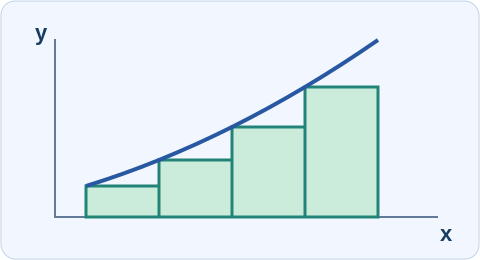
Lower rectangle steps under an increasing graph leave a shrinking gap from the curve.

For an increasing function, each left endpoint gives a lower height. Use the same width for every rectangle.

Worked example

Calculate strict integral bounds using rectangles

Use 33 equal rectangles to find lower and upper bounds on ∫02x2+3 dx\int_{0}^{2}x^{2} + 3\,\mathrm d x.

  1. The width of each rectangle is 23\frac{2}{3}. The integrand is increasing on the interval.

  2. Use left endpoint heights for the lower bound and the opposite endpoint heights for the upper bound.

  3. Multiplying each height sum by the common width gives lower bound 20227\frac{202}{27} and upper bound 27427\frac{274}{27}.

Your turn

Use 44 equal rectangles to find lower and upper bounds on ∫03(3−x)2+4 dx\int_{0}^{3}\left(3 - x\right)^{2} + 4\,\mathrm d x.

Enter an exact number, for example 3/2 or 2-sqrt(3).

Enter an exact number, for example 3/2 or 2-sqrt(3).

Section 2 of 5 · Core · about 5 min

Why does the upper-minus-lower difference simplify?

An endpoint that belongs to two adjacent intervals appears once in each sum. It cancels in the difference.

Worked example

Find how many rectangles make the bounds close enough

Use equal rectangles on 1≤x≤21\le x\le 2 for the curve y=x2y=x^{2}. Find the least integer number of rectangles for which the upper minus lower sum is at most 14\frac{1}{4}.

  1. Adjacent heights cancel in the difference of endpoint sums. The only survivors are the first and last heights.

  2. Multiply their difference by width. The gap with nn rectangles is 3n\frac{3}{n}.

  3. Solving the inequality gives the least integer 1212.

Your turn

Use equal rectangles on 1≤x≤31\le x\le 3 for the curve y=x2y=x^{2}. Find the least integer number of rectangles for which the upper minus lower sum is at most 1613\frac{16}{13}.

Enter the value on its own or write n = … . Fractions and exact square roots are accepted.

Section 3 of 5 · Core · about 7 min

How does an integral bound a sum of reciprocal terms?

For a decreasing positive function, compare its value at each integer with the integral over the interval before or after that integer.

Worked example

Compare a finite reciprocal sum with two integrals

For S=∑r=151r+2S=\sum_{r=1}^{5}\frac1{r+2}, find the positive ratios AA and BB for the rectangle bounds ln⁡A<S<ln⁡B\ln A<S<\ln B obtained from unit-width strips immediately to the left and right of the sum’s sample points.

  1. The function 1x+2\frac1{x+2} decreases. Each unit rectangle at an integer lies above the curve immediately to its right and below the curve immediately to its left.

  2. Use the integral from 11 to 66 for a lower bound and from 00 to 55 for an upper bound.

  3. Evaluate the log differences. The lower logarithm has ratio 83\frac{8}{3} and the upper logarithm has ratio 72\frac{7}{2}.

Your turn

For S=∑r=261r+3S=\sum_{r=2}^{6}\frac1{r+3}, find the positive ratios AA and BB for the rectangle bounds ln⁡A<S<ln⁡B\ln A<S<\ln B obtained from unit-width strips immediately to the left and right of the sum’s sample points.

Enter the value on its own or write a = … . Fractions and exact square roots are accepted.

Enter the value on its own or write b = … . Fractions and exact square roots are accepted.

Worked example

Compare a finite reciprocal sum with two integrals

For S=∑r=371r+4S=\sum_{r=3}^{7}\frac1{r+4}, find the positive ratios AA and BB for the rectangle bounds ln⁡A<S<ln⁡B\ln A<S<\ln B obtained from unit-width strips immediately to the left and right of the sum’s sample points.

Try it on paper first.

  1. The function 1x+4\frac1{x+4} decreases. Each unit rectangle at an integer lies above the curve immediately to its right and below the curve immediately to its left.

  2. Use the integral from 33 to 88 for a lower bound and from 22 to 77 for an upper bound.

  3. Evaluate the log differences. The lower logarithm has ratio 127\frac{12}{7} and the upper logarithm has ratio 116\frac{11}{6}.

Your turn

For S=∑r=481r+5S=\sum_{r=4}^{8}\frac1{r+5}, find the positive ratios AA and BB for the rectangle bounds ln⁡A<S<ln⁡B\ln A<S<\ln B obtained from unit-width strips immediately to the left and right of the sum’s sample points.

Enter the value on its own or write a = … . Fractions and exact square roots are accepted.

Enter the value on its own or write b = … . Fractions and exact square roots are accepted.

Section 4 of 5 · Core · about 5 min

What tells me the interval and sample point in a scaled sum?

An expression of the form 1n∑r=1nf(rn)\frac1n\sum_{r=1}^n f(\frac rn) uses rectangle width 1n\frac1n and right endpoints covering the unit interval.

Worked example

Identify the rectangle width and sample position

Find the exact value of lim⁡n→∞1n∑r=1n(2+3r2n2)\lim_{n\to\infty}\frac1n\sum_{r=1}^n\left(2+3\frac{r^2}{n^2}\right).

  1. The common width is 1n\frac1n. The sample position rn\frac rn runs through right endpoints on [0,1][0,1].

  2. The integrand is 3x2+23 x^{2} + 2. It is continuous throughout this interval, so the Riemann sums converge to its integral.

  3. Integrate the polynomial from zero to one, giving 33.

Your turn

Find the exact value of lim⁡n→∞1n∑r=1n(3+4r2n2)\lim_{n\to\infty}\frac1n\sum_{r=1}^n\left(3+4\frac{r^2}{n^2}\right).

Enter an exact number, for example 3/2 or 2-sqrt(3).

Section 5 of 5 · Core · about 7 min

Why does the rectangle approximation converge?

Continuity on a closed interval ensures that upper and lower rectangle sums approach the same value as the mesh shrinks.

Worked example

Identify the rectangle width and sample position

Find AA and BB if lim⁡n→∞1n∑r=1n12+3rn\lim_{n\to\infty}\frac1n\sum_{r=1}^n\frac1{2+3\frac rn} equals Aln⁡BA\ln B, where AA is the reciprocal of the coefficient of the variable in the denominator of the limiting integrand and BB is the upper endpoint denominator divided by the lower one.

  1. The common width is 1n\frac1n. The sample position rn\frac rn runs through right endpoints on [0,1][0,1].

  2. The integrand is 13x+2\frac{1}{3 x + 2}. It is continuous throughout this interval, so the Riemann sums converge to its integral.

  3. The integral is log⁡(52)3\frac{\log{\left(\frac{5}{2} \right)}}{3}. The coefficient is 13\frac{1}{3} and the ratio is 52\frac{5}{2}.

Your turn

Find AA and BB if lim⁡n→∞1n∑r=1n13+4rn\lim_{n\to\infty}\frac1n\sum_{r=1}^n\frac1{3+4\frac rn} equals Aln⁡BA\ln B, where AA is the reciprocal of the coefficient of the variable in the denominator of the limiting integrand and BB is the upper endpoint denominator divided by the lower one.

Enter the value on its own or write a = … . Fractions and exact square roots are accepted.

Enter the value on its own or write b = … . Fractions and exact square roots are accepted.

Worked example

Identify the rectangle width and sample position

Find AA and BB if lim⁡n→∞1n∑r=1n14+5rn\lim_{n\to\infty}\frac1n\sum_{r=1}^n\frac1{4+5\frac rn} equals Aln⁡BA\ln B, where AA is the reciprocal of the coefficient of the variable in the denominator of the limiting integrand and BB is the upper endpoint denominator divided by the lower one.

Try it on paper first.

  1. The common width is 1n\frac1n. The sample position rn\frac rn runs through right endpoints on [0,1][0,1].

  2. The integrand is 15x+4\frac{1}{5 x + 4}. It is continuous throughout this interval, so the Riemann sums converge to its integral.

  3. The integral is log⁡(94)5\frac{\log{\left(\frac{9}{4} \right)}}{5}. The coefficient is 15\frac{1}{5} and the ratio is 94\frac{9}{4}.

Your turn

Find AA and BB if lim⁡n→∞1n∑r=1n15+6rn\lim_{n\to\infty}\frac1n\sum_{r=1}^n\frac1{5+6\frac rn} equals Aln⁡BA\ln B, where AA is the reciprocal of the coefficient of the variable in the denominator of the limiting integrand and BB is the upper endpoint denominator divided by the lower one.

Enter the value on its own or write a = … . Fractions and exact square roots are accepted.

Enter the value on its own or write b = … . Fractions and exact square roots are accepted.

Worked examples

Practise the method

Core practice

Question 1 of 4

0 / 4 checked in this collection

Question list

Core practice

Fresh variants

Exam-style

Both complete rectangle formulae and their limit

3 marks

For f(x)=x2+2xf(x)=x^2+2x on [0,1], find the full upper and lower rectangle sums using N=n equal intervals. Give each as numerator; denominator in n, followed by their common limit.

Enter a single fraction such as (2x+1)/(x−3). You can also separate the numerator and denominator with a semicolon.

Enter a single fraction such as (2x+1)/(x−3). You can also separate the numerator and denominator with a semicolon.

Enter an exact number, for example 3/2 or 2-sqrt(3).

Full answer-format guide

Exact numbers: 3/2, sqrt(5), 2-sqrt(3), pi/6, 3*pi/2. Sets: {1,4}. Intervals: (3,5]; a round bracket excludes the endpoint. Infinity: inf; union: U; no solutions: empty. Separate coordinate pairs or triples with semicolons. Expressions: 2x^2+3x-1; equations: x^2=3x+1 or the polynomial equal to zero. Factors: x-1 ; x+2. Parameter fraction: numerator ; denominator. List integer answers individually.

Review the method

Progress stays in this browser. Create an account to save it or sign in.

Extra practice from this lesson

Calculate strict integral bounds using rectangles

Use 55 equal rectangles to find lower and upper bounds on ∫04x2+5 dx\int_{0}^{4}x^{2} + 5\,\mathrm d x.

Enter an exact number, for example 3/2 or 2-sqrt(3).

Enter an exact number, for example 3/2 or 2-sqrt(3).

Find how many rectangles make the bounds close enough

Use equal rectangles on 1≤x≤41\le x\le 4 for the curve y=x2y=x^{2}. Find the least integer number of rectangles for which the upper minus lower sum is at most 4514\frac{45}{14}.

Enter the value on its own or write n = … . Fractions and exact square roots are accepted.

Compare a finite reciprocal sum with two integrals

For S=∑r=591r+6S=\sum_{r=5}^{9}\frac1{r+6}, find the positive ratios AA and BB for the rectangle bounds ln⁡A<S<ln⁡B\ln A<S<\ln B obtained from unit-width strips immediately to the left and right of the sum’s sample points.

Enter the value on its own or write a = … . Fractions and exact square roots are accepted.

Enter the value on its own or write b = … . Fractions and exact square roots are accepted.

Identify the rectangle width and sample position

Find the exact value of lim⁡n→∞1n∑r=1n(4+5r2n2)\lim_{n\to\infty}\frac1n\sum_{r=1}^n\left(4+5\frac{r^2}{n^2}\right).

Enter an exact number, for example 3/2 or 2-sqrt(3).

Identify the rectangle width and sample position

Find AA and BB if lim⁡n→∞1n∑r=1n16+7rn\lim_{n\to\infty}\frac1n\sum_{r=1}^n\frac1{6+7\frac rn} equals Aln⁡BA\ln B, where AA is the reciprocal of the coefficient of the variable in the denominator of the limiting integrand and BB is the upper endpoint denominator divided by the lower one.

Enter the value on its own or write a = … . Fractions and exact square roots are accepted.

Enter the value on its own or write b = … . Fractions and exact square roots are accepted.

Apply it · original exam-style problems

Show your working on paper and compare it with the worked solution and marking guidance.

Come back to what needs practice

Quick revision sheet (A4)

Your review plan starts after your first check.