Maths4UBETA

Graphs, ranges and transformations

Track support, symmetry and unattained asymptotic values.

Try the quick check →
Lesson 2 of 6

Section 1 of 5 · Core · about 8 min

How can I sketch the three basic curves?

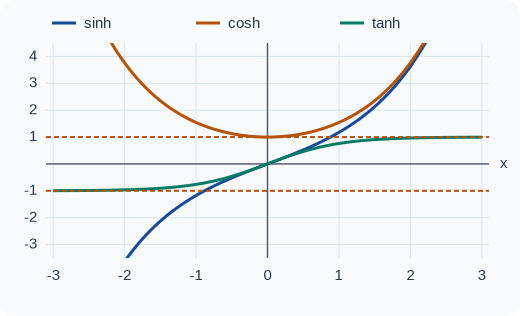
Use the value at zero and symmetry as starting points. The exponential definitions give the behaviour away from zero without a table of many points.

The two odd curves pass through the origin. Hyperbolic cosine has its minimum at height 1. Hyperbolic tangent stays between the dashed lines at heights −1 and 1.

The two odd curves pass through the origin. Hyperbolic cosine has its minimum at height 1. Hyperbolic tangent stays between the dashed lines at heights −1 and 1.

Worked example

Minimum then translation

The function is f(x)=2cosh⁡x+3f(x)=2\cosh x+3. Give the coordinates of the turning point and whether it is a maximum or minimum.

  1. The input of the hyperbolic cosine is zero at x=0x=0. Its value there is one and all other values are at least one. The vertical multiplier determines which type of turning point remains.

  2. (0,5)(0,5). Minimum.

Your turn

The function is f(x)=3cosh⁡(x−1)+2f(x)=3\cosh \bigl(x-1\bigr)+2. Give the coordinates of the turning point and whether it is a maximum or minimum.

Enter the value on its own or write x = … . Fractions and exact square roots are accepted.

Enter the value on its own or write y = … . Fractions and exact square roots are accepted.

Turning point type

Worked example

Reflect and shift

The function is f(x)=−2cosh⁡(x−2)+1f(x)=-2\cosh \bigl(x-2\bigr)+1. Give the coordinates of the turning point and whether it is a maximum or minimum.

  1. The input of the hyperbolic cosine is zero at x=2x=2. Its value there is one and all other values are at least one. The vertical multiplier determines which type of turning point remains.

  2. (2,−1)(2,-1). Maximum.

Your turn

The function is f(x)=−3cosh⁡(2(x−4))+1f(x)=-3\cosh \bigl(2(x-4)\bigr)+1. Give the coordinates of the turning point and whether it is a maximum or minimum.

Enter the value on its own or write x = … . Fractions and exact square roots are accepted.

Enter the value on its own or write y = … . Fractions and exact square roots are accepted.

Turning point type

Section 2 of 5 · Core · about 6 min

What happens to the minimum of cosh after a transformation?

The input of the parent curve is zero at its minimum. Find the matching new input and transform the output separately.

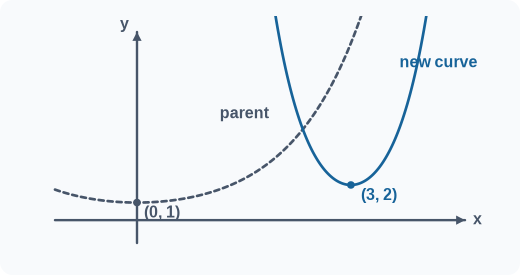
Dashed parent cosh has its minimum at zero, one. The narrower transformed curve has minimum at three, two.
Compare y=cosh⁡xy=\cosh x with y=3cosh⁡(2(x−3))−1y=3\cosh\bigl(2(x-3)\bigr)-1. The new minimum is (3,2)(3,2).

Worked example

Find zero of the argument

The function is f(x)=3cosh⁡(2(x−3))−1f(x)=3\cosh \bigl(2(x-3)\bigr)-1. Give the coordinates of the turning point and whether it is a maximum or minimum.

  1. The input of the hyperbolic cosine is zero at x=3x=3. Its value there is one and all other values are at least one. The vertical multiplier determines which type of turning point remains.

  2. (3,2)(3,2). Minimum.

Your turn

The function is f(x)=2cosh⁡(3(x−3))−2f(x)=2\cosh \bigl(3(x-3)\bigr)-2. Give the coordinates of the turning point and whether it is a maximum or minimum.

Enter the value on its own or write x = … . Fractions and exact square roots are accepted.

Enter the value on its own or write y = … . Fractions and exact square roots are accepted.

Turning point type

Section 3 of 5 · Core · about 8 min

Where do the horizontal asymptotes move?

The output heights of atanh⁡(b(x−h))+da\tanh(b(x-h))+d approach the images of −1-1 and 11. The sign of abab decides which end approaches which height.

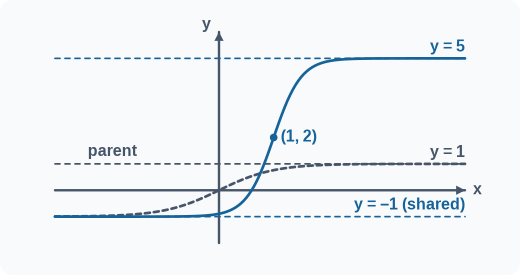
Tanh parent has limiting heights negative one and one. Transformed increasing graph has centre one, two and approaches negative one and five.
The centre of y=3tanh⁡(2(x−1))+2y=3\tanh\bigl(2(x-1)\bigr)+2 is (1,2)(1,2). Its range is (−1,5)(-1,5); neither limit is attained.

Worked example

Move and scale the limiting heights

The function is f(x)=3tanh⁡(2(x−1))+2f(x)=3\tanh \bigl(2(x-1)\bigr)+2. Give both horizontal asymptote heights in increasing order and the x-coordinate of the centre of symmetry.

  1. The hyperbolic tangent stays between −1-1 and 11. The magnitude of the vertical scale sets the two distances from 22. The horizontal shift determines the centre.

  2. y=−1y=-1 and y=5y=5. The centre is at x=1x=1.

Your turn

The function is f(x)=4tanh⁡(2(x−2))+3f(x)=4\tanh \bigl(2(x-2)\bigr)+3. Give both horizontal asymptote heights in increasing order and the x-coordinate of the centre of symmetry.

Enter an exact number, for example 3/2 or 2-sqrt(3).

Enter an exact number, for example 3/2 or 2-sqrt(3).

Enter an exact number, for example 3/2 or 2-sqrt(3).

Worked example

Negative scale and two asymptotes

The function is f(x)=−2tanh⁡(−(x−3))−4f(x)=-2\tanh \bigl(-(x-3)\bigr)-4. Give both horizontal asymptote heights in increasing order and the x-coordinate of the centre of symmetry.

  1. The hyperbolic tangent stays between −1-1 and 11. The magnitude of the vertical scale sets the two distances from −4-4. The horizontal shift determines the centre.

  2. y=−6y=-6 and y=−2y=-2. The centre is at x=3x=3.

Your turn

The function is f(x)=2tanh⁡(−2(x−3))+5f(x)=2\tanh \bigl(-2(x-3)\bigr)+5. Give both horizontal asymptote heights in increasing order and the x-coordinate of the centre of symmetry.

Enter an exact number, for example 3/2 or 2-sqrt(3).

Enter an exact number, for example 3/2 or 2-sqrt(3).

Enter an exact number, for example 3/2 or 2-sqrt(3).

Section 4 of 5 · Core · about 6 min

How do I locate and orient a transformed sinh graph?

An increasing odd curve has a centre where its argument is zero. After a shift, that centre may no longer be on either axis.

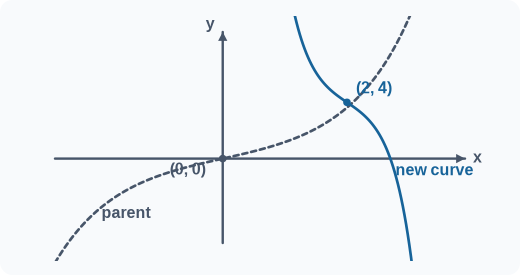
Dashed parent sinh increases through zero, zero. The transformed graph decreases through two, four.
Compare y=sinh⁡xy=\sinh x with y=4−sinh⁡(3(x−2))y=4-\sinh\bigl(3(x-2)\bigr). The decreasing curve retains all real output values.

Worked example

Reverse the orientation once

The function is f(x)=−sinh⁡(3(x−2))+4f(x)=-\sinh \bigl(3(x-2)\bigr)+4. Give the coordinates of the centre of symmetry and classify the function as increasing or decreasing.

  1. The centre is where the argument of the original odd function is zero. Reversing one of the horizontal and vertical orientations reverses whether it increases. Reversing both restores the original orientation.

  2. (2,4)(2,4). Decreasing.

Your turn

The function is f(x)=−2sinh⁡(−3(x−1))+2f(x)=-2\sinh \bigl(-3(x-1)\bigr)+2. Give the coordinates of the centre of symmetry and classify the function as increasing or decreasing.

Enter an exact number, for example 3/2 or 2-sqrt(3).

Enter an exact number, for example 3/2 or 2-sqrt(3).

Behaviour

Section 5 of 5 · Core · about 6 min

How do reciprocal graphs inherit restrictions?

Where the denominator approaches zero, its reciprocal can become unbounded. Where the denominator grows without bound, the reciprocal can tend to zero.

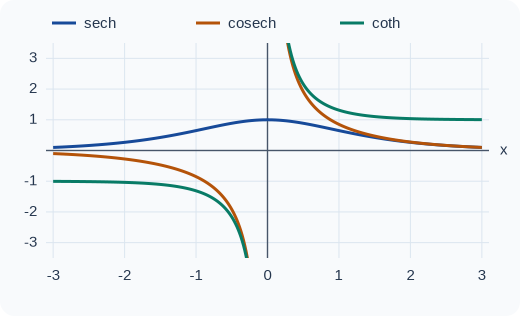
Only the hyperbolic secant has a point on the vertical axis. The hyperbolic cosecant and cotangent diverge on either side of that axis.

Only the hyperbolic secant has a point on the vertical axis. The hyperbolic cosecant and cotangent diverge on either side of that axis.

Worked example

Trace a reciprocal curve

Use the graph of cosh⁡x\cosh x to find the domain and range of sech⁡x=1cosh⁡x\operatorname{sech}x=\frac{1}{\cosh x}. Give the coordinates of its maximum point and the equation of its horizontal asymptote.

  1. For every real xx, cosh⁡x≥1\cosh x\ge1. The denominator never vanishes, so the domain is R\mathbb R.

  2. Taking a reciprocal reverses order for positive values. The minimum cosh⁡0=1\cosh 0=1 gives the maximum at (0,1)(0,1).

  3. As x→±∞x\to\pm\infty, cosh⁡x\cosh x grows without bound. Its reciprocal tends to zero and stays positive. The horizontal asymptote is y=0y=0, and the range is 0<sech⁡x≤10<\operatorname{sech}x\le1.

Your turn

What are the asymptotes of cosech⁡x\operatorname{cosech}x?

Choose the correct statement

Worked examples

Practise the method

Core practice

Question 1 of 4

0 / 4 checked in this collection

Question list

Core practice

Fresh variants

Exam-style

A minimum point and complete range

2 marks

For y=2cosh⁡(3(x−(−2)))−3y=2\cosh(3(x-(-2)))-3, give the minimum point and the full range as an interval.

Enter a point as (1, 2) or x = 1, y = 2. Separate complete pairs with commas or semicolons.

Give the output range as an inequality or an interval. For example, y ≤ 4 is (−∞, 4]. You can type <= for ≤.

Full answer-format guide

Exact numbers: 3/2, sqrt(5), 2-sqrt(3), pi/6, 3*pi/2. Sets: {1,4}. Intervals: (3,5]; a round bracket excludes the endpoint. Infinity: inf; union: U; no solutions: empty. Separate coordinate pairs or triples with semicolons. Expressions: 2x^2+3x-1; equations: x^2=3x+1 or the polynomial equal to zero. Factors: x-1 ; x+2. Parameter fraction: numerator ; denominator. List integer answers individually.

Review the method

Progress stays in this browser. Create an account to save it or sign in.

Extra practice from this lesson

Scale the turning height

The function is f(x)=−4cosh⁡(x−2)+3f(x)=-4\cosh \bigl(x-2\bigr)+3. Give the coordinates of the turning point and whether it is a maximum or minimum.

Enter the value on its own or write x = … . Fractions and exact square roots are accepted.

Enter the value on its own or write y = … . Fractions and exact square roots are accepted.

Turning point type

Use a fractional scale

The function is f(x)=(32)tanh⁡ ⁣(1(x−3))+(4)f(x)=\left(\frac{3}{2}\right)\tanh\!\left(1(x-3)\right)+\left(4\right). Give both horizontal asymptote heights in increasing order and the x-coordinate of the centre of symmetry.

Enter an exact number, for example 3/2 or 2-sqrt(3).

Enter an exact number, for example 3/2 or 2-sqrt(3).

Enter an exact number, for example 3/2 or 2-sqrt(3).

Locate a translated centre

The function is f(x)=3sinh⁡(−2(x−4))+1f(x)=3\sinh \bigl(-2(x-4)\bigr)+1. Give the coordinates of the centre of symmetry and classify the function as increasing or decreasing.

Enter an exact number, for example 3/2 or 2-sqrt(3).

Enter an exact number, for example 3/2 or 2-sqrt(3).

Behaviour

Determine the orientation

The function is f(x)=2sinh⁡(2(x−2))+5f(x)=2\sinh \bigl(2(x-2)\bigr)+5. Give the coordinates of the centre of symmetry and classify the function as increasing or decreasing.

Enter an exact number, for example 3/2 or 2-sqrt(3).

Enter an exact number, for example 3/2 or 2-sqrt(3).

Behaviour

Use the closed turning height

The function is f(x)=cosh⁡(4(x−1))−2f(x)=\cosh \bigl(4(x-1)\bigr)-2. Give the coordinates of the turning point and whether it is a maximum or minimum.

Enter the value on its own or write x = … . Fractions and exact square roots are accepted.

Enter the value on its own or write y = … . Fractions and exact square roots are accepted.

Turning point type

Apply it · original exam-style problems

Show your working on paper and compare it with the worked solution and marking guidance.

Come back to what needs practice

Quick revision sheet (A4)

Your review plan starts after your first check.