Worked example
Differentiate a squared dependent variable
At the point on , where and , find the gradient of the tangent.
The centred variables have and . First differentiate to obtain .
At the point both centred variables vanish. So , and .
Differentiate the whole relation before inserting a point.
Try the quick check →Section 1 of 5 · Core · about 8 min
On a smooth branch, varies with even if the relation does not give an explicit formula for . The chain rule is applied wherever appears.
Worked example
At the point on , where and , find the gradient of the tangent.
The centred variables have and . First differentiate to obtain .
At the point both centred variables vanish. So , and .
Worked example
At the point on , where and , find the gradient of the tangent.
The centred variables have and . First differentiate to obtain .
At the point both centred variables vanish. So , and .
Section 2 of 5 · Core · about 6 min
After collecting the equation has form . Here and are derivatives of the defining expression holding the other coordinate fixed.
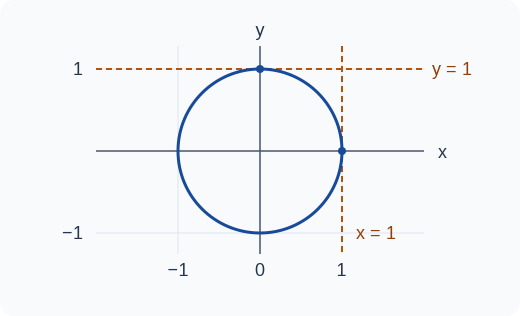
At the rightmost point the circle has a vertical tangent. At the top its tangent is horizontal.
Worked example
At the point on , where and , find the gradient of the tangent.
The centred variables have and . First differentiate to obtain .
At the point both centred variables vanish. So , and .
Section 3 of 5 · Core · about 8 min
The first derivative equation involves a product between a possibly variable coefficient and . Differentiate both factors before evaluating at the point.
Worked example
At the point on , where and , find both first and second derivatives of with respect to .
The centred variables have and . First differentiate to obtain .
At the point both centred variables vanish. So , and .
Differentiating that relation again uses the product rule. Before substitution the resulting equation is .
At the point, this gives . The factor multiplying is and is nonzero.
Section 4 of 5 · Core · about 6 min
A slope describes a line only when combined with its point. The tangent and normal share that point and are perpendicular.
Worked example
At the point on , where and , find the gradients of the tangent and normal.
The centred variables have and . First differentiate to obtain .
At the point both centred variables vanish. So , and .
Differentiating that relation again uses the product rule. Before substitution the resulting equation is .
At the point, this gives . The factor multiplying is and is nonzero.
The normal is perpendicular to the tangent, so use the negative reciprocal .
Section 5 of 5 · Extension · about 6 min
The second derivative measures how the gradient of a regular branch changes with . A point need not be stationary for this to be useful.
Worked example
At the point on , where and , find the second derivative and state the local concavity.
The centred variables have and . First differentiate to obtain .
At the point both centred variables vanish. So , and .
Differentiating that relation again uses the product rule. Before substitution the resulting equation is .
At the point, this gives . The factor multiplying is and is nonzero.
Its sign gives concave up on this smooth branch.
Question 1 of 4
0 / 4 checked in this collection
On a regular local branch of , find the complete expression for y′ as a rational function in x and y. Use numerator; denominator.
Progress stays in this browser. Create an account to save it or sign in.
Show your working on paper and compare it with the worked solution and marking guidance.
Your review plan starts after your first check.