Maths4UBETA

Complex powers, rotations and root arguments

Connect algebra, modulus and the angle of a complex number.

Try the quick check →
Lesson 1 of 5

Section 1 of 6 · Core · about 6 min

How does multiplication move an Argand point?

Write each non-zero number as a modulus times a unit rotation.
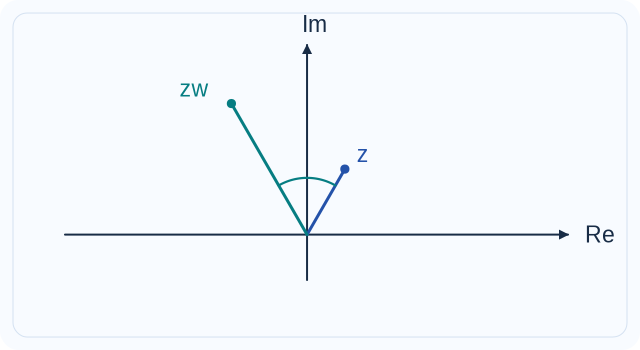
Multiplication by a complex number scales one vector and rotates it.

Multiplication by 2eiπ32\mathrm e^{\mathrm i\frac{\pi}{3}} doubles the length and turns the vector through π3\tfrac{\pi}{3} anticlockwise.

Worked example

Combine two rotations

Let z=2 eiπ3z=2\,\mathrm e^{\frac{i \pi}{3}} and w=3 eiπ4w=3\,\mathrm e^{\frac{i \pi}{4}}.

Give the modulus and the coefficient of π\pi in the principal argument of zwzw.

  1. Multiply the moduli and add the arguments.

  2. zw=6 e7iπ12zw=6\,\mathrm e^{\frac{7 i \pi}{12}}, with the argument in (−π,π](-\pi,\pi].

Worked example

Undo part of a rotation by dividing

Let z=6 e−2iπ3z=6\,\mathrm e^{- \frac{2 i \pi}{3}} and w=2 e3iπ4w=2\,\mathrm e^{\frac{3 i \pi}{4}}.

Give the modulus and the coefficient of π\pi in the principal argument of zw\tfrac zw.

Try it on paper first.

  1. Divide the moduli and subtract the arguments.

  2. zw=3 e7iπ12\tfrac zw=3\,\mathrm e^{\frac{7 i \pi}{12}}, with the argument in (−π,π](-\pi,\pi].

Your turn

Let z=4 e5iπ6z=4\,\mathrm e^{\frac{5 i \pi}{6}} and w=2 e3iπ4w=2\,\mathrm e^{\frac{3 i \pi}{4}}.

Give the modulus and the coefficient of π\pi in the principal argument of zwzw.

Enter an exact number, for example 3/2 or 2-sqrt(3).

Enter an exact number, for example 3/2 or 2-sqrt(3).

Section 2 of 6 · Core · about 7 min

How can I prove the positive integer formula?

Use the trigonometric angle-addition formulae in the induction step.

Worked example

Find the induction move

Let u=cos⁡θ+isin⁡θu=\cos\theta+\mathrm i\sin\theta. Suppose uk=cos⁡(kθ)+isin⁡(kθ)u^k=\cos(k\theta)+\mathrm i\sin(k\theta).

Which operation gives the induction step?

  1. The case k=1k=1 is immediate. Multiply the case kk by uu to get uk+1u^{k+1}.

  2. The real part becomes cos⁡(kθ)cos⁡θ−sin⁡(kθ)sin⁡θ\cos(k\theta)\cos\theta-\sin(k\theta)\sin\theta and the imaginary coefficient becomes sin⁡(kθ)cos⁡θ+cos⁡(kθ)sin⁡θ\sin(k\theta)\cos\theta+\cos(k\theta)\sin\theta.

  3. These equal cos⁡((k+1)θ)\cos((k+1)\theta) and sin⁡((k+1)θ)\sin((k+1)\theta). The induction proves the result for positive integers.

Your turn

The induction proves the formula for positive integer powers.

Which check provides the base case?

Choose an answer

Section 3 of 6 · Core · about 7 min

What changes for a negative exponent?

A reciprocal reverses an argument and replaces the modulus by its reciprocal.

Worked example

Use a negative integer power

Let z=2 eiπ6z=2\,\mathrm e^{\frac{i \pi}{6}}.

Find the real and imaginary parts of z−4z^{-4}.

  1. Raise the modulus to the same power and multiply the argument by the exponent.

    ∣z−4∣=116,arg⁡(z−4)≡−2π3(mod2π)|z^{-4}|=\frac{1}{16},\quad \arg(z^{-4})\equiv - \frac{2 \pi}{3}\pmod{2\pi}.

  2. The principal argument is −2π3- \frac{2 \pi}{3}, so the number is −132−3i32- \frac{1}{32} - \frac{\sqrt{3} i}{32}.

Your turn

Let z=2 eiπ4z=2\,\mathrm e^{\frac{i \pi}{4}}.

Give the exact modulus and the coefficient of π\pi in the principal argument.

Enter an exact number, for example 3/2 or 2-sqrt(3).

Enter an exact number, for example 3/2 or 2-sqrt(3).

Section 4 of 6 · Core · about 7 min

How do I find every branch of a rational exponent?

Write every input argument as one angle plus an integer number of full turns.

Worked example

List all cube roots of a rotated point

Let z=27 eiπ2z=27\,\mathrm e^{\frac{i \pi}{2}}. Find all values of z13z^{\frac{1}{3}}.

Give the complete set of coefficients of π\pi in (−π,π](-\pi,\pi].

  1. Write the input arguments as π2+2kπ\frac{\pi}{2}+2k\pi. Multiply each by the rational power.

    Use k=0,…,2k=0,\ldots,2 and put the angles in the requested interval.

  2. Common modulusPrincipal argument
    33−π2- \frac{\pi}{2}
    33π6\frac{\pi}{6}
    335π6\frac{5 \pi}{6}
  3. There are 33 distinct branches. Raising any value to 33 gives z1z^{1}.

Your turn

Let z=64 e2iπ3z=64\,\mathrm e^{\frac{2 i \pi}{3}}. Find all values of z23z^{\frac{2}{3}}.

Give the complete set of coefficients of π\pi in [0,2π)[0,2\pi).

Give the complete set: {1, 4} for separate values, (1, 5] for an interval, U for union or empty for no real solutions. Use sqrt(...) for exact roots.

Section 5 of 6 · Core · about 7 min

Where do the branches sit on the diagram?

Each branch has the same modulus. The full set is equally spaced around the origin.

Worked example

Find the radius and spacing for fourth roots

Let z=81 eiπz=81\,\mathrm e^{i \pi}. Find all values of z14z^{\frac{1}{4}}.

Give the common modulus and the counter-clockwise spacing as a coefficient of π\pi.

  1. Write the input arguments as π+2kπ\pi+2k\pi. Multiply each by the rational power.

    Use k=0,…,3k=0,\ldots,3 and put the angles in the requested interval.

  2. Common modulusPrincipal argument
    33−3π4- \frac{3 \pi}{4}
    33−π4- \frac{\pi}{4}
    33π4\frac{\pi}{4}
    333π4\frac{3 \pi}{4}
  3. There are 44 distinct branches. Raising any value to 44 gives z1z^{1}.

Your turn

Let z=32 eiπ6z=32\,\mathrm e^{\frac{i \pi}{6}}. Find all values of z15z^{\frac{1}{5}}.

Give the common modulus and the counter-clockwise spacing as a coefficient of π\pi.

Enter an exact number, for example 3/2 or 2-sqrt(3).

Enter an exact number, for example 3/2 or 2-sqrt(3).

Section 6 of 6 · Extension · about 6 min

How do I check a negative rational power?

Take a nonzero input and work with a positive modulus. A negative numerator gives the reciprocal modulus for the same positive exponent.

Worked example

A negative rational power with four branches

Let z=16 eiπ2z=16\,\mathrm e^{\frac{i \pi}{2}}. Find all values of z−34z^{\frac{-3}{4}}.

Give the common modulus. Give the complete set of coefficients of π\pi in (−π,π](-\pi,\pi].

  1. Write the input arguments as π2+2kπ\frac{\pi}{2}+2k\pi. Multiply each by the rational power.

    Use k=0,…,3k=0,\ldots,3 and put the angles in the requested interval.

  2. Common modulusPrincipal argument
    18\frac{1}{8}−7π8- \frac{7 \pi}{8}
    18\frac{1}{8}−3π8- \frac{3 \pi}{8}
    18\frac{1}{8}π8\frac{\pi}{8}
    18\frac{1}{8}5π8\frac{5 \pi}{8}
  3. There are 44 distinct branches. Raising any value to 44 gives z−3z^{-3}.

Your turn

Let z=125 eiπ2z=125\,\mathrm e^{\frac{i \pi}{2}}. Find all values of z−23z^{\frac{-2}{3}}.

Give the common modulus. Give the complete set of coefficients of π\pi in (−π,π](-\pi,\pi].

Enter an exact number, for example 3/2 or 2-sqrt(3).

Give the complete set: {1, 4} for separate values, (1, 5] for an interval, U for union or empty for no real solutions. Use sqrt(...) for exact roots.

Worked examples

Practise the method

Core practice

Question 1 of 4

0 / 4 checked in this collection

Question list

Core practice

Fresh variants

Exam-style

The whole positive power

2 marks

Evaluate (1+i)5(1+i)^{5}, giving both components in a+bi.

Enter an exact number, for example 3/2 or 2-sqrt(3).

Enter an exact number, for example 3/2 or 2-sqrt(3).

Full answer-format guide

Exact numbers: 3/2, sqrt(5), 2-sqrt(3), pi/6, 3*pi/2. Sets: {1,4}. Intervals: (3,5]; a round bracket excludes the endpoint. Infinity: inf; union: U; no solutions: empty. Separate coordinate pairs or triples with semicolons. Expressions: 2x^2+3x-1; equations: x^2=3x+1 or the polynomial equal to zero. Factors: x-1 ; x+2. Parameter fraction: numerator ; denominator. List integer answers individually.

Review the method

Progress stays in this browser. Create an account to save it or sign in.

Extra practice from this lesson

Compute two Cartesian parts using a fourth power

Let z=3 e−iπ3z=3\,\mathrm e^{- \frac{i \pi}{3}}.

Find the real and imaginary parts of z4z^{4}.

Enter an exact number, for example 3/2 or 2-sqrt(3).

Enter an exact number, for example 3/2 or 2-sqrt(3).

Give the principal argument on the negative real axis

Let z=2 eiπ2z=2\,\mathrm e^{\frac{i \pi}{2}}.

Give the exact modulus and the coefficient of π\pi in the principal argument.

Enter an exact number, for example 3/2 or 2-sqrt(3).

Enter an exact number, for example 3/2 or 2-sqrt(3).

Quotient from points on opposite sides of the axis

Let z=10 e−iπ3z=10\,\mathrm e^{- \frac{i \pi}{3}} and w=4 eiπ4w=4\,\mathrm e^{\frac{i \pi}{4}}.

Give the modulus and the coefficient of π\pi in the principal argument of zw\tfrac zw.

Enter an exact number, for example 3/2 or 2-sqrt(3).

Enter an exact number, for example 3/2 or 2-sqrt(3).

Catch the fourth branch on the edge of the interval

Let z=16z=16. Find all values of z14z^{\frac{1}{4}}.

Give the common modulus. Give the complete set of coefficients of π\pi in (−π,π](-\pi,\pi].

Enter an exact number, for example 3/2 or 2-sqrt(3).

Give the complete set: {1, 4} for separate values, (1, 5] for an interval, U for union or empty for no real solutions. Use sqrt(...) for exact roots.

Find a square-root power with a negative numerator

Let z=9 eiπ3z=9\,\mathrm e^{\frac{i \pi}{3}}. Find all values of z−32z^{\frac{-3}{2}}.

Give the common modulus. Give the complete set of coefficients of π\pi in (−π,π](-\pi,\pi].

Enter an exact number, for example 3/2 or 2-sqrt(3).

Give the complete set: {1, 4} for separate values, (1, 5] for an interval, U for union or empty for no real solutions. Use sqrt(...) for exact roots.

Use six positive-interval angles

Let z=64 eiπ2z=64\,\mathrm e^{\frac{i \pi}{2}}. Find all values of z56z^{\frac{5}{6}}.

Give the complete set of coefficients of π\pi in [0,2π)[0,2\pi).

Give the complete set: {1, 4} for separate values, (1, 5] for an interval, U for union or empty for no real solutions. Use sqrt(...) for exact roots.

Apply it · original exam-style problems

Show your working on paper and compare it with the worked solution and marking guidance.

Come back to what needs practice

Quick revision sheet (A4)

Your review plan starts after your first check.