Maths4UBETA

Lines and common perpendiculars

Use independent parameters to distinguish intersection, parallelism and skewness.

Try the quick check →
Lesson 2 of 5

Section 1 of 5 · Core · about 5 min

How can I tell whether a point is on a line?

A known point and one non-zero direction specify the line. The parameter selects the position.

Worked example

Use one line parameter in all three coordinates

Does (3,3,4)\left(3,3,4\right) lie on r=[1−12]+t[121]\mathbf r=\left[\begin{matrix}1\\-1\\2\end{matrix}\right]+t\left[\begin{matrix}1\\2\\1\end{matrix}\right]? Give the parameter obtained from the x-coordinate and decide.

  1. The first coordinate fixes the candidate parameter at 22.

  2. The same parameter must also produce the y- and z-coordinates.

  3. Substitution into the whole vector equation gives (3,3,4)\left(3,3,4\right). This is the given point.

Your turn

Does (3,1,5)\left(3,1,5\right) lie on r=[2−12]+t[122]\mathbf r=\left[\begin{matrix}2\\-1\\2\end{matrix}\right]+t\left[\begin{matrix}1\\2\\2\end{matrix}\right]? Give the parameter obtained from the x-coordinate and decide.

Enter an exact number, for example 3/2 or 2-sqrt(3).

Does the point lie on the line?

Section 2 of 5 · Core · about 5 min

What determines a common point of two lines?

A common point need not occur at the same value of both parameters.

Worked example

Solve for separate parameters at a common point

Find both parameters and the x-coordinate where r=[1−12]+s[121]\mathbf r=\left[\begin{matrix}1\\-1\\2\end{matrix}\right]+s\left[\begin{matrix}1\\2\\1\end{matrix}\right] and r=[143]+t[2−11]\mathbf r=\left[\begin{matrix}1\\4\\3\end{matrix}\right]+t\left[\begin{matrix}2\\-1\\1\end{matrix}\right] intersect.

  1. Set the three coordinate equations equal. The two parameters refer to different lines.

  2. Solving the first two equations gives s=2s=2 and t=1t=1. The third equation agrees.

  3. Substitution gives the common point (3,3,4)\left(3,3,4\right).

Your turn

Find both parameters and the x-coordinate where r=[2−12]+s[122]\mathbf r=\left[\begin{matrix}2\\-1\\2\end{matrix}\right]+s\left[\begin{matrix}1\\2\\2\end{matrix}\right] and r=[176]+t[2−11]\mathbf r=\left[\begin{matrix}1\\7\\6\end{matrix}\right]+t\left[\begin{matrix}2\\-1\\1\end{matrix}\right] intersect.

Enter the value on its own or write s = … . Fractions and exact square roots are accepted.

Enter the value on its own or write t = … . Fractions and exact square roots are accepted.

Enter the value on its own or write x = … . Fractions and exact square roots are accepted.

Section 3 of 5 · Core · about 7 min

What makes two non-parallel lines skew?

Two non-parallel lines have at most one common point. If its third coordinate fails, the lines are skew.

Worked example

Decide when non-parallel lines are skew

For lines r=[1−12]+s[121]\mathbf r=\left[\begin{matrix}1\\-1\\2\end{matrix}\right]+s\left[\begin{matrix}1\\2\\1\end{matrix}\right] and r=[145]+t[2−11]\mathbf r=\left[\begin{matrix}1\\4\\5\end{matrix}\right]+t\left[\begin{matrix}2\\-1\\1\end{matrix}\right], solve equality of x- and y-coordinates. Do the lines intersect?

  1. The directional vectors are not parallel. Solve the x and y equations to get s=2s=2 and t=1t=1.

  2. At these values the z-coordinates differ by 22.

  3. There is no common point, so these non-parallel lines are skew.

Your turn

For lines r=[2−12]+s[122]\mathbf r=\left[\begin{matrix}2\\-1\\2\end{matrix}\right]+s\left[\begin{matrix}1\\2\\2\end{matrix}\right] and r=[3610]+t[2−11]\mathbf r=\left[\begin{matrix}3\\6\\10\end{matrix}\right]+t\left[\begin{matrix}2\\-1\\1\end{matrix}\right], solve equality of x- and y-coordinates. Do the lines intersect?

Enter the value on its own or write s = … . Fractions and exact square roots are accepted.

Enter the value on its own or write t = … . Fractions and exact square roots are accepted.

Do the lines intersect?

Worked example

Decide when non-parallel lines are skew

For lines r=[3−12]+s[123]\mathbf r=\left[\begin{matrix}3\\-1\\2\end{matrix}\right]+s\left[\begin{matrix}1\\2\\3\end{matrix}\right] and r=[5817]+t[2−11]\mathbf r=\left[\begin{matrix}5\\8\\17\end{matrix}\right]+t\left[\begin{matrix}2\\-1\\1\end{matrix}\right], solve equality of x- and y-coordinates. Do the lines intersect?

Try it on paper first.

  1. The directional vectors are not parallel. Solve the x and y equations to get s=4s=4 and t=1t=1.

  2. At these values the z-coordinates differ by 44.

  3. There is no common point, so these non-parallel lines are skew.

Your turn

For lines r=[4−12]+s[124]\mathbf r=\left[\begin{matrix}4\\-1\\2\end{matrix}\right]+s\left[\begin{matrix}1\\2\\4\end{matrix}\right] and r=[71026]+t[2−11]\mathbf r=\left[\begin{matrix}7\\10\\26\end{matrix}\right]+t\left[\begin{matrix}2\\-1\\1\end{matrix}\right], solve equality of x- and y-coordinates. Do the lines intersect?

Enter the value on its own or write s = … . Fractions and exact square roots are accepted.

Enter the value on its own or write t = … . Fractions and exact square roots are accepted.

Do the lines intersect?

Section 4 of 5 · Core · about 5 min

How do I find the nearest point on a line?

Take a variable point on the line. The shortest segment to the external point is perpendicular to its direction.

Worked example

Find a foot by imposing perpendicularity

From point (2,−4,1)\left(2,-4,1\right), find the foot on r=[1−12]+t[121]\mathbf r=\left[\begin{matrix}1\\-1\\2\end{matrix}\right]+t\left[\begin{matrix}1\\2\\1\end{matrix}\right] and the shortest distance. Give the foot parameter and exact distance.

  1. Let the foot be on the line with parameter t. Its vector to the given point must be perpendicular to the line’s direction.

  2. Set the scalar product to zero and solve, giving t=−1t=-1. The foot is (0,−3,1)\left(0,-3,1\right).

  3. The joining vector is [2−10]\left[\begin{matrix}2\\-1\\0\end{matrix}\right], whose magnitude is 5\sqrt{5}.

Your turn

From point (6,−3,2)\left(6,-3,2\right), find the foot on r=[2−12]+t[122]\mathbf r=\left[\begin{matrix}2\\-1\\2\end{matrix}\right]+t\left[\begin{matrix}1\\2\\2\end{matrix}\right] and the shortest distance. Give the foot parameter and exact distance.

Enter the value on its own or write t = … . Fractions and exact square roots are accepted.

Enter an exact number, for example 3/2 or 2-sqrt(3).

Section 5 of 5 · Core · about 7 min

How do I find the shortest join between skew lines?

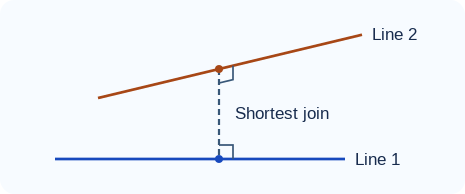
Take a variable point on each line. The shortest joining vector is perpendicular to both line directions.

Two skew lines with a dashed shortest segment joining one point on each line, drawn schematically.

The shortest joining segment is perpendicular to both spatial directions.

Worked example

Find both ends of a common perpendicular

Find the parameters of the endpoints of the common perpendicular between r=[000]+s[100]\mathbf r=\left[\begin{matrix}0\\0\\0\end{matrix}\right]+s\left[\begin{matrix}1\\0\\0\end{matrix}\right] and r=[012]+t[010]\mathbf r=\left[\begin{matrix}0\\1\\2\end{matrix}\right]+t\left[\begin{matrix}0\\1\\0\end{matrix}\right]. Give its length.

  1. If the joining vector is perpendicular to both directions, it has zero x- and y-components here.

  2. The x-coordinate condition gives s=0s=0 and the y-coordinate condition gives t=−1t=-1.

  3. The endpoints then differ only in z, with length 22.

Your turn

Find the parameters of the endpoints of the common perpendicular between r=[000]+s[100]\mathbf r=\left[\begin{matrix}0\\0\\0\end{matrix}\right]+s\left[\begin{matrix}1\\0\\0\end{matrix}\right] and r=[023]+t[010]\mathbf r=\left[\begin{matrix}0\\2\\3\end{matrix}\right]+t\left[\begin{matrix}0\\1\\0\end{matrix}\right]. Give its length.

Enter the value on its own or write s = … . Fractions and exact square roots are accepted.

Enter the value on its own or write t = … . Fractions and exact square roots are accepted.

Enter an exact number, for example 3/2 or 2-sqrt(3).

Worked example

Find both ends of a common perpendicular

Find the parameters of the endpoints of the common perpendicular between r=[000]+s[100]\mathbf r=\left[\begin{matrix}0\\0\\0\end{matrix}\right]+s\left[\begin{matrix}1\\0\\0\end{matrix}\right] and r=[034]+t[010]\mathbf r=\left[\begin{matrix}0\\3\\4\end{matrix}\right]+t\left[\begin{matrix}0\\1\\0\end{matrix}\right]. Give its length.

Try it on paper first.

  1. If the joining vector is perpendicular to both directions, it has zero x- and y-components here.

  2. The x-coordinate condition gives s=0s=0 and the y-coordinate condition gives t=−3t=-3.

  3. The endpoints then differ only in z, with length 44.

Your turn

Find the parameters of the endpoints of the common perpendicular between r=[000]+s[100]\mathbf r=\left[\begin{matrix}0\\0\\0\end{matrix}\right]+s\left[\begin{matrix}1\\0\\0\end{matrix}\right] and r=[045]+t[010]\mathbf r=\left[\begin{matrix}0\\4\\5\end{matrix}\right]+t\left[\begin{matrix}0\\1\\0\end{matrix}\right]. Give its length.

Enter the value on its own or write s = … . Fractions and exact square roots are accepted.

Enter the value on its own or write t = … . Fractions and exact square roots are accepted.

Enter an exact number, for example 3/2 or 2-sqrt(3).

Worked examples

Practise the method

Core practice

Question 1 of 4

0 / 4 checked in this collection

Question list

Core practice

Fresh variants

Exam-style

Find the whole perpendicular foot

4 marks

Find the foot H from P=[533]P=\left[\begin{matrix}5\\3\\3\end{matrix}\right] to r=[101]+t[121]r=\left[\begin{matrix}1\\0\\1\end{matrix}\right]+t\left[\begin{matrix}1\\2\\1\end{matrix}\right], and the exact distance PH.

Enter an exact number, for example 3/2 or 2-sqrt(3).

Enter an exact number, for example 3/2 or 2-sqrt(3).

Enter an exact number, for example 3/2 or 2-sqrt(3).

Enter an exact number, for example 3/2 or 2-sqrt(3).

Full answer-format guide

Exact numbers: 3/2, sqrt(5), 2-sqrt(3), pi/6, 3*pi/2. Sets: {1,4}. Intervals: (3,5]; a round bracket excludes the endpoint. Infinity: inf; union: U; no solutions: empty. Separate coordinate pairs or triples with semicolons. Expressions: 2x^2+3x-1; equations: x^2=3x+1 or the polynomial equal to zero. Factors: x-1 ; x+2. Parameter fraction: numerator ; denominator. List integer answers individually.

Review the method

Progress stays in this browser. Create an account to save it or sign in.

Extra practice from this lesson

Use one line parameter in all three coordinates

Does (3,−1,2)\left(3,-1,2\right) lie on r=[3−12]+t[123]\mathbf r=\left[\begin{matrix}3\\-1\\2\end{matrix}\right]+t\left[\begin{matrix}1\\2\\3\end{matrix}\right]? Give the parameter obtained from the x-coordinate and decide.

Enter an exact number, for example 3/2 or 2-sqrt(3).

Does the point lie on the line?

Solve for separate parameters at a common point

Find both parameters and the x-coordinate where r=[3−12]+s[123]\mathbf r=\left[\begin{matrix}3\\-1\\2\end{matrix}\right]+s\left[\begin{matrix}1\\2\\3\end{matrix}\right] and r=[11011]+t[2−11]\mathbf r=\left[\begin{matrix}1\\10\\11\end{matrix}\right]+t\left[\begin{matrix}2\\-1\\1\end{matrix}\right] intersect.

Enter the value on its own or write s = … . Fractions and exact square roots are accepted.

Enter the value on its own or write t = … . Fractions and exact square roots are accepted.

Enter the value on its own or write x = … . Fractions and exact square roots are accepted.

Decide when non-parallel lines are skew

For lines r=[5−12]+s[125]\mathbf r=\left[\begin{matrix}5\\-1\\2\end{matrix}\right]+s\left[\begin{matrix}1\\2\\5\end{matrix}\right] and r=[91237]+t[2−11]\mathbf r=\left[\begin{matrix}9\\12\\37\end{matrix}\right]+t\left[\begin{matrix}2\\-1\\1\end{matrix}\right], solve equality of x- and y-coordinates. Do the lines intersect?

Enter the value on its own or write s = … . Fractions and exact square roots are accepted.

Enter the value on its own or write t = … . Fractions and exact square roots are accepted.

Do the lines intersect?

Find a foot by imposing perpendicularity

From point (10,−2,5)\left(10,-2,5\right), find the foot on r=[3−12]+t[123]\mathbf r=\left[\begin{matrix}3\\-1\\2\end{matrix}\right]+t\left[\begin{matrix}1\\2\\3\end{matrix}\right] and the shortest distance. Give the foot parameter and exact distance.

Enter the value on its own or write t = … . Fractions and exact square roots are accepted.

Enter an exact number, for example 3/2 or 2-sqrt(3).

Find both ends of a common perpendicular

Find the parameters of the endpoints of the common perpendicular between r=[000]+s[100]\mathbf r=\left[\begin{matrix}0\\0\\0\end{matrix}\right]+s\left[\begin{matrix}1\\0\\0\end{matrix}\right] and r=[056]+t[010]\mathbf r=\left[\begin{matrix}0\\5\\6\end{matrix}\right]+t\left[\begin{matrix}0\\1\\0\end{matrix}\right]. Give its length.

Enter the value on its own or write s = … . Fractions and exact square roots are accepted.

Enter the value on its own or write t = … . Fractions and exact square roots are accepted.

Enter an exact number, for example 3/2 or 2-sqrt(3).

Apply it · original exam-style problems

Show your working on paper and compare it with the worked solution and marking guidance.

Come back to what needs practice

Quick revision sheet (A4)

Your review plan starts after your first check.