Maths4UBETA

Sketching admissible polar curves

Use a domain, a short table and symmetry to trace the actual curve.

Try the quick check →
Lesson 2 of 5

Section 1 of 5 · Core · about 5 min

Which parts of the radius rule should I draw?

Find the permitted angular intervals before plotting. In this course use the non-negative-radius convention.

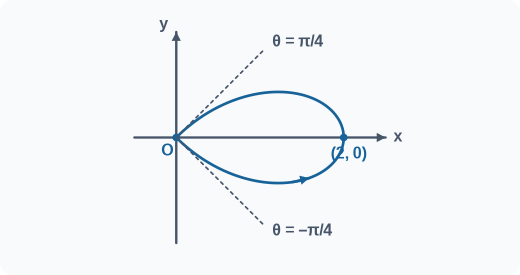
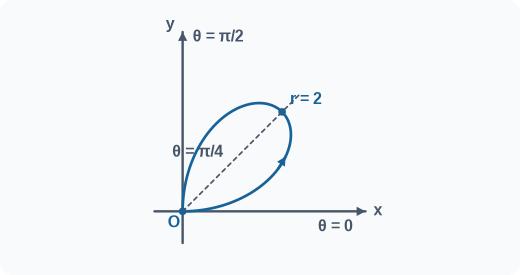
One petal rises from the pole along the initial ray and comes back along the positive vertical ray. The point farthest from the pole lies on the diagonal.
For r=2sin⁡2θr=2\sin 2\theta the connected trace uses 0≤θ≤π20\le\theta\le\frac\pi2. The angle π\pi gives the same pole and adds no branch.

Use three anchor rays to sketch the whole petal. The displayed arrow follows increasing θ\theta.

AngleRadiusPoint
0000Pole
π4\frac\pi422(2,2)(\sqrt2,\sqrt2)
π2\frac\pi200Pole

Worked example

Find the angular interval for a non-negative petal

On 0≤θ≤π0\le\theta\le \pi, keep only non-negative values in r=2sin⁡(2θ)r=2 \sin{\left(2 \theta \right)}. Give the complete allowed angle interval in interval notation, containing π4\frac{\pi}{4} and the maximum radius.

  1. The sine factor is non-negative from zero through π2\frac{\pi}{2} in this part of the interval.

  2. The isolated angle π\pi is also a pole, but lies outside the requested connected piece.

  3. Within the requested interval the sine reaches one at θ=π4\theta=\frac{\pi}{4}, so the maximum radius is 22.

Your turn

On 0≤θ≤π0\le\theta\le \pi, keep only non-negative values in r=3sin⁡(2θ)r=3 \sin{\left(2 \theta \right)}. Give the complete allowed angle interval in interval notation, containing π4\frac{\pi}{4} and the maximum radius.

Use inequalities in x or interval notation. Join intervals with ‘or’ or ∪. Enter an isolated value on its own.

Enter the value on its own or write r = … . Fractions and exact square roots are accepted.

Section 2 of 5 · Core · about 5 min

Which landmarks establish the shape of a cardioid?

Use the extreme cosine values and the coordinate axes as starting rays. Evaluate the radius on these rays and place the points.

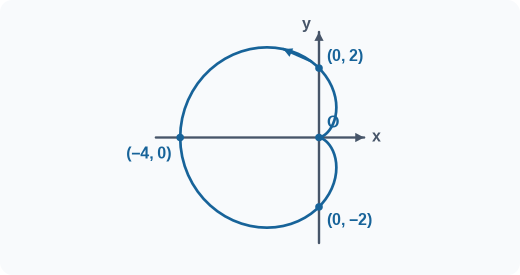
Left-facing cardioid starts and ends at the pole, crosses the vertical axis at height two and negative two, and reaches negative four on the horizontal axis.
For r=2−2cos⁡θr=2-2\cos\theta, the radius sequence at the quarter-turns is 0,2,4,2,00,2,4,2,0. Join the plotted points in that order.
AngleRadiusCartesian point
0,2π0,2\pi00(0,0)(0,0)
π2\frac\pi222(0,2)(0,2)
π\pi44(−4,0)(-4,0)
3π2\frac{3\pi}222(0,−2)(0,-2)

Worked example

Use the pole and opposite-axis landmark

For r=2−2cos⁡(θ)r=2 - 2 \cos{\left(\theta \right)} on 0≤θ≤2π0\le\theta\le 2 \pi, identify the greatest radius and the x-coordinate of the point attaining it.

  1. The radius is zero at the two ends, meeting the pole. Reflection across the initial line corresponds to replacing θ by 2π−θ2\pi-\theta.

  2. The largest radius occurs where cosine is minus one, at θ=π\theta=\pi. It is 44.

  3. At that angle the point lies to the left of the pole on the x-axis. Its x-coordinate is −4-4.

Your turn

For r=3−3cos⁡(θ)r=3 - 3 \cos{\left(\theta \right)} on 0≤θ≤2π0\le\theta\le 2 \pi, identify the greatest radius and the x-coordinate of the point attaining it.

Enter the value on its own or write r = … . Fractions and exact square roots are accepted.

Enter the value on its own or write x = … . Fractions and exact square roots are accepted.

Section 3 of 5 · Core · about 7 min

When can I reflect one half of a sketch?

Under reflection in the initial line an angle changes to its negative. The radius must be the same on the reflected ray.

The upper and lower halves of the right petal mirror one another in the initial line. Both boundary rays lead to the pole.
For r=2cos⁡2θr=2\cos 2\theta the two boundary radii are zero and the radius at θ=0\theta=0 is two.

Worked example

Use symmetry to complete an admissible lobe

For r=2cos⁡(2θ)r=2 \cos{\left(2 \theta \right)} on −π4≤θ≤π4- \frac{\pi}{4}\le\theta\le \frac{\pi}{4}, find the greatest radius and decide whether the curve is symmetric about the initial line.

  1. Cosine is even, so replacing θ by its negative leaves the radius unchanged.

  2. Both endpoints have zero radius. Their intermediate points form one connected lobe reflected across the initial line.

  3. The maximum occurs at θ=0\theta=0, when cosine is one. It equals 22.

Your turn

For r=3cos⁡(2θ)r=3 \cos{\left(2 \theta \right)} on −π4≤θ≤π4- \frac{\pi}{4}\le\theta\le \frac{\pi}{4}, find the greatest radius and decide whether the curve is symmetric about the initial line.

Enter the value on its own or write r = … . Fractions and exact square roots are accepted.

Symmetric about the initial line?

Worked example

Recognise a different reflection axis

For r=2sin⁡θr=2\sin\theta on 0≤θ≤π0\le\theta\le\pi, find the symmetry line and give the Cartesian equation.

Try it on paper first.

  1. The reflection θ↦π−θ\theta\mapsto\pi-\theta stays in the allowed interval and preserves rr. The curve is symmetric about the vertical axis.

  2. Multiply by rr to get x2+y2=2yx^2+y^2=2y, so x2+(y−1)2=1x^2+(y-1)^2=1. The endpoints both give the pole.

Your turn

For r=5cos⁡(2θ)r=5 \cos{\left(2 \theta \right)} on −π4≤θ≤π4- \frac{\pi}{4}\le\theta\le \frac{\pi}{4}, find the greatest radius and decide whether the curve is symmetric about the initial line.

Enter the value on its own or write r = … . Fractions and exact square roots are accepted.

Symmetric about the initial line?

Section 4 of 5 · Core · about 5 min

How can an increasing radius determine a spiral?

When the direction turns and the radius steadily grows, the curve traces an outward spiral segment.

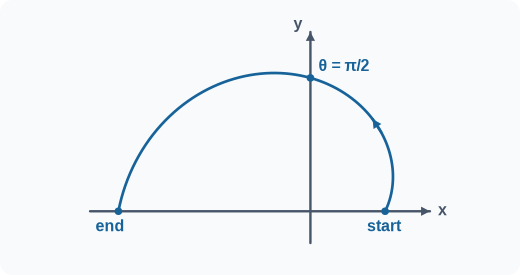
An open spiral winds counterclockwise above the horizontal axis. It starts at x equals two and ends on the negative horizontal axis.
For r=2+θr=2+\theta, mark θ=0,π2,π\theta=0,\frac\pi2,\pi with radii 2,2+π2,2+π2,2+\frac\pi2,2+\pi. The endpoints do not join.

Plot (2,0)(2,0), (0,2+π2)(0,2+\frac\pi2) and (−2−π,0)(-2-\pi,0) from the three rays. With increasing θ\theta, turn anticlockwise while increasing the distance from the pole.

Worked example

Sketch a spiral from its endpoint rays

For r=θ+2r=\theta + 2 on 0≤θ≤π0\le\theta\le \pi, find the starting x-coordinate, ending x-coordinate and the height on the positive y-axis.

  1. The radius increases as the direction turns anticlockwise. At θ zero the starting point is (2,0)\left(2,0\right).

  2. At θ equal to π, the curve lies on the negative x-axis, so the ending position is (−π−2,0)\left(- \pi - 2,0\right).

  3. At θ=π2\theta=\frac{\pi}{2} the radius equals the y-coordinate, giving π2+2\frac{\pi}{2} + 2.

Your turn

For r=2θ+3r=2 \theta + 3 on 0≤θ≤π0\le\theta\le \pi, find the starting x-coordinate, ending x-coordinate and the height on the positive y-axis.

Enter an exact number, for example 3/2 or 2-sqrt(3).

Enter an exact number, for example 3/2 or 2-sqrt(3).

Enter an exact number, for example 3/2 or 2-sqrt(3).

Section 5 of 5 · Core · about 7 min

How do I distinguish the pole from another point on an axis?

An axis point can occur because a sine or cosine projection vanishes even when the radius is non-zero.

Worked example

Use each axis crossing to check a cardioid sketch

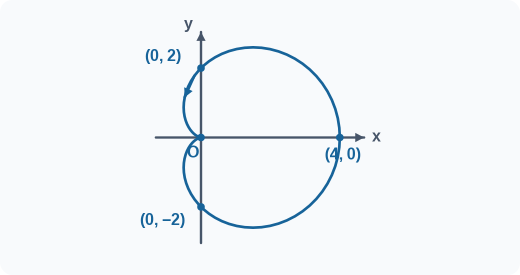
Sketch r=2+2cos⁡θr=2+2\cos\theta for 0≤θ≤2π0\le\theta\le2\pi. Label every axis point and show the direction of tracing.

Try it on paper first.

  1. Calculate the radii on the five quarter-turn rays. The sequence is 4,2,0,2,44,2,0,2,4.

  2. The zero-radius point is the pole at θ=π\theta=\pi. The two non-zero vertical-axis points are (0,2)(0,2) and (0,−2)(0,-2).

  3. Trace from (4,0)(4,0) into the upper half-plane, through the pole and back along the lower half-plane. Compare your sketch with the reference.

    Right-facing cardioid with cusp at the pole, farthest point four, zero, and vertical-axis crossings at two and negative two.

Your turn

The curve is r=3cos⁡(θ)+3r=3 \cos{\left(\theta \right)} + 3 for 0≤θ≤2π0\le\theta\le 2 \pi. Give the positive x-intercept and the angle at the pole.

Enter the value on its own or write x = … . Fractions and exact square roots are accepted.

Enter an exact number, for example 3/2 or 2-sqrt(3).

Worked example

Decide whether the axis crossing is the pole

For r=2cos⁡θr=2\cos\theta on −π2≤θ≤π2-\frac\pi2\le\theta\le\frac\pi2, find all intersections with the vertical axis.

Try it on paper first.

  1. For the vertical axis, x=rcos⁡θ=0x=r\cos\theta=0. Substitute both allowed endpoint angles with cos⁡θ=0\cos\theta=0.

  2. In both cases r=0r=0. The two parameter values give the same point, so the only vertical-axis point is the pole.

Your turn

The curve is r=5cos⁡(θ)+5r=5 \cos{\left(\theta \right)} + 5 for 0≤θ≤2π0\le\theta\le 2 \pi. Give the positive x-intercept and the angle at the pole.

Enter the value on its own or write x = … . Fractions and exact square roots are accepted.

Enter an exact number, for example 3/2 or 2-sqrt(3).

Worked examples

Practise the method

Core practice

Question 1 of 4

0 / 4 checked in this collection

Question list

Core practice

Fresh variants

Exam-style

State every admissible angular interval

1 mark

For r=3cos⁡(2θ)r=3\cos(2\theta), use r≥0r\ge0 and −π<θ≤π-\pi<\theta\le\pi. Give the complete set of allowed angles.

Give the complete set: {1, 4} for separate values, (1, 5] for an interval, U for union or empty for no real solutions. Use sqrt(...) for exact roots.

Full answer-format guide

Exact numbers: 3/2, sqrt(5), 2-sqrt(3), pi/6, 3*pi/2. Sets: {1,4}. Intervals: (3,5]; a round bracket excludes the endpoint. Infinity: inf; union: U; no solutions: empty. Separate coordinate pairs or triples with semicolons. Expressions: 2x^2+3x-1; equations: x^2=3x+1 or the polynomial equal to zero. Factors: x-1 ; x+2. Parameter fraction: numerator ; denominator. List integer answers individually.

Review the method

Progress stays in this browser. Create an account to save it or sign in.

Extra practice from this lesson

Find the angular interval for a non-negative petal

On 0≤θ≤π0\le\theta\le \pi, keep only non-negative values in r=4sin⁡(2θ)r=4 \sin{\left(2 \theta \right)}. Give the complete allowed angle interval in interval notation, containing π4\frac{\pi}{4} and the maximum radius.

Use inequalities in x or interval notation. Join intervals with ‘or’ or ∪. Enter an isolated value on its own.

Enter the value on its own or write r = … . Fractions and exact square roots are accepted.

Use the pole and opposite-axis landmark

For r=4−4cos⁡(θ)r=4 - 4 \cos{\left(\theta \right)} on 0≤θ≤2π0\le\theta\le 2 \pi, identify the greatest radius and the x-coordinate of the point attaining it.

Enter the value on its own or write r = … . Fractions and exact square roots are accepted.

Enter the value on its own or write x = … . Fractions and exact square roots are accepted.

Use symmetry to complete an admissible lobe

For r=6cos⁡(2θ)r=6 \cos{\left(2 \theta \right)} on −π4≤θ≤π4- \frac{\pi}{4}\le\theta\le \frac{\pi}{4}, find the greatest radius and decide whether the curve is symmetric about the initial line.

Enter the value on its own or write r = … . Fractions and exact square roots are accepted.

Symmetric about the initial line?

Sketch a spiral from its endpoint rays

For r=3θ+4r=3 \theta + 4 on 0≤θ≤π0\le\theta\le \pi, find the starting x-coordinate, ending x-coordinate and the height on the positive y-axis.

Enter an exact number, for example 3/2 or 2-sqrt(3).

Enter an exact number, for example 3/2 or 2-sqrt(3).

Enter an exact number, for example 3/2 or 2-sqrt(3).

Distinguish a pole from an ordinary axis crossing

The curve is r=6cos⁡(θ)+6r=6 \cos{\left(\theta \right)} + 6 for 0≤θ≤2π0\le\theta\le 2 \pi. Give the positive x-intercept and the angle at the pole.

Enter the value on its own or write x = … . Fractions and exact square roots are accepted.

Enter an exact number, for example 3/2 or 2-sqrt(3).

Apply it · original exam-style problems

Show your working on paper and compare it with the worked solution and marking guidance.

Come back to what needs practice

Quick revision sheet (A4)

Your review plan starts after your first check.