Maths4UBETA

Invariant sets and maps in space

Distinguish fixed points from invariant lines, include vertical directions and extend to three coordinates.

Try the quick check →
Lesson 5 of 5

Section 1 of 5 · Core · about 5 min

How do I find all points that stay exactly where they are?

A fixed point has its original coordinates after applying the map. Set the image equal to the original coordinate column.

Worked example

Find fixed points by solving the two coordinate equations

For A=[120−1]A=\left[\begin{matrix}1 & 2\\0 & -1\end{matrix}\right], which axis consists entirely of fixed points? Give the other coordinate shared by every fixed point.

  1. Set the image column equal to the original one. This gives 2y=02y=0 and −y=y-y=y.

  2. Hence y=0y=0 and x is unrestricted.

  3. Every point on the x-axis is fixed. A point off that axis changes its y-coordinate.
Your turn

For A=[130−1]A=\left[\begin{matrix}1 & 3\\0 & -1\end{matrix}\right], which axis consists entirely of fixed points? Give the other coordinate shared by every fixed point.

Axis of fixed points

Enter the value on its own or write y = … . Fractions and exact square roots are accepted.

Section 2 of 5 · Core · about 5 min

Can a line be invariant even while points move along it?

A line is invariant if it is mapped onto itself. Individual points can move to different positions on the same line.

Worked example

Distinguish an invariant line from a line of fixed points

The transformation uses A=[2003]A=\left[\begin{matrix}2 & 0\\0 & 3\end{matrix}\right]. Give the multiplier on the y-axis, and decide whether the whole y-axis is fixed point by point.

  1. A point of the y-axis has x-coordinate zero. Applying A leaves that coordinate zero and multiplies y by 33.

  2. The output remains on the axis, so the line is invariant.

  3. The multiplier is not one. Except for the origin, the points move along the line.

Your turn

The transformation uses A=[3004]A=\left[\begin{matrix}3 & 0\\0 & 4\end{matrix}\right]. Give the multiplier on the y-axis, and decide whether the whole y-axis is fixed point by point.

Enter an exact number, for example 3/2 or 2-sqrt(3).

Every point fixed?

Section 3 of 5 · Core · about 7 min

How do I test a line that does not pass through the origin?

An affine line has a direction and an offset. Preserving the direction alone does not guarantee that the line stays where it was.

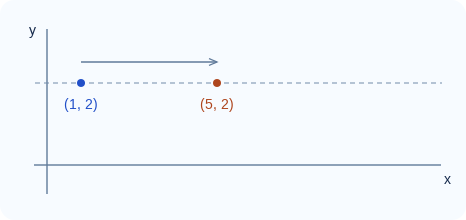
The point (1, 2) moves along the horizontal line to (5, 2). The line stays the same even though the point moves.

A shear can preserve a line without fixing the points on it.

Worked example

Check a horizontal line that misses the origin

The shear uses A=[1201]A=\left[\begin{matrix}1 & 2\\0 & 1\end{matrix}\right]. Decide whether the line y=2y=2 is invariant and find the x-coordinate of the image of [12]\left[\begin{matrix}1\\2\end{matrix}\right].

  1. The matrix leaves every y-coordinate unchanged. The image of every point on the horizontal line stays on that line.

  2. The inverse shear also keeps the same line, so the line maps onto itself.

  3. The x-coordinate changes to 55 for the given point.

Your turn

The shear uses A=[1301]A=\left[\begin{matrix}1 & 3\\0 & 1\end{matrix}\right]. Decide whether the line y=3y=3 is invariant and find the x-coordinate of the image of [13]\left[\begin{matrix}1\\3\end{matrix}\right].

Is the line invariant?

Enter the value on its own or write x = … . Fractions and exact square roots are accepted.

Worked example

Check a horizontal line that misses the origin

The shear uses A=[1401]A=\left[\begin{matrix}1 & 4\\0 & 1\end{matrix}\right]. Decide whether the line y=4y=4 is invariant and find the x-coordinate of the image of [14]\left[\begin{matrix}1\\4\end{matrix}\right].

Try it on paper first.

  1. The matrix leaves every y-coordinate unchanged. The image of every point on the horizontal line stays on that line.

  2. The inverse shear also keeps the same line, so the line maps onto itself.

  3. The x-coordinate changes to 1717 for the given point.

Your turn

The shear uses A=[1501]A=\left[\begin{matrix}1 & 5\\0 & 1\end{matrix}\right]. Decide whether the line y=5y=5 is invariant and find the x-coordinate of the image of [15]\left[\begin{matrix}1\\5\end{matrix}\right].

Is the line invariant?

Enter the value on its own or write x = … . Fractions and exact square roots are accepted.

Section 4 of 5 · Core · about 5 min

Why should I check the vertical line separately?

The direction vector with first entry one represents every finite slope. No finite slope represents a vertical line.

Worked example

Find finite invariant slopes and check the vertical axis

Find the slopes of all invariant lines through the origin for A=[3122]A=\left[\begin{matrix}3 & 1\\2 & 2\end{matrix}\right]. Is the vertical line through the origin invariant?

  1. A finite slope mm has a direction column [1m]\left[\begin{matrix}1\\m\end{matrix}\right]. The image must be parallel to it.

  2. Equating cross products of the coordinates gives m2+m−2=0m^{2} + m - 2=0, with the two slopes 11 and −2-2.

  3. The image of the vertical direction is [12]\left[\begin{matrix}1\\2\end{matrix}\right]. Its first coordinate is non-zero, so the vertical line is not invariant.

Your turn

Find the slopes of all invariant lines through the origin for A=[5164]A=\left[\begin{matrix}5 & 1\\6 & 4\end{matrix}\right]. Is the vertical line through the origin invariant?

Give the complete set: {1, 4} for separate values, (1, 5] for an interval, U for union or empty for no real solutions. Use sqrt(...) for exact roots.

Vertical line invariant?

Section 5 of 5 · Core · about 7 min

Which coordinates change in a spatial map?

A rotation about a coordinate axis leaves its coordinate unchanged and rotates the two perpendicular coordinates. A reflection in a coordinate plane reverses the perpendicular coordinate.

Worked example

Read a three-coordinate transformation along an axis or plane

Find the image of [125]\left[\begin{matrix}1\\2\\5\end{matrix}\right] under a quarter-turn about the z-axis mapping the positive x-axis towards the positive y-axis.

  1. Use a two-coordinate rule on the affected axes. The x and y positions rotate while z is unchanged.

  2. The three unit images give the matrix [0−10100001]\left[\begin{matrix}0 & -1 & 0\\1 & 0 & 0\\0 & 0 & 1\end{matrix}\right].

  3. Its product with the given column is [−215]\left[\begin{matrix}-2\\1\\5\end{matrix}\right].

Your turn

Find the image of [216]\left[\begin{matrix}2\\1\\6\end{matrix}\right] under reflection in the xz-plane.

Enter the value on its own or write x = … . Fractions and exact square roots are accepted.

Enter the value on its own or write y = … . Fractions and exact square roots are accepted.

Enter the value on its own or write z = … . Fractions and exact square roots are accepted.

Worked example

Read a three-coordinate transformation along an axis or plane

Find the image of [307]\left[\begin{matrix}3\\0\\7\end{matrix}\right] under a quarter-turn about the z-axis mapping the positive x-axis towards the positive y-axis.

Try it on paper first.

  1. Use a two-coordinate rule on the affected axes. The x and y positions rotate while z is unchanged.

  2. The three unit images give the matrix [0−10100001]\left[\begin{matrix}0 & -1 & 0\\1 & 0 & 0\\0 & 0 & 1\end{matrix}\right].

  3. Its product with the given column is [037]\left[\begin{matrix}0\\3\\7\end{matrix}\right].

Your turn

Find the image of [4−18]\left[\begin{matrix}4\\-1\\8\end{matrix}\right] under reflection in the xz-plane.

Enter the value on its own or write x = … . Fractions and exact square roots are accepted.

Enter the value on its own or write y = … . Fractions and exact square roots are accepted.

Enter the value on its own or write z = … . Fractions and exact square roots are accepted.

Worked examples

Practise the method

Core practice

Question 1 of 4

0 / 4 checked in this collection

Question list

Core practice

Fresh variants

Exam-style

Find the complete line of fixed points

1 mark

Find all fixed points of M=(3001)M=\begin{pmatrix}3 & 0\\0 & 1\end{pmatrix}. Give one Cartesian equation for the complete set.

Enter both sides of the equation or give an expression equal to zero. Use ^ for powers and / for fractions.

Full answer-format guide

Exact numbers: 3/2, sqrt(5), 2-sqrt(3), pi/6, 3*pi/2. Sets: {1,4}. Intervals: (3,5]; a round bracket excludes the endpoint. Infinity: inf; union: U; no solutions: empty. Separate coordinate pairs or triples with semicolons. Expressions: 2x^2+3x-1; equations: x^2=3x+1 or the polynomial equal to zero. Factors: x-1 ; x+2. Parameter fraction: numerator ; denominator. List integer answers individually.

Review the method

Progress stays in this browser. Create an account to save it or sign in.

Extra practice from this lesson

Find fixed points by solving the two coordinate equations

For A=[140−1]A=\left[\begin{matrix}1 & 4\\0 & -1\end{matrix}\right], which axis consists entirely of fixed points? Give the other coordinate shared by every fixed point.

Axis of fixed points

Enter the value on its own or write y = … . Fractions and exact square roots are accepted.

Distinguish an invariant line from a line of fixed points

The transformation uses A=[4005]A=\left[\begin{matrix}4 & 0\\0 & 5\end{matrix}\right]. Give the multiplier on the y-axis, and decide whether the whole y-axis is fixed point by point.

Enter an exact number, for example 3/2 or 2-sqrt(3).

Every point fixed?

Check a horizontal line that misses the origin

The shear uses A=[1601]A=\left[\begin{matrix}1 & 6\\0 & 1\end{matrix}\right]. Decide whether the line y=6y=6 is invariant and find the x-coordinate of the image of [16]\left[\begin{matrix}1\\6\end{matrix}\right].

Is the line invariant?

Enter the value on its own or write x = … . Fractions and exact square roots are accepted.

Find finite invariant slopes and check the vertical axis

Find the slopes of all invariant lines through the origin for A=[71126]A=\left[\begin{matrix}7 & 1\\12 & 6\end{matrix}\right]. Is the vertical line through the origin invariant?

Give the complete set: {1, 4} for separate values, (1, 5] for an interval, U for union or empty for no real solutions. Use sqrt(...) for exact roots.

Vertical line invariant?

Read a three-coordinate transformation along an axis or plane

Find the image of [5−29]\left[\begin{matrix}5\\-2\\9\end{matrix}\right] under a quarter-turn about the z-axis mapping the positive x-axis towards the positive y-axis.

Enter the value on its own or write x = … . Fractions and exact square roots are accepted.

Enter the value on its own or write y = … . Fractions and exact square roots are accepted.

Enter the value on its own or write z = … . Fractions and exact square roots are accepted.

Apply it · original exam-style problems

Show your working on paper and compare it with the worked solution and marking guidance.

Come back to what needs practice

Quick revision sheet (A4)

Your review plan starts after your first check.