Maths4UBETA

Powers of ten and standard form

Scale numbers by powers of ten and describe very large or very small numbers in standard form.

Try the quick check →
Lesson 2 of 3

Section 1 of 3 · Core · about 8 min

Move across place values

Use the value of each place, rather than imagining a loose decimal point.

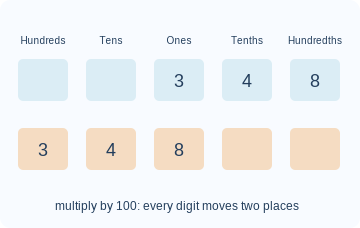
Place value rows showing 3.48 and the same digits two columns left as 348

Multiplying by 100 makes each digit count 100 times its former value.

Worked example

Shift the place values

The measurement display starts at 0.0340.034.

  1. Find the new reading after multiplying by 10210^2.

    [2]
  2. Describe how to return to the starting value.

    [1]
  1. (a) Multiplying by 10210^2 makes every place worth 100 times as much.

  2. 175\frac{17}{5}

  3. (b) Use the inverse operation.

  4. Divide by 10210^2.

Your turn

The measurement display starts at 0.1740.174.

Find the new reading after multiplying by 10410^4.

Enter one number. Fractions and decimals are accepted.

Worked example

Shift the place values

The measurement display starts at 0.0410.041.

  1. Find the new reading after multiplying by 10210^2.

    [2]
  2. Describe how to return to the starting value.

    [1]

Try it on paper first.

  1. (a) Multiplying by 10210^2 makes every place worth 100 times as much.

  2. 4110\frac{41}{10}

  3. (b) Use the inverse operation.

  4. Divide by 10210^2.

Your turn

The measurement display starts at 0.1810.181.

Find the new reading after multiplying by 10410^4.

Enter one number. Fractions and decimals are accepted.

Section 2 of 3 · Core · about 8 min

Read a standard-form number

Point to the single non-zero digit before the decimal point.

Worked example

Use standard form

A microscope display gives the number 0.001250.00125. In standard form it is A×10nA\times10^n.

  1. Find nn.

    [2]
  2. State AA.

    [1]
  1. (a) The coefficient is 54\frac{5}{4}. The original number is 10−310^{-3} times as large as this coefficient.

  2. −3-3

  3. (b) Move the decimal point so exactly one non-zero digit lies before it.

  4. 54\frac{5}{4}

Your turn

A microscope display gives the number 0.00000450.0000045. In standard form it is A×10nA\times10^n.

Find nn.

Enter one number. Fractions and decimals are accepted.

Worked example

Use standard form

A microscope display gives the number 13201320. In standard form it is A×10nA\times10^n.

  1. Find nn.

    [2]
  2. State AA.

    [1]

Try it on paper first.

  1. (a) The coefficient is 3325\frac{33}{25}. The original number is 10310^{3} times as large as this coefficient.

  2. 33

  3. (b) Move the decimal point so exactly one non-zero digit lies before it.

  4. 3325\frac{33}{25}

Your turn

A microscope display gives the number 52000005200000. In standard form it is A×10nA\times10^n.

Find nn.

Enter one number. Fractions and decimals are accepted.

Section 3 of 3 · Core · about 8 min

Scale by a small power of ten

Write a negative power of ten as a fraction when the direction is hard to see.

Worked example

Divide by a negative power of ten

A counter reads 2.162.16.

  1. Evaluate 2.16÷10−52.16\div10^{-5}.

    [2]
  2. Give the equivalent operation using a positive index.

    [1]
  1. (a) 10−5=1/10510^{-5}=1/10^5. Dividing by that fraction multiplies by its reciprocal.

  2. 216000216000

  3. (b) Take the reciprocal of the divisor.

  4. 2.16×1052.16\times10^5

Your turn

A counter reads 1.361.36.

Evaluate 1.36÷10−71.36\div10^{-7}.

Enter one number. Fractions and decimals are accepted.

Worked example

Divide by a negative power of ten

A counter reads 2.232.23.

  1. Evaluate 2.23÷10−52.23\div10^{-5}.

    [2]
  2. Give the equivalent operation using a positive index.

    [1]

Try it on paper first.

  1. (a) 10−5=1/10510^{-5}=1/10^5. Dividing by that fraction multiplies by its reciprocal.

  2. 223000223000

  3. (b) Take the reciprocal of the divisor.

  4. 2.23×1052.23\times10^5

Your turn

A counter reads 1.431.43.

Evaluate 1.43÷10−71.43\div10^{-7}.

Enter one number. Fractions and decimals are accepted.

Worked examples

Practise the method

Core practice

Question 1 of 12

0 / 12 checked in this collection

Question list

Core practice

Fresh variants

Exam-style

Shift the place values

1 mark

The measurement display starts at 0.2130.213.

Find the new reading after multiplying by 10310^3.

Enter one number. Fractions and decimals are accepted.

Full answer-format guide

Exact numbers: 3/2, sqrt(5), 2-sqrt(3), pi/6, 3*pi/2. Sets: {1,4}. Intervals: (3,5]; a round bracket excludes the endpoint. Infinity: inf; union: U; no solutions: empty. Separate coordinate pairs or triples with semicolons. Expressions: 2x^2+3x-1; equations: x^2=3x+1 or the polynomial equal to zero. Factors: x-1 ; x+2. Parameter fraction: numerator ; denominator. List integer answers individually.

Review the method

Progress stays in this browser. Create an account to save it or sign in.

Extra practice from this lesson

The measurement display starts at 0.0940.094.

Find the new reading after multiplying by 10610^6.

Enter one number. Fractions and decimals are accepted.

The measurement display starts at 0.1010.101.

Find the new reading after multiplying by 10610^6.

Enter one number. Fractions and decimals are accepted.

A microscope display gives the number 0.01850.0185. In standard form it is A×10nA\times10^n.

Find nn.

Enter one number. Fractions and decimals are accepted.

A microscope display gives the number 192192. In standard form it is A×10nA\times10^n.

Find nn.

Enter one number. Fractions and decimals are accepted.

A counter reads 0.560.56.

Evaluate 0.56÷10−30.56\div10^{-3}.

Enter one number. Fractions and decimals are accepted.

A counter reads 0.630.63.

Evaluate 0.63÷10−30.63\div10^{-3}.

Enter one number. Fractions and decimals are accepted.

Apply it · original exam-style problems

Show your working on paper and compare it with the worked solution and marking guidance.

Come back to what needs practice

Quick revision sheet (A4)

Your review plan starts after your first check.