Maths4UBETA

Mixed practice with a calculator

Use a calculator accurately and explain why a method and rounding decision fit each question.

Try the quick check →
Lesson 2 of 2

Section 1 of 3 · Core · about 8 min

Keep unrounded working down to the final line

Save the full result of one step before using it in the next.

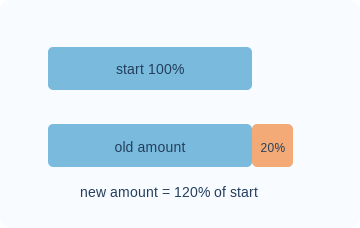
A starting bar of 100 percent and an increased bar of 120 percent

An increase of 20% means multiply the current amount by 1.20.

Worked example

Calculator: changing sign-up numbers

A club starts with 370 sign-ups. Its total grows by 8% in each of two years.

  1. Find the predicted final total to the nearest whole person.

    [2]
  2. Explain how rounding during the calculation can affect the answer.

    [1]
  1. (a) Multiply the initial total by 1.08 twice. The unrounded result is 431.568.

  2. 432432

  3. (b) Keep the exact or calculator value until the final result.

  4. A rounding change in year one is multiplied during year two.
Your turn

A club starts with 330 sign-ups. Its total grows by 12% in each of two years.

Find the predicted final total to the nearest whole person.

Enter one number. Fractions and decimals are accepted.

Worked example

Calculator: changing sign-up numbers

A club starts with 390 sign-ups. Its total grows by 8% in each of two years.

  1. Find the predicted final total to the nearest whole person.

    [2]
  2. Explain how rounding during the calculation can affect the answer.

    [1]

Try it on paper first.

  1. (a) Multiply the initial total by 1.08 twice. The unrounded result is 454.896.

  2. 455455

  3. (b) Keep the exact or calculator value until the final result.

  4. A rounding change in year one is multiplied during year two.

Your turn

A club starts with 350 sign-ups. Its total grows by 12% in each of two years.

Find the predicted final total to the nearest whole person.

Enter one number. Fractions and decimals are accepted.

Section 2 of 3 · Core · about 8 min

Use the right formula and unit

Mark which measurement is given before deciding what to type.

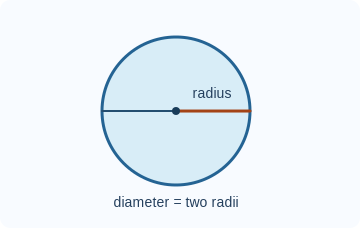
A circle with a diameter through its centre and the right half marked radius

The diameter crosses the centre and reaches both sides of the circle.

Worked example

Calculator: measure a circular area

A circular flower bed has diameter 17 m.

  1. Find its area in square metres, rounded to 2 decimal places.

    [2]
  2. Find how many 3-square-metre packs are needed to cover the bed.

    [2]
  1. (a) Halve the diameter to get a radius of 8.5 m.

  2. Multiply the square of this radius by π.

  3. 226.98226.98

  4. (b) Divide the exact area by 3, then round up because part of a pack still uses a whole pack.

  5. 76 packs.

Your turn

A circular flower bed has diameter 13.6 m.

Find its area in square metres, rounded to 2 decimal places.

Round as requested in the label, or enter your calculator value. Decimal or fraction input is accepted.

Worked example

Calculator: measure a circular area

A circular flower bed has diameter 19 m.

  1. Find its area in square metres, rounded to 2 decimal places.

    [2]
  2. Find how many 3-square-metre packs are needed to cover the bed.

    [2]

Try it on paper first.

  1. (a) Halve the diameter to get a radius of 9.5 m.

  2. Multiply the square of this radius by π.

  3. 283.53283.53

  4. (b) Divide the exact area by 3, then round up because part of a pack still uses a whole pack.

  5. 95 packs.

Your turn

A circular flower bed has diameter 15.6 m.

Find its area in square metres, rounded to 2 decimal places.

Round as requested in the label, or enter your calculator value. Decimal or fraction input is accepted.

Section 3 of 3 · Core · about 8 min

Read a compound unit as a division

Use the word ‘per’ to identify the quantity underneath.

Worked example

Calculator: compare mass per unit volume

A solid block has volume 108 cubic centimetres and mass 64.8 grams.

  1. Calculate its density in grams per cubic centimetre.

    [2]
  2. A same-material block has volume 216 cubic centimetres. Calculate its mass.

    [2]
  1. (a) Use mass divided by volume.

  2. 35\frac{3}{5}

  3. (b) With density fixed, doubling the volume doubles the mass.

  4. 129.6 grams.

Your turn

A solid block has volume 110 cubic centimetres and mass 66 grams.

Calculate its density in grams per cubic centimetre.

Enter an exact value or round to 3 significant figures.

Worked example

Calculator: compare mass per unit volume

A solid block has volume 117 cubic centimetres and mass 70.2 grams.

  1. Calculate its density in grams per cubic centimetre.

    [2]
  2. A same-material block has volume 234 cubic centimetres. Calculate its mass.

    [2]

Try it on paper first.

  1. (a) Use mass divided by volume.

  2. 35\frac{3}{5}

  3. (b) With density fixed, doubling the volume doubles the mass.

  4. 140.4 grams.

Your turn

A solid block has volume 121 cubic centimetres and mass 72.6 grams.

Calculate its density in grams per cubic centimetre.

Enter an exact value or round to 3 significant figures.

Worked examples

Practise the method

Core practice

Question 1 of 12

0 / 12 checked in this collection

Question list

Core practice

Fresh variants

Exam-style

Calculator: changing sign-up numbers

1 mark

A club starts with 410 sign-ups. Its total grows by 10% in each of two years.

Find the predicted final total to the nearest whole person.

Enter one number. Fractions and decimals are accepted.

Full answer-format guide

Exact numbers: 3/2, sqrt(5), 2-sqrt(3), pi/6, 3*pi/2. Sets: {1,4}. Intervals: (3,5]; a round bracket excludes the endpoint. Infinity: inf; union: U; no solutions: empty. Separate coordinate pairs or triples with semicolons. Expressions: 2x^2+3x-1; equations: x^2=3x+1 or the polynomial equal to zero. Factors: x-1 ; x+2. Parameter fraction: numerator ; denominator. List integer answers individually.

Review the method

Progress stays in this browser. Create an account to save it or sign in.

Extra practice from this lesson

A club starts with 510 sign-ups. Its total grows by 16% in each of two years.

Find the predicted final total to the nearest whole person.

Enter one number. Fractions and decimals are accepted.

A club starts with 310 sign-ups. Its total grows by 16% in each of two years.

Find the predicted final total to the nearest whole person.

Enter one number. Fractions and decimals are accepted.

A circular flower bed has diameter 10 m.

Find its area in square metres, rounded to 2 decimal places.

Round as requested in the label, or enter your calculator value. Decimal or fraction input is accepted.

A circular flower bed has diameter 12 m.

Find its area in square metres, rounded to 2 decimal places.

Round as requested in the label, or enter your calculator value. Decimal or fraction input is accepted.

A solid block has volume 104 cubic centimetres and mass 62.4 grams.

Calculate its density in grams per cubic centimetre.

Enter an exact value or round to 3 significant figures.

A solid block has volume 130 cubic centimetres and mass 78 grams.

Calculate its density in grams per cubic centimetre.

Enter an exact value or round to 3 significant figures.

Apply it · original exam-style problems

Show your working on paper and compare it with the worked solution and marking guidance.

Come back to what needs practice

Quick revision sheet (A4)

Your review plan starts after your first check.