Maths4UBETA

Place value, ordering and rounding

Use tenths and hundredths, order negative decimals and round to significant figures.

Try the quick check →
Lesson 1 of 3

Section 1 of 3 · Core · about 8 min

How does dividing by 0.1 change a number?

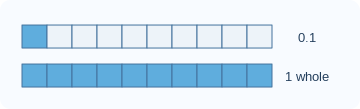
Imagine cutting a length into tenths. A whole metre contains ten tenths.

One tenth and a whole

Ten pieces of size one tenth make one whole. Count tenths when you divide by 0.1.

Worked example

Dividing by a small decimal

A label shows a length of 2.52.5 m.

  1. Calculate 2.52.5 ÷ 0.010.01.

    [2]
  2. Calculate 2.52.5 × 0.010.01.

    [2]
  1. (a) 0.010.01 is one of 100 equal parts of 1. Dividing counts how many of these parts fit.

  2. Multiply both numbers in the division by 100. The divisor becomes 1.

  3. 250250

  4. (b) Multiplying by one tenth or one hundredth makes the value smaller. Move the digits to lower place values.
  5. 0.0250.025

Your turn

A label shows a length of 4.54.5 m.

Calculate 4.54.5 ÷ 0.010.01.

Enter one number. Fractions and decimals are accepted.

Worked example

Dividing by a small decimal

A label shows a length of 2.62.6 m.

  1. Calculate 2.62.6 ÷ 0.10.1.

    [2]
  2. Calculate 2.62.6 × 0.10.1.

    [2]

Try it on paper first.

  1. (a) 0.10.1 is one of 10 equal parts of 1. Dividing counts how many of these parts fit.

  2. Multiply both numbers in the division by 10. The divisor becomes 1.

  3. 2626

  4. (b) Multiplying by one tenth or one hundredth makes the value smaller. Move the digits to lower place values.

  5. 0.260.26

Your turn

A label shows a length of 4.64.6 m.

Calculate 4.64.6 ÷ 0.10.1.

Enter one number. Fractions and decimals are accepted.

Section 2 of 3 · Core · about 8 min

Where do significant figures start?

Significant figures tell us how much detail to keep.

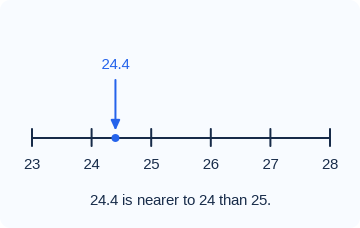
Scaled number line: 24.4 lies between 24 and 25, to the left of 24.5.

Scaled number line: 24.4 lies between 24 and 25, to the left of 24.5.

Worked example

Significant figures on a length label

A printed label records 4.734.73 cm.

  1. Write the length to two significant figures.

    [2]
  2. A separate measurement is 47304730 mm. Round it to two significant figures.

    [2]
  1. (a) Start at the first non-zero digit. Keep the units and tenths digits. Look at the hundredths digit of 4.734.73 before rounding.

  2. The rounded length is 4.74.7 cm.

  3. 4.74.7 cm

  4. (b) For this four-digit measurement keep the thousands and hundreds digits. Replace dropped places by zero.

  5. 47004700 mm

Your turn

A printed label records 6.736.73 cm.

Write the length to two significant figures.

Enter one number. Fractions and decimals are accepted.

Worked example

Significant figures on a length label

A printed label records 4.834.83 cm.

  1. Write the length to two significant figures.

    [2]
  2. A separate measurement is 48304830 mm. Round it to two significant figures.

    [2]

Try it on paper first.

  1. (a) Start at the first non-zero digit. Keep the units and tenths digits. Look at the hundredths digit of 4.834.83 before rounding.

  2. The rounded length is 4.84.8 cm.

  3. 4.84.8 cm

  4. (b) For this four-digit measurement keep the thousands and hundreds digits. Replace dropped places by zero.

  5. 48004800 mm

Your turn

A printed label records 6.836.83 cm.

Write the length to two significant figures.

Enter one number. Fractions and decimals are accepted.

Section 3 of 3 · Core · about 8 min

Which negative number is smaller?

Write both decimals to the same number of places.

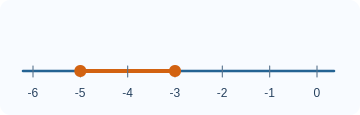
Two negative values on a number line

Negative five is to the left of negative three, so it is smaller.

Worked example

Comparing decimal readings

Two screen readings are −21.3-21.3 and −21.38-21.38.

  1. Write the lower reading.

    [2]
  2. Give the positive difference between the two readings.

    [2]
  1. (a) Extra zeroes do not change a decimal. Compare −21.30-21.30 with −21.38-21.38 on a number line.

  2. Farther left means smaller. For negative readings, the greater distance from zero gives the smaller reading.

  3. −21.38-21.38

  4. (b) A difference is a distance. Subtract the lower reading from the higher one.

  5. 0.080.08

Your turn

Two screen readings are −23.4-23.4 and −23.48-23.48.

Write the lower reading.

Enter an exact value or round to 3 significant figures.

Worked example

Comparing decimal readings

Two screen readings are −22.3-22.3 and −22.38-22.38.

  1. Write the lower reading.

    [2]
  2. Give the positive difference between the two readings.

    [2]

Try it on paper first.

  1. (a) Extra zeroes do not change a decimal. Compare −22.30-22.30 with −22.38-22.38 on a number line.

  2. Farther left means smaller. For negative readings, the greater distance from zero gives the smaller reading.

  3. −22.38-22.38

  4. (b) A difference is a distance. Subtract the lower reading from the higher one.

  5. 0.080.08

Your turn

Two screen readings are −24.4-24.4 and −24.48-24.48.

Write the lower reading.

Enter an exact value or round to 3 significant figures.

Worked examples

Practise the method

Core practice

Question 1 of 12

0 / 12 checked in this collection

Question list

Core practice

Fresh variants

Exam-style

Dividing by a small decimal

1 mark

A label shows a length of 77 m.

Calculate 77 ÷ 0.10.1.

Enter one number. Fractions and decimals are accepted.

Full answer-format guide

Exact numbers: 3/2, sqrt(5), 2-sqrt(3), pi/6, 3*pi/2. Sets: {1,4}. Intervals: (3,5]; a round bracket excludes the endpoint. Infinity: inf; union: U; no solutions: empty. Separate coordinate pairs or triples with semicolons. Expressions: 2x^2+3x-1; equations: x^2=3x+1 or the polynomial equal to zero. Factors: x-1 ; x+2. Parameter fraction: numerator ; denominator. List integer answers individually.

Review the method

Progress stays in this browser. Create an account to save it or sign in.

Extra practice from this lesson

A label shows a length of 6.56.5 m.

Calculate 6.56.5 ÷ 0.010.01.

Enter one number. Fractions and decimals are accepted.

A label shows a length of 6.66.6 m.

Calculate 6.66.6 ÷ 0.10.1.

Enter one number. Fractions and decimals are accepted.

A printed label records 3.1393.139 cm.

Write the length to two significant figures.

Enter one number. Fractions and decimals are accepted.

A printed label records 3.2393.239 cm.

Write the length to two significant figures.

Enter one number. Fractions and decimals are accepted.

Two screen readings are −25.5-25.5 and −25.58-25.58.

Write the lower reading.

Enter an exact value or round to 3 significant figures.

Two screen readings are −26.5-26.5 and −26.58-26.58.

Write the lower reading.

Enter an exact value or round to 3 significant figures.

Apply it · original exam-style problems

Show your working on paper and compare it with the worked solution and marking guidance.

Come back to what needs practice

Quick revision sheet (A4)

Your review plan starts after your first check.