Maths4UBETA

Fractions and mixed numbers

Connect recurring decimals to fractions, order values and calculate with mixed numbers.

Try the quick check →
Lesson 1 of 3

Section 1 of 4 · Core · about 8 min

How can a decimal be exact and keep going?

A bar above a digit or group of digits means it repeats indefinitely.

Worked example

An exact fraction for a repeating decimal

A display uses a bar to show a repeated digit. It shows 3.1‾3.\overline{1}.

  1. Write the decimal as an exact fraction.

    [2]
  2. Explain what the overline means.

    [2]
  1. (a) Multiplying by 10 shifts one repeated digit before the decimal point. Subtract one copy of the original number, so the repeated parts cancel.

  2. The result is 9x=289x=28 where x is the original number. Divide both sides by 9.

  3. 289\frac{28}{9}

  4. (b) The overline is a compact way to mark the repeated block.

  5. The digit 1 repeats forever after the point.
Your turn

A display uses a bar to show a repeated digit. It shows 3.5‾3.\overline{5}.

Write the decimal as an exact fraction.

Enter one number. Fractions and decimals are accepted.

Worked example

An exact fraction for a repeating decimal

A display uses a bar to show a repeated digit. It shows 4.1‾4.\overline{1}.

  1. Write the decimal as an exact fraction.

    [2]
  2. Explain what the overline means.

    [2]

Try it on paper first.

  1. (a) Multiplying by 10 shifts one repeated digit before the decimal point. Subtract one copy of the original number, so the repeated parts cancel.

  2. The result is 9x=379x=37 where x is the original number. Divide both sides by 9.

  3. 379\frac{37}{9}

  4. (b) The overline is a compact way to mark the repeated block.

  5. The digit 1 repeats forever after the point.

Your turn

A display uses a bar to show a repeated digit. It shows 4.5‾4.\overline{5}.

Write the decimal as an exact fraction.

Enter one number. Fractions and decimals are accepted.

Section 2 of 4 · Core · about 8 min

How do I compare unequal pieces?

Choose a shared fraction denominator or convert to decimals when it helps.

Worked example

Comparing two fractions

Two markers have values 11 and 1920\frac{19}{20}.

  1. Which value is greater? Give it exactly.

    [2]
  2. Is −1-1 less than or greater than −1920-\frac{19}{20}? Explain.

    [2]
  1. (a) A common denominator is 20. Rewrite the first fraction as 2020\frac{20}{20} and the second as 1920\frac{19}{20}.

  2. For the same denominator, the larger numerator gives the larger value.

  3. 11

  4. (b) Reflecting two positions across zero reverses their order.

  5. It is less.

Your turn

Two markers have values 115\frac{11}{5} and 5425\frac{54}{25}.

Which value is greater? Give it exactly.

Enter one number. Fractions and decimals are accepted.

Worked example

Comparing two fractions

Two markers have values 54\frac{5}{4} and 65\frac{6}{5}.

  1. Which value is greater? Give it exactly.

    [2]
  2. Is −54-\frac{5}{4} less than or greater than −65-\frac{6}{5}? Explain.

    [2]

Try it on paper first.

  1. (a) A common denominator is 20. Rewrite the first fraction as 2520\frac{25}{20} and the second as 2420\frac{24}{20}.

  2. For the same denominator, the larger numerator gives the larger value.

  3. 54\frac{5}{4}

  4. (b) Reflecting two positions across zero reverses their order.

  5. It is less.

Your turn

Two markers have values 125\frac{12}{5} and 5925\frac{59}{25}.

Which value is greater? Give it exactly.

Enter one number. Fractions and decimals are accepted.

Section 3 of 4 · Core · about 8 min

What if the top mixed number has fewer parts?

Picture a whole and the leftover pieces separately.

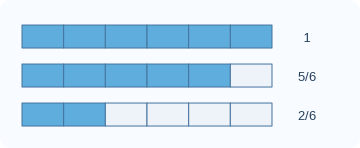
Whole and sixths on equal length bars

The whole has six sixths. Subtracting 2 sixths from 5 sixths leaves 3 sixths.

Worked example

Subtracting mixed amounts

A bag contains 9 159\,\frac{1}{5} kg of potting mix. A planter needs 2 252\,\frac{2}{5} kg.

  1. How much remains? Give a mixed number in its simplest form.

    [2]
  2. Explain why the fractional part must be smaller than one whole in a mixed-number answer.

    [2]
  1. (a) Estimate with whole numbers first. The remainder is close to 7 kg.

  2. Trade 1 whole for a full set of fractional parts, or convert both values into improper fractions before subtracting.

  3. The exact difference is 345\frac{34}{5}, which has mixed form 6 456\,\frac{4}{5}.

  4. 6 456\,\frac{4}{5} kg

  5. (b) Collect each full denominator’s worth of parts into one whole.

  6. A whole group must be moved into the whole-number part.

Your turn

A bag contains 5 175\,\frac{1}{7} kg of potting mix. A planter needs 2 272\,\frac{2}{7} kg.

How much remains? Give a mixed number in its simplest form.

kg

Enter the mixed number with the fractional part in simplest form.

Worked example

Subtracting mixed amounts

A bag contains 10 1510\,\frac{1}{5} kg of potting mix. A planter needs 2 252\,\frac{2}{5} kg.

  1. How much remains? Give a mixed number in its simplest form.

    [2]
  2. Explain why the fractional part must be smaller than one whole in a mixed-number answer.

    [2]

Try it on paper first.

  1. (a) Estimate with whole numbers first. The remainder is close to 8 kg.

  2. Trade 1 whole for a full set of fractional parts, or convert both values into improper fractions before subtracting.

  3. The exact difference is 395\frac{39}{5}, which has mixed form 7 457\,\frac{4}{5}.

  4. 7 457\,\frac{4}{5} kg

  5. (b) Collect each full denominator’s worth of parts into one whole.

  6. A whole group must be moved into the whole-number part.

Your turn

A bag contains 6 176\,\frac{1}{7} kg of potting mix. A planter needs 2 272\,\frac{2}{7} kg.

How much remains? Give a mixed number in its simplest form.

kg

Enter the mixed number with the fractional part in simplest form.

Section 4 of 4 · Core · about 8 min

How do whole groups and fractions work together?

A mixed number combines whole units with fractional units.

Worked example

Whole batches and fractional cups

A batch needs 4 134\,\frac{1}{3} cups of oats. A smaller measuring cup holds 13\frac{1}{3} of a whole cup.

  1. Find the amount for 5 batches.

    [2]
  2. How many of the smaller measuring cups fit exactly into 5 whole cups?

    [2]
  1. (a) Multiply the whole and fractional parts separately. The result is 20+5320+\frac{5}{3} cups.

  2. 653\frac{65}{3} cups

  3. (b) There are 3 of the unit parts in a whole cup. Group them into sets of 1.

  4. 1515 measuring cups

Your turn

A batch needs 5 135\,\frac{1}{3} cups of oats. A smaller measuring cup holds 13\frac{1}{3} of a whole cup.

Find the amount for 12 batches.

Enter one number. Fractions and decimals are accepted.

Worked example

Whole batches and fractional cups

A batch needs 4 134\,\frac{1}{3} cups of oats. A smaller measuring cup holds 13\frac{1}{3} of a whole cup.

  1. Find the amount for 6 batches.

    [2]
  2. How many of the smaller measuring cups fit exactly into 6 whole cups?

    [2]

Try it on paper first.

  1. (a) Multiply the whole and fractional parts separately. The result is 24+224+2 cups.

  2. 2626 cups

  3. (b) There are 3 of the unit parts in a whole cup. Group them into sets of 1.

  4. 1818 measuring cups

Your turn

A batch needs 5 135\,\frac{1}{3} cups of oats. A smaller measuring cup holds 13\frac{1}{3} of a whole cup.

Find the amount for 13 batches.

Enter an exact value or round to 3 significant figures.

Worked examples

Practise the method

Core practice

Question 1 of 12

0 / 12 checked in this collection

Question list

Core practice

Fresh variants

Exam-style

An exact fraction for a repeating decimal

1 mark

A display uses a bar to show a repeated digit. It shows 0.5‾0.\overline{5}.

Write the decimal as an exact fraction.

Enter one number. Fractions and decimals are accepted.

Full answer-format guide

Exact numbers: 3/2, sqrt(5), 2-sqrt(3), pi/6, 3*pi/2. Sets: {1,4}. Intervals: (3,5]; a round bracket excludes the endpoint. Infinity: inf; union: U; no solutions: empty. Separate coordinate pairs or triples with semicolons. Expressions: 2x^2+3x-1; equations: x^2=3x+1 or the polynomial equal to zero. Factors: x-1 ; x+2. Parameter fraction: numerator ; denominator. List integer answers individually.

Review the method

Progress stays in this browser. Create an account to save it or sign in.

Extra practice from this lesson

A display uses a bar to show a repeated digit. It shows 0.2‾0.\overline{2}.

Write the decimal as an exact fraction.

Enter one number. Fractions and decimals are accepted.

A display uses a bar to show a repeated digit. It shows 1.2‾1.\overline{2}.

Write the decimal as an exact fraction.

Enter one number. Fractions and decimals are accepted.

Two markers have values 57\frac{5}{7} and 2435\frac{24}{35}.

Which value is greater? Give it exactly.

Enter one number. Fractions and decimals are accepted.

Two markers have values 67\frac{6}{7} and 2935\frac{29}{35}.

Which value is greater? Give it exactly.

Enter one number. Fractions and decimals are accepted.

A bag contains 13 1813\,\frac{1}{8} kg of potting mix. A planter needs 2 142\,\frac{1}{4} kg.

How much remains? Give a mixed number in its simplest form.

kg

Enter the mixed number with the fractional part in simplest form.

A bag contains 14 1814\,\frac{1}{8} kg of potting mix. A planter needs 2 142\,\frac{1}{4} kg.

How much remains? Give a mixed number in its simplest form.

kg

Enter the mixed number with the fractional part in simplest form.

A batch needs 2 342\,\frac{3}{4} cups of oats. A smaller measuring cup holds 34\frac{3}{4} of a whole cup.

Find the amount for 6 batches.

Enter an exact value or round to 3 significant figures.

A batch needs 2 342\,\frac{3}{4} cups of oats. A smaller measuring cup holds 34\frac{3}{4} of a whole cup.

Find the amount for 7 batches.

Enter an exact value or round to 3 significant figures.

Apply it · original exam-style problems

Show your working on paper and compare it with the worked solution and marking guidance.

Come back to what needs practice

Quick revision sheet (A4)

Your review plan starts after your first check.