Maths4UBETA

Constructions and midpoints

Use arcs to construct triangles and bisectors and calculate the midpoint on a coordinate grid.

Try the quick check →
Lesson 2 of 2

Section 1 of 3 · Core · about 8 min

How can I find the centre of a segment on a grid?

A midpoint is the place halfway between the endpoints.

Worked example

Find the midpoint of a segment

Points P and Q are (−5,−2)(-5,-2) and (7,6)(7,6).

  1. Find the coordinates of the midpoint M.

    [2]
  2. Describe a way to check the midpoint by looking at movements.

    [2]
  1. (a) The x coordinates are −5-5 and 77. Add them and halve the sum.

  2. Do the same with the two y coordinates.

  3. (1,2)(1,2)

  4. (b) A midpoint divides the segment into two equal halves in the same direction.

  5. The horizontal move P to M should equal M to Q, and the vertical moves should also be equal.
Your turn

Find the midpoint of P=(0,3)P=(0, 3) and Q=(2,7)Q=(2, 7).

Segment P to Q, where P is (0, 3) and Q is (2, 7).

Enter each pair in the order shown. Separate complete pairs with commas or semicolons.

Your turn

Find the midpoint of P=(−5,0)P=(-5, 0) and Q=(−3,4)Q=(-3, 4).

Segment P to Q, where P is (-5, 0) and Q is (-3, 4).

Enter each pair in the order shown. Separate complete pairs with commas or semicolons.

Your turn

Points P and Q are (−12,−3)(-12,-3) and (14,7)(14,7).

Find the coordinates of the midpoint M.

Enter a point as (1, 2) or x = 1, y = 2. Separate complete pairs with commas or semicolons.

Worked example

Find the midpoint of a segment

Points P and Q are (−6,−2)(-6,-2) and (8,6)(8,6).

  1. Find the coordinates of the midpoint M.

    [2]
  2. Describe a way to check the midpoint by looking at movements.

    [2]

Try it on paper first.

  1. (a) The x coordinates are −6-6 and 88. Add them and halve the sum.

  2. Do the same with the two y coordinates.

  3. (1,2)(1,2)

  4. (b) A midpoint divides the segment into two equal halves in the same direction.

  5. The horizontal move P to M should equal M to Q, and the vertical moves should also be equal.
Your turn

Points P and Q are (−13,−3)(-13,-3) and (15,7)(15,7).

Find the coordinates of the midpoint M.

Enter a point as (1, 2) or x = 1, y = 2. Separate complete pairs with commas or semicolons.

Section 2 of 3 · Core · about 8 min

Which compass arcs locate the third corner?

Draw the given base side first.

Worked example

Construct a triangle from three lengths

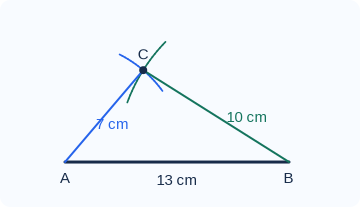
Design triangle ABC with AB = 13 cm, AC = 7 cm and BC = 10 cm.

  1. If you draw AB first, set the compass at A. What radius will trace the possible positions of C?

    [2]
  2. Describe the straightedge-and-compass construction.

    [2]
  1. (a) All points at the correct distance from A sit on its compass arc. Use AC as the radius.

  2. 77 cm

  3. (b) The arc intersection lies at both of the required distances. Either side of AB gives a mirror-image construction.

  4. Draw AB of length 13 cm. From A draw an arc with radius 7 cm. From B draw an arc with radius 10 cm. Label an arc intersection C, then join A and B to C.

    Draw base AB 13 cm, an arc of radius 7 cm from A and an arc of radius 10 cm from B. Join their intersection C to A and B.

Your turn

Design triangle ABC with AB = 13 cm, AC = 9 cm and BC = 8 cm.

If you draw AB first, set the compass at A. What radius will trace the possible positions of C?

Enter one number. Fractions and decimals are accepted.

Worked example

Construct a triangle from three lengths

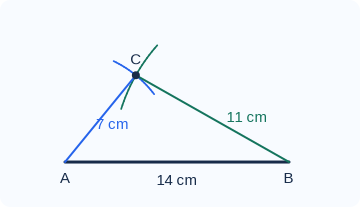
Design triangle ABC with AB = 14 cm, AC = 7 cm and BC = 11 cm.

  1. If you draw AB first, set the compass at A. What radius will trace the possible positions of C?

    [2]
  2. Describe the straightedge-and-compass construction.

    [2]

Try it on paper first.

  1. (a) All points at the correct distance from A sit on its compass arc. Use AC as the radius.

  2. 77 cm

  3. (b) The arc intersection lies at both of the required distances. Either side of AB gives a mirror-image construction.

  4. Draw AB of length 14 cm. From A draw an arc with radius 7 cm. From B draw an arc with radius 11 cm. Label an arc intersection C, then join A and B to C.

    Draw base AB 14 cm, an arc of radius 7 cm from A and an arc of radius 11 cm from B. Join their intersection C to A and B.

Your turn

Design triangle ABC with AB = 14 cm, AC = 9 cm and BC = 9 cm.

If you draw AB first, set the compass at A. What radius will trace the possible positions of C?

Enter one number. Fractions and decimals are accepted.

Section 3 of 3 · Core · about 8 min

How do equal distances help me bisect?

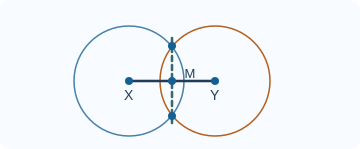
Compass arcs can locate a point which is equally far from two endpoints.

Matching compass circles for a perpendicular bisector

The two crossing points are equally far from X and Y. Joining the crossings creates the perpendicular bisector.

Worked example

Find angle and segment bisectors

An angle is 106°. A separate segment XY is 8 cm long.

  1. How many degrees are between the angle bisector and either arm?

    [2]
  2. Describe how to construct the perpendicular bisector of XY.

    [2]
  3. Describe how to construct the angle bisector.

    [2]
  1. (a) A bisector makes two equal angles. Halve the given angle.

  2. 5353 degrees

  3. (b) Both arc crossings are the same distance from X and Y. The line through them meets XY at its midpoint and at a right angle.

  4. Make two matching arcs from X and Y, with the same compass opening greater than half XY. Join the intersections of the arcs.

  5. (c) The first two cuts are equally far from the vertex, and the new crossing is equally far from both cuts.

  6. From the vertex, draw one arc cutting both arms. Use each crossing as a centre for a pair of arcs of equal radius. Join the vertex to the interior crossing of these new arcs.

Your turn

An angle is 48°. A separate segment XY is 10 cm long.

How many degrees are between the angle bisector and either arm?

Enter the angle in degrees.

Worked example

Find angle and segment bisectors

An angle is 108°. A separate segment XY is 8 cm long.

  1. How many degrees are between the angle bisector and either arm?

    [2]
  2. Describe how to construct the perpendicular bisector of XY.

    [2]
  3. Describe how to construct the angle bisector.

    [2]

Try it on paper first.

  1. (a) A bisector makes two equal angles. Halve the given angle.

  2. 5454 degrees

  3. (b) Both arc crossings are the same distance from X and Y. The line through them meets XY at its midpoint and at a right angle.

  4. Make two matching arcs from X and Y, with the same compass opening greater than half XY. Join the intersections of the arcs.

  5. (c) The first two cuts are equally far from the vertex, and the new crossing is equally far from both cuts.

  6. From the vertex, draw one arc cutting both arms. Use each crossing as a centre for a pair of arcs of equal radius. Join the vertex to the interior crossing of these new arcs.

Your turn

An angle is 50°. A separate segment XY is 10 cm long.

How many degrees are between the angle bisector and either arm?

Enter the angle in degrees.

Worked examples

Practise the method

Core practice

Question 1 of 12

0 / 12 checked in this collection

Question list

Core practice

Fresh variants

Exam-style

Find the midpoint of a segment

1 mark

Points P and Q are (−8,−10)(-8,-10) and (16,14)(16,14).

Find the coordinates of the midpoint M.

Enter a point as (1, 2) or x = 1, y = 2. Separate complete pairs with commas or semicolons.

Full answer-format guide

Exact numbers: 3/2, sqrt(5), 2-sqrt(3), pi/6, 3*pi/2. Sets: {1,4}. Intervals: (3,5]; a round bracket excludes the endpoint. Infinity: inf; union: U; no solutions: empty. Separate coordinate pairs or triples with semicolons. Expressions: 2x^2+3x-1; equations: x^2=3x+1 or the polynomial equal to zero. Factors: x-1 ; x+2. Parameter fraction: numerator ; denominator. List integer answers individually.

Review the method

Progress stays in this browser. Create an account to save it or sign in.

Extra practice from this lesson

Points P and Q are (−6,−5)(-6,-5) and (8,9)(8,9).

Find the coordinates of the midpoint M.

Enter a point as (1, 2) or x = 1, y = 2. Separate complete pairs with commas or semicolons.

Points P and Q are (−7,−5)(-7,-5) and (9,9)(9,9).

Find the coordinates of the midpoint M.

Enter a point as (1, 2) or x = 1, y = 2. Separate complete pairs with commas or semicolons.

Design triangle ABC with AB = 13 cm, AC = 11 cm and BC = 6 cm.

If you draw AB first, set the compass at A. What radius will trace the possible positions of C?

Enter one number. Fractions and decimals are accepted.

Design triangle ABC with AB = 14 cm, AC = 11 cm and BC = 7 cm.

If you draw AB first, set the compass at A. What radius will trace the possible positions of C?

Enter one number. Fractions and decimals are accepted.

An angle is 88°. A separate segment XY is 10 cm long.

How many degrees are between the angle bisector and either arm?

Enter the angle in degrees.

An angle is 90°. A separate segment XY is 10 cm long.

How many degrees are between the angle bisector and either arm?

Enter the angle in degrees.

Apply it · original exam-style problems

Show your working on paper and compare it with the worked solution and marking guidance.

Come back to what needs practice

Quick revision sheet (A4)

Your review plan starts after your first check.