Maths4UBETA

Calculating with fractions and mixed numbers

Add mixed numbers and make sense of multiplying and dividing proper fractions.

Try the quick check →
Lesson 3 of 4

Section 1 of 4 · Core · about 8 min

How do we add mixed numbers?

A mixed number shows some whole objects and part of another. When two small parts are added, they may make an extra whole.

Worked example

Add mixed lengths and regroup

Two shelves measure 2342\frac{3}{4} m and 1231\frac{2}{3} m. Find their combined length.

  1. The whole parts give 2+1=32+1=3 m. Use twelfths for the fractions.

  2. 34+23=912+812=1712\frac{3}{4}+\frac{2}{3}=\frac{9}{12}+\frac{8}{12}=\frac{17}{12} m.

  3. 1712=1512\frac{17}{12}=1\frac{5}{12} m. The total is 45124\frac{5}{12} m.

Your turn

Two pieces of rope are 116711\frac{6}{7} m and 1671\frac{6}{7} m long.

Add the lengths. Give a mixed number in its simplest form.

Total length in metres

Enter the mixed number with the fractional part in simplest form.

Worked example

Check a mixed-number total without regrouping

Sam walks 3143\frac{1}{4} km in the morning and 2162\frac{1}{6} km in the afternoon. Will the total reach 6 km?

Try it on paper first.

  1. The whole parts give 5 km. Rewrite the fractions in twelfths. 312+212=512\frac{3}{12}+\frac{2}{12}=\frac{5}{12}.

  2. The total is 55125\frac{5}{12} km, so Sam does not reach 6 km.

Your turn

Two pieces of rope are 127812\frac{7}{8} m and 1671\frac{6}{7} m long.

Add the lengths. Give a mixed number in its simplest form.

Total length in metres

Enter the mixed number with the fractional part in simplest form.

Section 2 of 4 · Core · about 8 min

What does a fraction of a fraction look like?

A fraction of a quantity means a part of it. When the quantity is already a fraction, draw the first part and then shade part of that part.
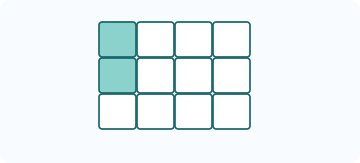
A three-by-four grid with two shaded cells in one column

Take one quarter of the full grid. Two thirds of that column covers two of the twelve cells.

Worked example

Read a fraction of a shaded strip

A quarter of a strip is marked. Two thirds of the marked part is painted. Find the fraction of the whole strip that is painted.

  1. Split the strip into four quarters and each quarter into three equal cells. The strip has 12 cells altogether.

  2. Two cells are painted. This is 212=16\frac{2}{12}=\frac{1}{6} of the strip.

Your turn

Use the fractions 15\frac{1}{5} and 12\frac{1}{2}. A pupil reads the first fraction of a whole book and annotates the second fraction of the part read.

Work out 15×12\frac{1}{5}\times \frac{1}{2}.

Enter an exact value or round to 3 significant figures.

Worked example

Cancel factors before multiplying

A full batch needs 38\frac{3}{8} kg of oats. Find the amount for 23\frac{2}{3} of a batch.

Try it on paper first.

  1. Use 23×38\frac{2}{3}\times\frac{3}{8}. The matching factor 3 in a numerator and denominator cancels.

  2. 28=14\frac{2}{8}=\frac{1}{4} kg. A smaller batch needs less than 38\frac{3}{8} kg.

Your turn

Use the fractions 12\frac{1}{2} and 12\frac{1}{2}. A pupil reads the first fraction of a whole book and annotates the second fraction of the part read.

Work out 12×12\frac{1}{2}\times \frac{1}{2}.

Enter an exact value or round to 3 significant figures.

Section 3 of 4 · Core · about 8 min

What does division by a fraction count?

In a measurement question, division can ask how many equal-length pieces fit into a given length. The count of pieces can be larger than the starting number of metres.

Worked example

Count equal groups with sixths

A bag holds 23\frac{2}{3} kg of seeds. A packet holds 16\frac{1}{6} kg. How many packets can be filled?

  1. Write 23=46\frac{2}{3}=\frac{4}{6} kg. Each packet takes one sixth, so four packets can be filled.

  2. The same calculation by the reciprocal method is 23×6=4\frac{2}{3}\times6=4.

Your turn

Use the fractions 27\frac{2}{7} and 13\frac{1}{3}. The first fraction is a measured ribbon length in metres. The second is the length of one unit on a model plan.

Work out 27÷13\frac{2}{7}\div \frac{1}{3}.

Enter an exact value or round to 3 significant figures.

Worked example

Read a quotient that includes part of a group

A board is 34\frac{3}{4} m long. How many half-metre lengths is that, counting part of a length?

Try it on paper first.

  1. One half metre is two quarters of a metre. Three quarters is one such length and half of another.

  2. Calculate 34÷12=34×2=32\frac{3}{4}\div\frac{1}{2}=\frac{3}{4}\times2=\frac32. The answer is one and a half lengths.

Your turn

Use the fractions 14\frac{1}{4} and 13\frac{1}{3}. The first fraction is a measured ribbon length in metres. The second is the length of one unit on a model plan.

Work out 14÷13\frac{1}{4}\div \frac{1}{3}.

Enter an exact value or round to 3 significant figures.

Section 4 of 4 · Core · about 8 min

When is it easier to cancel first?

Look at what surrounds the brackets before you choose a method. A number outside a bracket multiplies every term inside.

Worked example

Distribute to cancel denominators

Work out 12(38+16)12\left(\frac{3}{8}+\frac{1}{6}\right).

  1. Multiply both terms by 12. 12×38=9212\times\frac{3}{8}=\frac92 and 12×16=212\times\frac{1}{6}=2.

  2. Add the two products. 92+2=132\frac92+2=\frac{13}{2}.

Your turn

The expression is 7×(47+3)7\times\left(\frac{4}{7}+3\right).

Work out the exact value.

Enter one number. Fractions and decimals are accepted.

Worked example

Add first when the fractions make a whole

Work out 7(59+49)7\left(\frac{5}{9}+\frac{4}{9}\right).

Try it on paper first.

  1. The pieces are already ninths. Inside the bracket, 59+49=99=1\frac{5}{9}+\frac{4}{9}=\frac99=1.

  2. Multiply by 7 to get 7. In this case, adding inside first is the quicker route.

Your turn

The expression is 8×(12+114)8\times\left(\frac{1}{2}+\frac{11}{4}\right).

Work out the exact value.

Enter one number. Fractions and decimals are accepted.

Worked examples

Practise the method

Core practice

Question 1 of 12

0 / 12 checked in this collection

Question list

Core practice

Fresh variants

Exam-style

Combining two mixed lengths

1 mark

Two pieces of rope are 7677\frac{6}{7} m and 8238\frac{2}{3} m long.

Add the lengths. Give a mixed number in its simplest form.

Total length in metres

Enter the mixed number with the fractional part in simplest form.

Full answer-format guide

Exact numbers: 3/2, sqrt(5), 2-sqrt(3), pi/6, 3*pi/2. Sets: {1,4}. Intervals: (3,5]; a round bracket excludes the endpoint. Infinity: inf; union: U; no solutions: empty. Separate coordinate pairs or triples with semicolons. Expressions: 2x^2+3x-1; equations: x^2=3x+1 or the polynomial equal to zero. Factors: x-1 ; x+2. Parameter fraction: numerator ; denominator. List integer answers individually.

Review the method

Progress stays in this browser. Create an account to save it or sign in.

Extra practice from this lesson

Two pieces of rope are 5895\frac{8}{9} m and 210112\frac{10}{11} m long.

Add the lengths. Give a mixed number in its simplest form.

Total length in metres

Enter the mixed number with the fractional part in simplest form.

Two pieces of rope are 69106\frac{9}{10} m and 210112\frac{10}{11} m long.

Add the lengths. Give a mixed number in its simplest form.

Total length in metres

Enter the mixed number with the fractional part in simplest form.

Use the fractions 13\frac{1}{3} and 14\frac{1}{4}. A pupil reads the first fraction of a whole book and annotates the second fraction of the part read.

Work out 13×14\frac{1}{3}\times \frac{1}{4}.

Enter an exact value or round to 3 significant figures.

Use the fractions 14\frac{1}{4} and 29\frac{2}{9}. A pupil reads the first fraction of a whole book and annotates the second fraction of the part read.

Work out 14×29\frac{1}{4}\times \frac{2}{9}.

Enter an exact value or round to 3 significant figures.

Use the fractions 25\frac{2}{5} and 313\frac{3}{13}. The first fraction is a measured ribbon length in metres. The second is the length of one unit on a model plan.

Work out 25÷313\frac{2}{5}\div \frac{3}{13}.

Enter an exact value or round to 3 significant figures.

Use the fractions 16\frac{1}{6} and 313\frac{3}{13}. The first fraction is a measured ribbon length in metres. The second is the length of one unit on a model plan.

Work out 16÷313\frac{1}{6}\div \frac{3}{13}.

Enter an exact value or round to 3 significant figures.

The expression is 8×(12+3)8\times\left(\frac{1}{2}+3\right).

Work out the exact value.

Enter one number. Fractions and decimals are accepted.

The expression is 9×(49+259)9\times\left(\frac{4}{9}+\frac{25}{9}\right).

Work out the exact value.

Enter one number. Fractions and decimals are accepted.

Find 235+17102\frac35+1\frac7{10} metres. Give a mixed number.

Total length in metres

Enter the whole number and the fractional part.

A bottle holding 35\frac{3}{5} litre fills cups that each hold 110\frac{1}{10} litre. How many full cups can it fill?

Enter the whole-number count.

Apply it · original exam-style problems

Show your working on paper and compare it with the worked solution and marking guidance.

Come back to what needs practice

Quick revision sheet (A4)

Your review plan starts after your first check.