Maths4UBETA

Averages and the range

Calculate the mean, median, mode and range, and choose a summary that fits the question.

Try the quick check →
Lesson 5 of 5

Section 1 of 4 · Core · about 8 min

How can we share a total equally?

Add all observations and imagine redistributing the total equally among them.

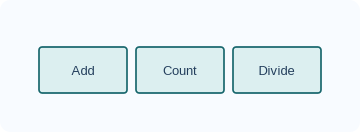
Add, Count, Divide

The mean is the amount each would get if the total were shared equally.

Worked example

Summarising five measurements

Five sensor readings are 22, 9, 7, 11, 9.

  1. Find the mean.

    [2]
  2. Explain how the mean would change if the largest value rose by 5.

    [2]
  1. (a) Add all five values. The sum is 58.

  2. Divide the sum by the count, 5.

  3. 585\frac{58}{5}.

  4. (b) Think about which positions or counts each summary uses.

  5. The sum goes up by 5 and there are still 5 values, so the mean goes up by 1.

Your turn

Five sensor readings are 42, 29, 27, 31, 29.

Find the mean.

Enter an exact value or round to 3 significant figures.

Worked example

Summarising five measurements

Five sensor readings are 23, 10, 8, 12, 10.

  1. Find the mean.

    [2]
  2. Explain how the mean would change if the largest value rose by 5.

    [2]

Try it on paper first.

  1. (a) Add all five values. The sum is 63.

  2. Divide the sum by the count, 5.

  3. 635\frac{63}{5}.

  4. (b) Think about which positions or counts each summary uses.

  5. The sum goes up by 5 and there are still 5 values, so the mean goes up by 1.

Your turn

Five sensor readings are 43, 30, 28, 32, 30.

Find the mean.

Enter an exact value or round to 3 significant figures.

Section 2 of 4 · Core · about 8 min

Which number is in the middle?

Sort the values first. The median sits in the middle position. For two central values, use their mean.

Worked example

Summarising five measurements

Five sensor readings are 35, 22, 20, 24, 22.

  1. Find the median.

    [2]
  2. Would the median change if the largest value increased? Explain.

    [2]
  1. (a) Put the readings in order: 20, 22, 22, 24, 35.

  2. Read the third value out of five.

  3. 2222.

  4. (b) Think about which positions or counts each summary uses.

  5. No. The third value stays the same when only the largest value increases.

Your turn

Five sensor readings are 62, 43, 40, 46, 43.

Find the median.

Enter one number. Fractions and decimals are accepted.

Worked example

Summarising five measurements

Five sensor readings are 36, 23, 21, 25, 23.

  1. Find the median.

    [2]
  2. Would the median change if the largest value increased? Explain.

    [2]

Try it on paper first.

  1. (a) Put the readings in order: 21, 23, 23, 25, 36.

  2. Read the third value out of five.

  3. 2323.

  4. (b) Think about which positions or counts each summary uses.

  5. No. The third value stays the same when only the largest value increases.

Your turn

Five sensor readings are 63, 44, 41, 47, 44.

Find the median.

Enter one number. Fractions and decimals are accepted.

Section 3 of 4 · Core · about 8 min

Do we need the most common value or the spread?

Use the mode to name the most frequent value or category. Use the range to say how far apart the extreme values are.

Worked example

Summarising five measurements

Five sensor readings are 48, 35, 33, 37, 35.

  1. Find the range.

    [2]
  2. Find the mode and explain how the mode and range describe different features of the data.

    [2]
  1. (a) The greatest value is 48 and the smallest is 33.

  2. Subtract 33 from 48.

  3. 1515.

  4. (b) Think about which positions or counts each summary uses.

  5. The mode is 35, the most frequent value. The range is 15, the gap from the smallest to the largest value.

Your turn

Five sensor readings are 37, 18, 15, 21, 18.

Find the range.

Enter one number. Fractions and decimals are accepted.

Worked example

Summarising five measurements

Five sensor readings are 49, 36, 34, 38, 36.

  1. Find the range.

    [2]
  2. Find the mode and explain how the mode and range describe different features of the data.

    [2]

Try it on paper first.

  1. (a) The greatest value is 49 and the smallest is 34.

  2. Subtract 34 from 49.

  3. 1515.

  4. (b) Think about which positions or counts each summary uses.

  5. The mode is 36, the most frequent value. The range is 15, the gap from the smallest to the largest value.

Your turn

Five sensor readings are 38, 19, 16, 22, 19.

Find the range.

Enter one number. Fractions and decimals are accepted.

Section 4 of 4 · Core · about 8 min

How can a frequency table help us summarise many values?

Read a row as the same value repeated for the given number of people or trials.

Worked example

Finding an average from a larger set

A club records completed rounds for 55 players. Every player belongs in one table row.

Count per playerPlayers
319
412
524
  1. Find the mean number of completed rounds.

    [2]
  2. Identify the mode or modes. Explain when the mode is helpful.

    [2]
  1. (a) For each row multiply rounds per player by the number of players.

  2. Add these results for 225 rounds in total. Divide by the 55 players.

  3. 4511\frac{45}{11}.

  4. (b) The highest frequency is 24.

  5. The most common round count is 5. The mode helps when you want to name a usual count that actually occurred.

Your turn

A club records completed rounds for 52 players. Every player belongs in one table row.

Count per playerPlayers
714
813
925

Find the mean number of completed rounds.

Enter an exact value or round to 3 significant figures.

Worked example

Finding an average from a larger set

A club records completed rounds for 57 players. Every player belongs in one table row.

Count per playerPlayers
420
512
625
  1. Find the mean number of completed rounds.

    [2]
  2. Identify the mode or modes. Explain when the mode is helpful.

    [2]

Try it on paper first.

  1. (a) For each row multiply rounds per player by the number of players.

  2. Add these results for 290 rounds in total. Divide by the 57 players.

  3. 29057\frac{290}{57}.

  4. (b) The highest frequency is 25.

  5. The most common round count is 6. The mode helps when you want to name a usual count that actually occurred.

Your turn

A club records completed rounds for 54 players. Every player belongs in one table row.

Count per playerPlayers
815
913
1026

Find the mean number of completed rounds.

Enter an exact value or round to 3 significant figures.

Worked examples

Practise the method

Core practice

Question 1 of 12

0 / 12 checked in this collection

Question list

Core practice

Fresh variants

Exam-style

Summarising five measurements

1 mark

Five sensor readings are 74, 19, 10, 28, 19.

Find the mean.

Enter one number. Fractions and decimals are accepted.

Full answer-format guide

Exact numbers: 3/2, sqrt(5), 2-sqrt(3), pi/6, 3*pi/2. Sets: {1,4}. Intervals: (3,5]; a round bracket excludes the endpoint. Infinity: inf; union: U; no solutions: empty. Separate coordinate pairs or triples with semicolons. Expressions: 2x^2+3x-1; equations: x^2=3x+1 or the polynomial equal to zero. Factors: x-1 ; x+2. Parameter fraction: numerator ; denominator. List integer answers individually.

Review the method

Progress stays in this browser. Create an account to save it or sign in.

Extra practice from this lesson

Five sensor readings are 31, 12, 9, 15, 12.

Find the mean.

Enter an exact value or round to 3 significant figures.

Five sensor readings are 32, 13, 10, 16, 13.

Find the mean.

Enter an exact value or round to 3 significant figures.

Five sensor readings are 44, 25, 22, 28, 25.

Find the median.

Enter one number. Fractions and decimals are accepted.

Five sensor readings are 45, 26, 23, 29, 26.

Find the median.

Enter one number. Fractions and decimals are accepted.

Five sensor readings are 64, 39, 35, 43, 39.

Find the range.

Enter one number. Fractions and decimals are accepted.

Five sensor readings are 65, 40, 36, 44, 40.

Find the range.

Enter one number. Fractions and decimals are accepted.

A club records completed rounds for 48 players. Every player belongs in one table row.

Count per playerPlayers
39
413
526

Find the mean number of completed rounds.

Enter an exact value or round to 3 significant figures.

A club records completed rounds for 50 players. Every player belongs in one table row.

Count per playerPlayers
410
513
627

Find the mean number of completed rounds.

Enter an exact value or round to 3 significant figures.

Apply it · original exam-style problems

Show your working on paper and compare it with the worked solution and marking guidance.

Come back to what needs practice

Quick revision sheet (A4)

Your review plan starts after your first check.