Maths4UBETA

Velocity, drift and collisions

Combine or resolve constant velocities and decide whether moving objects reach the same position at the same time.

Try the quick check →
Lesson 5 of 5

Section 1 of 3 · Lesson · about 8 min

Which two velocities should I add?

Practise the method

Draw a path between reference frames. First follow the object's movement through the water, then the movement of the water over the ground. The signed components show which direction the current helps and which direction it opposes. Work backwards by subtracting the current when the desired ground velocity is specified. The magnitude of the resulting velocity is its speed, if asked.

Worked example

Combine velocities relative to different frames

A boat moves at (34)\begin{pmatrix}3\\4\end{pmatrix} relative to water, and the current is (1−1)\begin{pmatrix}1\\-1\end{pmatrix} relative to land. Both are measured in metres per second. Find the velocity relative to land.

  1. Follow the frames in order. Add the boat's velocity through the water to the water's velocity relative to land.

  2. vland=(3+14−1)=(43) m s−1.\mathbf v_{\mathrm{land}}=\begin{pmatrix}3+1\\4-1\end{pmatrix}=\begin{pmatrix}4\\3\end{pmatrix}\ \mathrm{m\,s^{-1}}.

  3. The current increases the horizontal component and decreases the vertical one.
Your turn

A survey buoy has velocity (11−88)\begin{pmatrix}11\\-88\end{pmatrix} relative to the water. The water flows at (−282)\begin{pmatrix}-2\\82\end{pmatrix} relative to the ground. Both are in m s−1\mathrm{m\,s^{-1}}. Find the ground velocity.

Enter the horizontal and vertical components in order, or use i and j.

Worked example

Work backwards from the desired ground velocity

A boat needs ground velocity (41)\begin{pmatrix}4\\1\end{pmatrix}. The current is (1−2)\begin{pmatrix}1\\-2\end{pmatrix}. Both are measured in metres per second. Find the required velocity relative to water.

Try it on paper first.

  1. Ground velocity is the result after adding the current. Subtract the current to undo that addition.

  2. vwater=(4−11−(−2))=(33) m s−1.\mathbf v_{\mathrm{water}}=\begin{pmatrix}4-1\\1-(-2)\end{pmatrix}=\begin{pmatrix}3\\3\end{pmatrix}\ \mathrm{m\,s^{-1}}.

  3. Add the current back to check that the ground velocity is the intended one.

Your turn

A floating instrument needs ground velocity (2−5)\begin{pmatrix}2\\-5\end{pmatrix}. Its current has velocity (186)\begin{pmatrix}1\\86\end{pmatrix}. All velocities are in m s−1\mathrm{m\,s^{-1}}. Find the required velocity relative to the water.

Enter the horizontal and vertical components in order, or use i and j.

Section 2 of 3 · Lesson · about 8 min

How do I reach a position after a time?

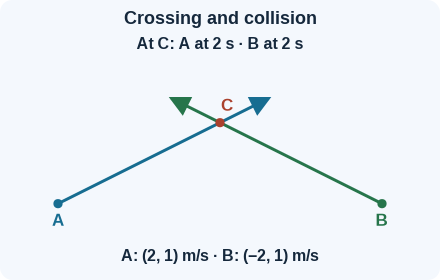
Blue route starts at A and green route starts at B at t = 0. They reach C at 2 and 2 seconds respectively.

At t=0t=0 the robots are at A=(1,1)A=(1,1) and B=(9,1)B=(9,1). Both reach C=(5,3)C=(5,3) after 2 seconds.

Practise the method

Check the units first. In m s−1\mathrm{m\,s^{-1}}, multiply by the time in seconds to get a displacement in metres. To compare two moving objects, use the time measured from the same instant. Read across the columns to get the equation in each coordinate. Use the row with a non-zero difference in velocities to identify the candidate collision time.

Worked example

Turn a ground velocity into a displacement

A boat starts at (12)\begin{pmatrix}1\\2\end{pmatrix} metres. Its velocity through the water is (21)\begin{pmatrix}2\\1\end{pmatrix} and the current is (−11)\begin{pmatrix}-1\\1\end{pmatrix} metres per second. Find its position after 3 seconds.

  1. The ground velocity is (12)\begin{pmatrix}1\\2\end{pmatrix} metres per second.

  2. Multiply by 3 seconds to get displacement (36)\begin{pmatrix}3\\6\end{pmatrix} metres.

  3. Add this to the start position. The position is (48)\begin{pmatrix}4\\8\end{pmatrix} metres.

Your turn

A raft starts at (810)\begin{pmatrix}81\\0\end{pmatrix} metres. Its velocity relative to the water is (3−93)\begin{pmatrix}3\\-93\end{pmatrix} and the current is (087)\begin{pmatrix}0\\87\end{pmatrix} in m s−1\mathrm{m\,s^{-1}}. Find the position after 9 seconds.

Enter the horizontal and vertical components in order, or use i and j.

Worked example

Find the common arrival time

Two robots start at (11)\begin{pmatrix}1\\1\end{pmatrix} and (91)\begin{pmatrix}9\\1\end{pmatrix} metres, with constant velocities (21)\begin{pmatrix}2\\1\end{pmatrix} and (−21)\begin{pmatrix}-2\\1\end{pmatrix} metres per second. When do they meet?

Try it on paper first.

  1. At the same time t, their horizontal positions are 1+2t1+2t and 9−2t9-2t.

  2. Equate them. 1+2t=9−2t1+2t=9-2t gives 4t=84t=8, so t=2t=2.

  3. Both vertical positions equal 1+t1+t, so they also agree at 2 seconds.

Your turn

Two inspection robots have initial positions (85−4)\begin{pmatrix}85\\-4\end{pmatrix} m and (121−121)\begin{pmatrix}121\\-121\end{pmatrix} m. Their constant velocities are (7−5)\begin{pmatrix}7\\-5\end{pmatrix} and (38)\begin{pmatrix}3\\8\end{pmatrix} m s−1\mathrm{m\,s^{-1}} respectively. After how many seconds do they meet?

Enter the whole-number count.

Section 3 of 3 · Lesson · about 8 min

When is a crossing a collision?

Practise the method

Solve the two component equations independently when both relative velocity components are non-zero. If the candidate times differ, the routes cross at different times or they do not meet. If a component has equal velocities, compare initial positions for that coordinate. Equal starts make that equation true for all times. Unequal starts make a meeting impossible.

Worked example

Find the point of contact

Two robots start at (21)\begin{pmatrix}2\\1\end{pmatrix} and (76)\begin{pmatrix}7\\6\end{pmatrix} metres, with constant velocities (12)\begin{pmatrix}1\\2\end{pmatrix} and (−4−3)\begin{pmatrix}-4\\-3\end{pmatrix} metres per second. Where do they meet?

  1. Use 2+t=7−4t2+t=7-4t to find t=1t=1. The vertical expressions agree because 1+2(1)=6−3(1)=31+2(1)=6-3(1)=3.

  2. Substitute into either whole position vector. The meeting position is (33)\begin{pmatrix}3\\3\end{pmatrix} metres.

Your turn

Two inspection robots have initial positions (86−5)\begin{pmatrix}86\\-5\end{pmatrix} m and (126−155)\begin{pmatrix}126\\-155\end{pmatrix} m. Their constant velocities are (8−6)\begin{pmatrix}8\\-6\end{pmatrix} and (49)\begin{pmatrix}4\\9\end{pmatrix} m s−1\mathrm{m\,s^{-1}} respectively. Find their meeting position.

Enter the horizontal and vertical components in order, or use i and j.

Worked example

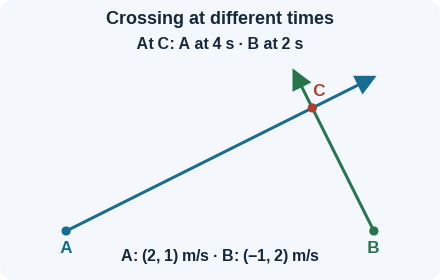
Same crossing, different arrival times

Two robots start at (00)\begin{pmatrix}0\\0\end{pmatrix} and (100)\begin{pmatrix}10\\0\end{pmatrix} metres, with constant velocities (21)\begin{pmatrix}2\\1\end{pmatrix} and (−12)\begin{pmatrix}-1\\2\end{pmatrix} metres per second. Their routes cross at (8,4)(8,4). Do the robots collide?

Try it on paper first.

  1. Robot A reaches that point when 2t=82t=8, so it arrives after 4 seconds.

  2. Robot B reaches it when 10−t=810-t=8, so it arrives after 2 seconds.

  3. A collision must occur at a shared point and a shared time. The arrival times differ.

  4. Blue route starts at A and green route starts at B at t = 0. They reach C at 4 and 2 seconds respectively.

Your turn

Two robots start at (00)\begin{pmatrix}0\\0\end{pmatrix} and (60)\begin{pmatrix}6\\0\end{pmatrix} metres, with constant velocities (11)\begin{pmatrix}1\\1\end{pmatrix} and (−12)\begin{pmatrix}-1\\2\end{pmatrix} metres per second. Their routes cross at (4,4)(4,4). Do they arrive together?

Choose one answer

Your turn

Two inspection robots have initial positions (90−9)\begin{pmatrix}90\\-9\end{pmatrix} m and (230−163)\begin{pmatrix}230\\-163\end{pmatrix} m. Their constant velocities are (12−5)\begin{pmatrix}12\\-5\end{pmatrix} and (26)\begin{pmatrix}2\\6\end{pmatrix} m s−1\mathrm{m\,s^{-1}} respectively. Do the robots meet after the timing starts?

Choose one answer

Worked examples

Practise the method

Core practice

Question 1 of 5

0 / 5 checked in this collection

Question list

Core practice

Fresh variants

Exam-style

Combine engine and current velocities

1 mark

A survey buoy has velocity (17−168)\begin{pmatrix}17\\-168\end{pmatrix} relative to the water. The water flows at (−5162)\begin{pmatrix}-5\\162\end{pmatrix} relative to the ground. Both are in m s−1\mathrm{m\,s^{-1}}. Find the ground velocity.

Enter the horizontal and vertical components in order, or use i and j.

Full answer-format guide

Exact numbers: 3/2, sqrt(5), 2-sqrt(3), pi/6, 3*pi/2. Sets: {1,4}. Intervals: (3,5]; a round bracket excludes the endpoint. Infinity: inf; union: U; no solutions: empty. Separate coordinate pairs or triples with semicolons. Expressions: 2x^2+3x-1; equations: x^2=3x+1 or the polynomial equal to zero. Factors: x-1 ; x+2. Parameter fraction: numerator ; denominator. List integer answers individually.

Review the method

Progress stays in this browser. Create an account to save it or sign in.

Extra practice from this lesson

Combine engine and current velocities

A survey buoy has velocity (12−107)\begin{pmatrix}12\\-107\end{pmatrix} relative to the water. The water flows at (−3104)\begin{pmatrix}-3\\104\end{pmatrix} relative to the ground. Both are in m s−1\mathrm{m\,s^{-1}}. Find the ground velocity.

Enter the horizontal and vertical components in order, or use i and j.

Choose a velocity that cancels the drift

A floating instrument needs ground velocity (5−6)\begin{pmatrix}5\\-6\end{pmatrix}. Its current has velocity (0122)\begin{pmatrix}0\\122\end{pmatrix}. All velocities are in m s−1\mathrm{m\,s^{-1}}. Find the required velocity relative to the water.

Enter the horizontal and vertical components in order, or use i and j.

Move a starting position for a fixed time

A raft starts at (103−3)\begin{pmatrix}103\\-3\end{pmatrix} metres. Its velocity relative to the water is (4−112)\begin{pmatrix}4\\-112\end{pmatrix} and the current is (−1109)\begin{pmatrix}-1\\109\end{pmatrix} in m s−1\mathrm{m\,s^{-1}}. Find the position after 7 seconds.

Enter the horizontal and vertical components in order, or use i and j.

Find when two moving objects meet

Two inspection robots have initial positions (121−2)\begin{pmatrix}121\\-2\end{pmatrix} m and (205−182)\begin{pmatrix}205\\-182\end{pmatrix} m. Their constant velocities are (10−6)\begin{pmatrix}10\\-6\end{pmatrix} and (39)\begin{pmatrix}3\\9\end{pmatrix} m s−1\mathrm{m\,s^{-1}} respectively. After how many seconds do they meet?

Enter the whole-number count.

Locate the meeting point

Two inspection robots have initial positions (108−8)\begin{pmatrix}108\\-8\end{pmatrix} m and (168−68)\begin{pmatrix}168\\-68\end{pmatrix} m. Their constant velocities are (8−3)\begin{pmatrix}8\\-3\end{pmatrix} and (23)\begin{pmatrix}2\\3\end{pmatrix} m s−1\mathrm{m\,s^{-1}} respectively. Find their meeting position.

Enter the horizontal and vertical components in order, or use i and j.

Decide whether two moving objects meet

Two inspection robots have initial positions (126−7)\begin{pmatrix}126\\-7\end{pmatrix} m and (138−85)\begin{pmatrix}138\\-85\end{pmatrix} m. Their constant velocities are (4−6)\begin{pmatrix}4\\-6\end{pmatrix} and (27)\begin{pmatrix}2\\7\end{pmatrix} m s−1\mathrm{m\,s^{-1}} respectively. Do the robots meet after the timing starts?

Choose one answer

Apply it · original exam-style problems

Show your working on paper and compare it with the worked solution and marking guidance.

Come back to what needs practice

Quick revision sheet (A4)

Your review plan starts after your first check.