Maths4UBETA

Domain and range

Find the complete set of legal inputs and outputs for square-root and reciprocal functions.

Try the quick check →
Lesson 2 of 7

Section 1 of 3 · Lesson · about 8 min

Which inputs make a real square root?

Locate the expression underneath the root sign. Its value must be at least zero.

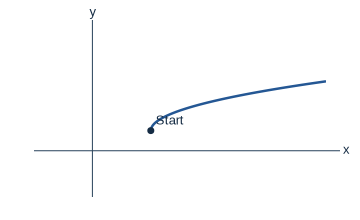
The square-root curve starts at one point and goes right and up.

The square-root curve starts at one point and goes right and up.

Worked example

Find all allowed inputs and outputs

Consider the real-valued function f(x)=2x−2−2f(x)=\sqrt{2 x - 2} - 2 on its largest possible real domain.

State the domain of the function.

  1. Make the expression inside the square root non-negative.

  2. The radicand is zero at the left endpoint, so the endpoint is included.

  3. Final answer: x≥1x\ge 1.

Your turn

Consider the real-valued function f(x)=4x−16+3f(x)=\sqrt{4 x - 16} + 3 on its largest possible real domain.

State the domain of the function.

Give the complete set: {1, 4} for separate values, (1, 5] for an interval, U for union or empty for no real solutions. Use sqrt(...) for exact roots.

Worked example

Find all allowed inputs and outputs

Consider the real-valued function f(x)=3x−3−1f(x)=\sqrt{3 x - 3} - 1 on its largest possible real domain.

State the domain of the function.

Try it on paper first.

  1. Make the expression inside the square root non-negative.

  2. The radicand is zero at the left endpoint, so the endpoint is included.

  3. Final answer: x≥1x\ge 1.

Your turn

Consider the real-valued function f(x)=5x−20−3f(x)=\sqrt{5 x - 20} - 3 on its largest possible real domain.

State the domain of the function.

Give the complete set: {1, 4} for separate values, (1, 5] for an interval, U for union or empty for no real solutions. Use sqrt(...) for exact roots.

Section 2 of 3 · Lesson · about 8 min

What changes when a square root is subtracted?

Track how its input changes from zero to large positive values. Multiplying a result by a negative number reverses its order.

Worked example

Find all allowed inputs and outputs

Consider the real-valued function f(x)=2−x−2f(x)=2 - \sqrt{x - 2} on its largest possible real domain.

Find the range of the function.

  1. Use the limiting or extreme values of the output.

  2. Subtracting a non-negative square-root value from 22 gives a maximum of 22.

  3. Final answer: y≤2y\le 2.

Your turn

Consider the real-valued function f(x)=−3x−5f(x)=- 3 \sqrt{x - 5} on its largest possible real domain.

Find the range of the function.

Give the complete set: {1, 4} for separate values, (1, 5] for an interval, U for union or empty for no real solutions. Use sqrt(...) for exact roots.

Worked example

Find all allowed inputs and outputs

Consider the real-valued function f(x)=3−2x−2f(x)=3 - 2 \sqrt{x - 2} on its largest possible real domain.

Find the range of the function.

Try it on paper first.

  1. Use the limiting or extreme values of the output.

  2. Subtracting a non-negative square-root value from 33 gives a maximum of 33.

  3. Final answer: y≤3y\le 3.

Your turn

Consider the real-valued function f(x)=1−4x−5f(x)=1 - 4 \sqrt{x - 5} on its largest possible real domain.

Find the range of the function.

Give the complete set: {1, 4} for separate values, (1, 5] for an interval, U for union or empty for no real solutions. Use sqrt(...) for exact roots.

Section 3 of 3 · Lesson · about 8 min

Which input and output are missing from a reciprocal?

Check where the denominator is zero. Then ask which horizontal level the output approaches without reaching.

Worked example

Find all allowed inputs and outputs

Consider the real-valued function f(x)=−1+5x−3f(x)=-1 + \frac{5}{x - 3} on its largest possible real domain.

Find the range of the function.

  1. Use the limiting or extreme values of the output.

  2. The fraction cannot equal zero. Solving y=−1+5x−3y=-1 + \frac{5}{x - 3} for xx gives a real input for every y≠−1y\ne -1 .

  3. Final answer: y≠−1y\ne -1.

Your turn

Consider the real-valued function f(x)=−3+2x−6f(x)=-3 + \frac{2}{x - 6} on its largest possible real domain.

Find the range of the function.

Give the complete set: {1, 4} for separate values, (1, 5] for an interval, U for union or empty for no real solutions. Use sqrt(...) for exact roots.

Worked example

Find all allowed inputs and outputs

Consider the real-valued function f(x)=1x−3f(x)=\frac{1}{x - 3} on its largest possible real domain.

Find the range of the function.

Try it on paper first.

  1. Use the limiting or extreme values of the output.

  2. The fraction cannot equal zero. Solving y=1x−3y=\frac{1}{x - 3} for xx gives a real input for every y≠0y\ne 0 .

  3. Final answer: y≠0y\ne 0.

Your turn

Consider the real-valued function f(x)=−2+3x−6f(x)=-2 + \frac{3}{x - 6} on its largest possible real domain.

Find the range of the function.

Give the complete set: {1, 4} for separate values, (1, 5] for an interval, U for union or empty for no real solutions. Use sqrt(...) for exact roots.

Worked examples

Practise the method

Core practice

Question 1 of 5

0 / 5 checked in this collection

Question list

Core practice

Fresh variants

Exam-style

Find all allowed inputs and outputs

1 mark

Consider the real-valued function f(x)=3x−33−3f(x)=\sqrt{3 x - 33} - 3 on its largest possible real domain.

State the domain of the function.

Give the complete set: {1, 4} for separate values, (1, 5] for an interval, U for union or empty for no real solutions. Use sqrt(...) for exact roots.

Full answer-format guide

Exact numbers: 3/2, sqrt(5), 2-sqrt(3), pi/6, 3*pi/2. Sets: {1,4}. Intervals: (3,5]; a round bracket excludes the endpoint. Infinity: inf; union: U; no solutions: empty. Separate coordinate pairs or triples with semicolons. Expressions: 2x^2+3x-1; equations: x^2=3x+1 or the polynomial equal to zero. Factors: x-1 ; x+2. Parameter fraction: numerator ; denominator. List integer answers individually.

Review the method

Progress stays in this browser. Create an account to save it or sign in.

Extra practice from this lesson

Consider the real-valued function f(x)=3x−21+3f(x)=\sqrt{3 x - 21} + 3 on its largest possible real domain.

State the domain of the function.

Give the complete set: {1, 4} for separate values, (1, 5] for an interval, U for union or empty for no real solutions. Use sqrt(...) for exact roots.

Consider the real-valued function f(x)=4x−32−3f(x)=\sqrt{4 x - 32} - 3 on its largest possible real domain.

State the domain of the function.

Give the complete set: {1, 4} for separate values, (1, 5] for an interval, U for union or empty for no real solutions. Use sqrt(...) for exact roots.

Consider the real-valued function f(x)=−2x−8f(x)=- 2 \sqrt{x - 8} on its largest possible real domain.

Find the range of the function.

Give the complete set: {1, 4} for separate values, (1, 5] for an interval, U for union or empty for no real solutions. Use sqrt(...) for exact roots.

Consider the real-valued function f(x)=1−3x−9f(x)=1 - 3 \sqrt{x - 9} on its largest possible real domain.

Find the range of the function.

Give the complete set: {1, 4} for separate values, (1, 5] for an interval, U for union or empty for no real solutions. Use sqrt(...) for exact roots.

Consider the real-valued function f(x)=−3+1x−9f(x)=-3 + \frac{1}{x - 9} on its largest possible real domain.

Find the range of the function.

Give the complete set: {1, 4} for separate values, (1, 5] for an interval, U for union or empty for no real solutions. Use sqrt(...) for exact roots.

Consider the real-valued function f(x)=−2+2x−10f(x)=-2 + \frac{2}{x - 10} on its largest possible real domain.

Find the range of the function.

Give the complete set: {1, 4} for separate values, (1, 5] for an interval, U for union or empty for no real solutions. Use sqrt(...) for exact roots.

Apply it · original exam-style problems

Show your working on paper and compare it with the worked solution and marking guidance.

Come back to what needs practice

Quick revision sheet (A4)

Your review plan starts after your first check.