Maths4UBETA

The remainder theorem

Use evaluated remainders and two independent equations to recover coefficients.

Try the quick check →
Lesson 5 of 5

Section 1 of 3 · Lesson · about 8 min

Why does substitution give a remainder?

At the root of the divisor its product with the quotient is zero. The remainder is the only term left.

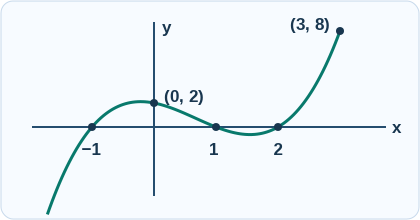
The cubic crosses the horizontal axis at negative 1, 1 and 2. Its y-intercept is 2. The point (3, 8) is also marked.

The zeros of P(x)=(x+1)(x−1)(x−2)P(x)=(x+1)(x-1)(x-2) are −1,1,2-1,1,2. A divisor whose zero is not a root leaves a non-zero remainder here.

Worked example

Read a remainder as a polynomial value

Let P(x)=(x+1)(x−1)(x−2)P(x)=(x+1)(x-1)(x-2). Find the remainders for divisors x−2x-2 and x−3x-3.

  1. Set the first divisor equal to zero. At x=2x=2, the factor x−2x-2 makes P(2)=0P(2)=0. The graph crosses the xx-axis there.

  2. The second divisor is zero at x=3x=3. The remainder is P(3)=4⋅2⋅1=8P(3)=4\cdot2\cdot1=8.

  3. Therefore x−2x-2 is a factor. Dividing by x−3x-3 leaves a remainder of 88.

Worked example

Use two remainders to determine two coefficients

Let P(x)=kx+m+2x3+3x2−8x+3P(x)=k x + m + 2 x^{3} + 3 x^{2} - 8 x + 3. The remainders on division by 2x+62 x + 6 and 3x−33 x - 3 are −4-4 and 44 respectively.

Find kk.

  1. Apply the remainder theorem to both divisors and subtract the two equations.

  2. Use −3k+m=−4-3k+m=-4 and 1k+m=41k+m=4.

  3. Final answer: 22.

Your turn

Let P(x)=kx+m+2x3+9x2−60x−32P(x)=k x + m + 2 x^{3} + 9 x^{2} - 60 x - 32. The remainders on division by 2x+162 x + 16 and 3x−123 x - 12 are −11-11 and 1313 respectively.

Find kk.

Enter one number. Fractions and decimals are accepted.

Worked example

Use two remainders to determine two coefficients

Let P(x)=kx+m+3x3+9x2−12xP(x)=k x + m + 3 x^{3} + 9 x^{2} - 12 x. The remainders on division by 2x+82 x + 8 and 3x−33 x - 3 are −10-10 and 55 respectively.

Find kk.

Try it on paper first.

  1. Apply the remainder theorem to both divisors and subtract the two equations.

  2. Use −4k+m=−10-4k+m=-10 and 1k+m=51k+m=5.

  3. Final answer: 33.

Your turn

Let P(x)=kx+m+3x3−4x2−28x−16P(x)=k x + m + 3 x^{3} - 4 x^{2} - 28 x - 16. The remainders on division by 2x+42 x + 4 and 3x−123 x - 12 are −1-1 and 1717 respectively.

Find kk.

Enter one number. Fractions and decimals are accepted.

Section 2 of 3 · Lesson · about 8 min

How can two remainders identify two constants?

Write one equation for each substitution. Subtract the equations to eliminate a common term.

Worked example

Use two remainders to determine two coefficients

Let P(x)=kx+m+3x3+13x2−52x+28P(x)=k x + m + 3 x^{3} + 13 x^{2} - 52 x + 28. The remainders on division by x+7x + 7 and x−2x - 2 are −39-39 and 1515 respectively.

Find mm.

  1. Substitute k into either of the remainder equations.

  2. Use the equation at −7-7 with k=6k=6.

  3. Final answer: 33.

Your turn

Let P(x)=kx+m+3x3−75xP(x)=k x + m + 3 x^{3} - 75 x. The remainders on division by x+5x + 5 and x−5x - 5 are −24-24 and 3636 respectively.

Find mm.

Enter one number. Fractions and decimals are accepted.

Worked example

Use two remainders to determine two coefficients

Let P(x)=kx+m+x3+5x2−22x+16P(x)=k x + m + x^{3} + 5 x^{2} - 22 x + 16. The remainders on division by x+8x + 8 and x−2x - 2 are −5-5 and 55 respectively.

Find mm.

Try it on paper first.

  1. Substitute k into either of the remainder equations.

  2. Use the equation at −8-8 with k=1k=1.

  3. Final answer: 33.

Your turn

Let P(x)=kx+m+x3+2x2−29x−30P(x)=k x + m + x^{3} + 2 x^{2} - 29 x - 30. The remainders on division by x+6x + 6 and x−5x - 5 are 00 and 1111 respectively.

Find mm.

Enter one number. Fractions and decimals are accepted.

Section 3 of 3 · Lesson · about 8 min

How do I predict another remainder?

Use the recovered coefficients in the original polynomial and substitute at the new divisor root.

Worked example

Use two remainders to determine two coefficients

Let P(x)=kx+m+x3+3x2−10x−24P(x)=k x + m + x^{3} + 3 x^{2} - 10 x - 24. The remainders on division by 2x+82 x + 8 and 3x−93 x - 9 are −12-12 and 1616 respectively.

Find the remainder when P(x)P(x) is divided by x+5x + 5.

  1. Use the completed coefficients and evaluate the polynomial where the new divisor is zero.

  2. Evaluate P(−5)P(-5).

  3. Final answer: −40-40.

Your turn

Let P(x)=kx+m+x3−5x2−8x+12P(x)=k x + m + x^{3} - 5 x^{2} - 8 x + 12. The remainders on division by 2x+42 x + 4 and 3x−183 x - 18 are −1-1 and 3131 respectively.

Find the remainder when P(x)P(x) is divided by x+3x + 3.

Enter one number. Fractions and decimals are accepted.

Worked example

Use two remainders to determine two coefficients

Let P(x)=kx+m+2x3+2x2−34x+30P(x)=k x + m + 2 x^{3} + 2 x^{2} - 34 x + 30. The remainders on division by 2x+102 x + 10 and 3x−93 x - 9 are −21-21 and 1919 respectively.

Find the remainder when P(x)P(x) is divided by x+6x + 6.

Try it on paper first.

  1. Use the completed coefficients and evaluate the polynomial where the new divisor is zero.

  2. Evaluate P(−6)P(-6).

  3. Final answer: −152-152.

Your turn

Let P(x)=kx+m+2x3−6x2−36xP(x)=k x + m + 2 x^{3} - 6 x^{2} - 36 x. The remainders on division by 2x+62 x + 6 and 3x−183 x - 18 are −8-8 and 3737 respectively.

Find the remainder when P(x)P(x) is divided by x+4x + 4.

Enter one number. Fractions and decimals are accepted.

Worked examples

Practise the method

Core practice

Question 1 of 5

0 / 5 checked in this collection

Question list

Core practice

Fresh variants

Exam-style

Use two remainders to determine two coefficients

1 mark

Let P(x)=kx+m+x3−9x2−22xP(x)=k x + m + x^{3} - 9 x^{2} - 22 x. The remainders on division by 2x+42 x + 4 and 3x−333 x - 33 are 1010 and 2323 respectively.

Find kk.

Enter one number. Fractions and decimals are accepted.

Full answer-format guide

Exact numbers: 3/2, sqrt(5), 2-sqrt(3), pi/6, 3*pi/2. Sets: {1,4}. Intervals: (3,5]; a round bracket excludes the endpoint. Infinity: inf; union: U; no solutions: empty. Separate coordinate pairs or triples with semicolons. Expressions: 2x^2+3x-1; equations: x^2=3x+1 or the polynomial equal to zero. Factors: x-1 ; x+2. Parameter fraction: numerator ; denominator. List integer answers individually.

Review the method

Progress stays in this browser. Create an account to save it or sign in.

Extra practice from this lesson

Let P(x)=kx+m+x3+x2−56xP(x)=k x + m + x^{3} + x^{2} - 56 x. The remainders on division by 2x+162 x + 16 and 3x−213 x - 21 are −24-24 and 3636 respectively.

Find kk.

Enter one number. Fractions and decimals are accepted.

Let P(x)=kx+m+2x3−11x2−38x−16P(x)=k x + m + 2 x^{3} - 11 x^{2} - 38 x - 16. The remainders on division by 2x+42 x + 4 and 3x−243 x - 24 are −1-1 and 4949 respectively.

Find kk.

Enter one number. Fractions and decimals are accepted.

Let P(x)=kx+m+2x3−7x2−77x+40P(x)=k x + m + 2 x^{3} - 7 x^{2} - 77 x + 40. The remainders on division by x+5x + 5 and x−8x - 8 are −1-1 and 2525 respectively.

Find mm.

Enter one number. Fractions and decimals are accepted.

Let P(x)=kx+m+3x3−9x2−162xP(x)=k x + m + 3 x^{3} - 9 x^{2} - 162 x. The remainders on division by x+6x + 6 and x−9x - 9 are −8-8 and 3737 respectively.

Find mm.

Enter one number. Fractions and decimals are accepted.

Let P(x)=kx+m+3x3−23x2−40x+36P(x)=k x + m + 3 x^{3} - 23 x^{2} - 40 x + 36. The remainders on division by 2x+42 x + 4 and 3x−273 x - 27 are −2-2 and 6464 respectively.

Find the remainder when P(x)P(x) is divided by x+3x + 3.

Enter one number. Fractions and decimals are accepted.

Let P(x)=kx+m+x3−8x2−23x+30P(x)=k x + m + x^{3} - 8 x^{2} - 23 x + 30. The remainders on division by 2x+62 x + 6 and 3x−303 x - 30 are 88 and 2121 respectively.

Find the remainder when P(x)P(x) is divided by x+4x + 4.

Enter one number. Fractions and decimals are accepted.

Apply it · original exam-style problems

Show your working on paper and compare it with the worked solution and marking guidance.

Come back to what needs practice

Quick revision sheet (A4)

Your review plan starts after your first check.