Maths4UBETA

Cubic inequalities from a graph

Find crossings at a nonzero level and read every required interval.

Try the quick check →
Lesson 5 of 6

Section 1 of 3 · Lesson · about 8 min

Where are the boundaries at a nonzero level?

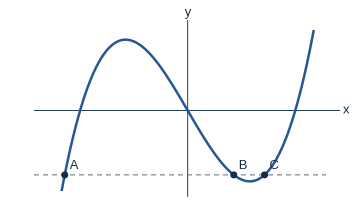
Draw a horizontal line at the stated output. Read the inputs where this line crosses the curve.

A horizontal line meets a cubic three times.

A horizontal line meets a cubic three times.

Worked example

Read a cubic inequality at a nonzero level

Let f(x)=(x−15)(x+13)(2x−2)f(x)=\left(x - 15\right) \left(x + 13\right) \left(2 x - 2\right). The table gives points for a sketch.

xxf(x)f(x)
−16-16−3162-3162
−15-15−1920-1920
77−1920-1920
1111−1920-1920
1212−1650-1650

Read the set of x-coordinates where the graph meets y=−1920y=-1920.

  1. A horizontal level meets the cubic at inputs giving the same output as the level.

  2. The three table entries at the required level are the three crossings.

  3. Final answer: {−15,7,11}\{-15, 7, 11\}.

Your turn

Let f(x)=(x−17)(x+11)(2x−6)f(x)=\left(x - 17\right) \left(x + 11\right) \left(2 x - 6\right). The table gives points for a sketch.

xxf(x)f(x)
−14-14−3162-3162
−13-13−1920-1920
99−1920-1920
1313−1920-1920
1414−1650-1650

Read the set of x-coordinates where the graph meets y=−1920y=-1920.

Give the complete set: {1, 4} for separate values, (1, 5] for an interval, U for union or empty for no real solutions. Use sqrt(...) for exact roots.

Worked example

Read a cubic inequality at a nonzero level

Let f(x)=(x−22)(x+20)(3x−3)f(x)=\left(x - 22\right) \left(x + 20\right) \left(3 x - 3\right). The table gives points for a sketch.

xxf(x)f(x)
−24-24−13800-13800
−23-23−9720-9720
1010−9720-9720
1616−9720-9720
1717−8880-8880

Read the set of x-coordinates where the graph meets y=−9720y=-9720.

Try it on paper first.

  1. A horizontal level meets the cubic at inputs giving the same output as the level.

  2. The three table entries at the required level are the three crossings.

  3. Final answer: {−23,10,16}\{-23, 10, 16\}.

Your turn

Let f(x)=(x−24)(x+18)(3x−9)f(x)=\left(x - 24\right) \left(x + 18\right) \left(3 x - 9\right). The table gives points for a sketch.

xxf(x)f(x)
−22-22−13800-13800
−21-21−9720-9720
1212−9720-9720
1818−9720-9720
1919−8880-8880

Read the set of x-coordinates where the graph meets y=−9720y=-9720.

Give the complete set: {1, 4} for separate values, (1, 5] for an interval, U for union or empty for no real solutions. Use sqrt(...) for exact roots.

Section 2 of 3 · Lesson · about 8 min

How do I read the parts above the level?

Trace the curve between successive crossings. Mark precisely the stretches where it is above the line.

Worked example

Read a cubic inequality at a nonzero level

Let f(x)=(x−16)(x+12)(3x−6)f(x)=\left(x - 16\right) \left(x + 12\right) \left(3 x - 6\right). The table gives points for a sketch.

xxf(x)f(x)
−15-15−4743-4743
−14-14−2880-2880
88−2880-2880
1212−2880-2880
1313−2475-2475

Make a sketch showing the crossings and use it to solve f(x)≥−2880f(x)\ge-2880.

  1. Use the crossings as the boundaries of regions. Compare the graph with the horizontal line within each region.

  2. Read the part between the first two crossings and the part after the third. Equality includes all three endpoints.

  3. Final answer: −14≤x≤8-14\le x\le 8 or x≥12x\ge 12.

Your turn

Let f(x)=(x−18)(x+10)(3x−12)f(x)=\left(x - 18\right) \left(x + 10\right) \left(3 x - 12\right). The table gives points for a sketch.

xxf(x)f(x)
−13-13−4743-4743
−12-12−2880-2880
1010−2880-2880
1414−2880-2880
1515−2475-2475

Make a sketch showing the crossings and use it to solve f(x)≥−2880f(x)\ge-2880.

Use inequalities in x or interval notation. Join intervals with ‘or’ or ∪. Enter an isolated value on its own.

Worked example

Read a cubic inequality at a nonzero level

Let f(x)=(x−23)(x−2)(x+19)f(x)=\left(x - 23\right) \left(x - 2\right) \left(x + 19\right). The table gives points for a sketch.

xxf(x)f(x)
−23-23−4600-4600
−22-22−3240-3240
1111−3240-3240
1717−3240-3240
1818−2960-2960

Make a sketch showing the crossings and use it to solve f(x)≥−3240f(x)\ge-3240.

Try it on paper first.

  1. Use the crossings as the boundaries of regions. Compare the graph with the horizontal line within each region.

  2. Read the part between the first two crossings and the part after the third. Equality includes all three endpoints.

  3. Final answer: −22≤x≤11-22\le x\le 11 or x≥17x\ge 17.

Your turn

Let f(x)=(x−25)(x−4)(x+17)f(x)=\left(x - 25\right) \left(x - 4\right) \left(x + 17\right). The table gives points for a sketch.

xxf(x)f(x)
−21-21−4600-4600
−20-20−3240-3240
1313−3240-3240
1919−3240-3240
2020−2960-2960

Make a sketch showing the crossings and use it to solve f(x)≥−3240f(x)\ge-3240.

Use inequalities in x or interval notation. Join intervals with ‘or’ or ∪. Enter an isolated value on its own.

Section 3 of 3 · Lesson · about 8 min

How do I read the parts below the level?

Compare each region's graph with the level. If the leading coefficient is negative the outer directions reverse.

Worked example

Read a cubic inequality at a nonzero level

Let f(x)=(x−16)(x−2)(x+12)f(x)=\left(x - 16\right) \left(x - 2\right) \left(x + 12\right). The table gives points for a sketch.

xxf(x)f(x)
−15-15−1581-1581
−14-14−960-960
88−960-960
1212−960-960
1313−825-825

Make a sketch showing the crossings and use it to solve f(x)<−960f(x)<-960.

  1. Use the crossings as the boundaries of regions. Compare the graph with the horizontal line within each region.

  2. Read the interval before the first crossing and the gap between the second and third. Exclude all three crossings themselves.

  3. Final answer: x<−14x<-14 or 8<x<128<x<12.

Your turn

Let f(x)=(x−19)(x−5)(x+9)f(x)=\left(x - 19\right) \left(x - 5\right) \left(x + 9\right). The table gives points for a sketch.

xxf(x)f(x)
−12-12−1581-1581
−11-11−960-960
1111−960-960
1515−960-960
1616−825-825

Make a sketch showing the crossings and use it to solve f(x)<−960f(x)<-960.

Use inequalities in x or interval notation. Join intervals with ‘or’ or ∪. Enter an isolated value on its own.

Worked example

Read a cubic inequality at a nonzero level

Let f(x)=(x−24)(x+18)(2x−6)f(x)=\left(x - 24\right) \left(x + 18\right) \left(2 x - 6\right). The table gives points for a sketch.

xxf(x)f(x)
−22-22−9200-9200
−21-21−6480-6480
1212−6480-6480
1818−6480-6480
1919−5920-5920

Make a sketch showing the crossings and use it to solve f(x)<−6480f(x)<-6480.

Try it on paper first.

  1. Use the crossings as the boundaries of regions. Compare the graph with the horizontal line within each region.

  2. Read the interval before the first crossing and the gap between the second and third. Exclude all three crossings themselves.

  3. Final answer: x<−21x<-21 or 12<x<1812<x<18.

Your turn

Let f(x)=(x−26)(x+16)(2x−10)f(x)=\left(x - 26\right) \left(x + 16\right) \left(2 x - 10\right). The table gives points for a sketch.

xxf(x)f(x)
−20-20−9200-9200
−19-19−6480-6480
1414−6480-6480
2020−6480-6480
2121−5920-5920

Make a sketch showing the crossings and use it to solve f(x)<−6480f(x)<-6480.

Use inequalities in x or interval notation. Join intervals with ‘or’ or ∪. Enter an isolated value on its own.

Worked examples

Practise the method

Core practice

Question 1 of 5

0 / 5 checked in this collection

Question list

Core practice

Fresh variants

Exam-style

Read a cubic inequality at a nonzero level

1 mark

Let f(x)=(x−30)(x−9)(x+12)f(x)=\left(x - 30\right) \left(x - 9\right) \left(x + 12\right). The table gives points for a sketch.

xxf(x)f(x)
−16-16−4600-4600
−15-15−3240-3240
1818−3240-3240
2424−3240-3240
2525−2960-2960

Read the set of x-coordinates where the graph meets y=−3240y=-3240.

Give the complete set: {1, 4} for separate values, (1, 5] for an interval, U for union or empty for no real solutions. Use sqrt(...) for exact roots.

Full answer-format guide

Exact numbers: 3/2, sqrt(5), 2-sqrt(3), pi/6, 3*pi/2. Sets: {1,4}. Intervals: (3,5]; a round bracket excludes the endpoint. Infinity: inf; union: U; no solutions: empty. Separate coordinate pairs or triples with semicolons. Expressions: 2x^2+3x-1; equations: x^2=3x+1 or the polynomial equal to zero. Factors: x-1 ; x+2. Parameter fraction: numerator ; denominator. List integer answers individually.

The checker checks final answers only. Compare your explanation, sketch and method with the worked solution; method marks need review.

Review the method

Progress stays in this browser. Create an account to save it or sign in.

Extra practice from this lesson

Let f(x)=(x−34)(x−6)(x+22)f(x)=\left(x - 34\right) \left(x - 6\right) \left(x + 22\right). The table gives points for a sketch.

xxf(x)f(x)
−27-27−10065-10065
−26-26−7680-7680
1818−7680-7680
2626−7680-7680
2727−7203-7203

Read the set of x-coordinates where the graph meets y=−7680y=-7680.

Give the complete set: {1, 4} for separate values, (1, 5] for an interval, U for union or empty for no real solutions. Use sqrt(...) for exact roots.

Let f(x)=(x−13)(x+1)(2x−12)f(x)=\left(x - 13\right) \left(x + 1\right) \left(2 x - 12\right). The table gives points for a sketch.

xxf(x)f(x)
−3-3−576-576
−2-2−240-240
99−240-240
1111−240-240
1212−156-156

Read the set of x-coordinates where the graph meets y=−240y=-240.

Give the complete set: {1, 4} for separate values, (1, 5] for an interval, U for union or empty for no real solutions. Use sqrt(...) for exact roots.

Let f(x)=(x−35)(x+21)(2x−14)f(x)=\left(x - 35\right) \left(x + 21\right) \left(2 x - 14\right). The table gives points for a sketch.

xxf(x)f(x)
−26-26−20130-20130
−25-25−15360-15360
1919−15360-15360
2727−15360-15360
2828−14406-14406

Make a sketch showing the crossings and use it to solve f(x)≥−15360f(x)\ge-15360.

Use inequalities in x or interval notation. Join intervals with ‘or’ or ∪. Enter an isolated value on its own.

Let f(x)=x(x−14)(3x−21)f(x)=x \left(x - 14\right) \left(3 x - 21\right). The table gives points for a sketch.

xxf(x)f(x)
−2-2−864-864
−1-1−360-360
1010−360-360
1212−360-360
1313−234-234

Make a sketch showing the crossings and use it to solve f(x)≥−360f(x)\ge-360.

Use inequalities in x or interval notation. Join intervals with ‘or’ or ∪. Enter an isolated value on its own.

Let f(x)=(x−36)(x+20)(3x−24)f(x)=\left(x - 36\right) \left(x + 20\right) \left(3 x - 24\right). The table gives points for a sketch.

xxf(x)f(x)
−25-25−30195-30195
−24-24−23040-23040
2020−23040-23040
2828−23040-23040
2929−21609-21609

Make a sketch showing the crossings and use it to solve f(x)<−23040f(x)<-23040.

Use inequalities in x or interval notation. Join intervals with ‘or’ or ∪. Enter an isolated value on its own.

Let f(x)=(x−15)(x−8)(x−1)f(x)=\left(x - 15\right) \left(x - 8\right) \left(x - 1\right). The table gives points for a sketch.

xxf(x)f(x)
−1-1−288-288
00−120-120
1111−120-120
1313−120-120
1414−78-78

Make a sketch showing the crossings and use it to solve f(x)<−120f(x)<-120.

Use inequalities in x or interval notation. Join intervals with ‘or’ or ∪. Enter an isolated value on its own.

Apply it · original exam-style problems

Show your working on paper and compare it with the worked solution and marking guidance.

Come back to what needs practice

Quick revision sheet (A4)

Your review plan starts after your first check.