Maths4UBETA

Factorials and the product rule

Simplify factorial ratios and justify the product rule.

Try the quick check →
Lesson 1 of 5

Section 1 of 3 · Lesson · about 8 min

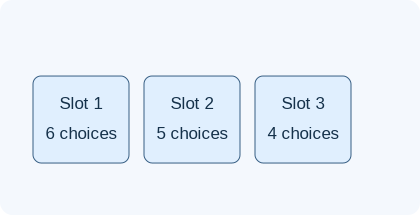
What changes when a place is filled?

Slot 1 has six choices, slot 2 has five choices, and slot 3 has four choices.

Six distinct objects fill three labelled slots. Each choice removes one object from the supply.

Practise the method

Write the choices for each position over a row of empty boxes. If all n positions are filled with distinct objects, the product is n!n!.

Worked example

Use the product rule to arrange distinct objects

Distinct posters are hung in a row. There are 7 objects. How many orders are possible with no restriction?

  1. There are 7 choices for the first place, 6 for the next, and so on down to one.

  2. Multiply these choices to obtain 7!7!.

  3. Answer: 50405040.

Your turn

Distinct books are placed on a shelf from left to right. There are 10 objects. How many orders are possible with no restriction?

Enter the whole-number count.

Worked example

Count ordered selections

A workshop has 14 distinct speaker applications. In how many ways can the organiser assign the 2 numbered speaking slots? A candidate or item may be used only once.

Try it on paper first.

  1. The slots are different, so use 14P2{}^{14}P_{2}.

  2. Compute 14!12!\frac{14!}{12!}.

  3. Answer: 182182.

Your turn

A workshop has 12 distinct speaker applications. In how many ways can the organiser assign the 4 numbered speaking slots? A candidate or item may be used only once.

Enter the whole-number count.

Section 2 of 3 · Lesson · about 8 min

How much of a factorial do I expand?

Practise the method

Treat 0!0! as one empty arrangement. For a longer numerator, step down one factor at a time.

Worked example

Cancel a factorial quotient

Evaluate 13!11!\frac{13!}{11!}.

  1. The common factor is 11!11!. Cancel it.

  2. Multiply the remaining factors: 13×1213\times12.

  3. Answer: 156156.

Your turn

Evaluate 6!2!\frac{6!}{2!}.

Enter one number. Fractions and decimals are accepted.

Worked example

Simplify a factorial expression

Evaluate (18+1)!18!+0!\frac{(18+1)!}{18!}+0!.

Try it on paper first.

  1. Write (18+1)!=(18+1)18!(18+1)!=(18+1)18!. Cancel the common factorial.

  2. The remaining terms are 19+119+1, since 0!=10!=1.

  3. Answer: 2020.

Your turn

Evaluate (10+1)!10!+0!\frac{(10+1)!}{10!}+0!.

Enter one number. Fractions and decimals are accepted.

Section 3 of 3 · Lesson · about 8 min

How can I solve a factorial equation?

Practise the method

Check that each resulting factorial argument is a non-negative integer. Use the context to choose a valid root.

Worked example

Find the integer in a factorial equation

Find the non-negative integer rr for which (r+2)!r!=380\frac{(r+2)!}{r!}=380.

  1. Expand and cancel to obtain (r+2)(r+1)=380(r+2)(r+1)=380.

  2. The two consecutive factors are 1919 and 2020. The other algebraic root is negative.

  3. Answer: 1818.

Your turn

Find the non-negative integer rr for which (r+2)!r!=156\frac{(r+2)!}{r!}=156.

Enter one number. Fractions and decimals are accepted.

Worked example

Recover the group size from ordered pairs

There are 552 ways to name a first and second person from a group of nn distinct people. Determine nn.

Try it on paper first.

  1. Use n(n−1)=552n(n-1)=552.

  2. The roots are 2424 and −23-23. Only the first is a possible group size.

  3. Answer: 2424.

Your turn

There are 56 ways to name a first and second person from a group of nn distinct people. Determine nn.

Enter one number. Fractions and decimals are accepted.

Worked examples

Practise the method

Core practice

Question 1 of 5

0 / 5 checked in this collection

Question list

Core practice

Fresh variants

Exam-style

Use the product rule to arrange distinct objects

1 mark

Distinct posters are hung in a row. There are 10 objects. How many orders are possible with no restriction?

Enter the whole-number count.

Full answer-format guide

Exact numbers: 3/2, sqrt(5), 2-sqrt(3), pi/6, 3*pi/2. Sets: {1,4}. Intervals: (3,5]; a round bracket excludes the endpoint. Infinity: inf; union: U; no solutions: empty. Separate coordinate pairs or triples with semicolons. Expressions: 2x^2+3x-1; equations: x^2=3x+1 or the polynomial equal to zero. Factors: x-1 ; x+2. Parameter fraction: numerator ; denominator. List integer answers individually.

Review the method

Progress stays in this browser. Create an account to save it or sign in.

Extra practice from this lesson

Use the product rule to arrange distinct objects

Distinct instruments are arranged in a straight display. There are 8 objects. How many orders are possible with no restriction?

Enter the whole-number count.

Count ordered selections

A design studio has 8 distinct mock-ups. In how many ways can the organiser fill 4 labelled places in a display? A candidate or item may be used only once.

Enter the whole-number count.

Cancel a factorial quotient

Evaluate 15!10!\frac{15!}{10!}.

Enter one number. Fractions and decimals are accepted.

Simplify a factorial expression

Evaluate (7+1)!7!+0!\frac{(7+1)!}{7!}+0!.

Enter one number. Fractions and decimals are accepted.

Find the integer in a factorial equation

Find the non-negative integer rr for which (r+2)!r!=72\frac{(r+2)!}{r!}=72.

Enter one number. Fractions and decimals are accepted.

Recover the group size from ordered pairs

There are 90 ways to name a first and second person from a group of nn distinct people. Determine nn.

Enter one number. Fractions and decimals are accepted.

Apply it · original exam-style problems

Show your working on paper and compare it with the worked solution and marking guidance.

Come back to what needs practice

Quick revision sheet (A4)

Your review plan starts after your first check.