Maths4UBETA

Arc lengths and sector perimeters

Use radian angles to find curves and count the complete boundary.

Try the quick check →
Lesson 2 of 6

Section 1 of 3 · Lesson · about 8 min

How does the angle determine the arc length?

The larger the turn, the further a point on the rim travels. For a fixed radius, doubling the angle doubles the arc length.

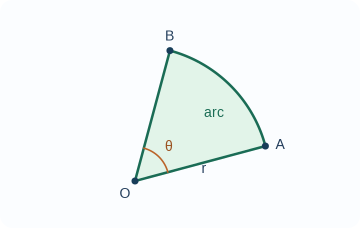
Sector AOB with central angle theta, radius r and an arc

Only the arc follows the circular boundary. The straight sides are the two radii.

Worked example

From an arc to the whole sector edge

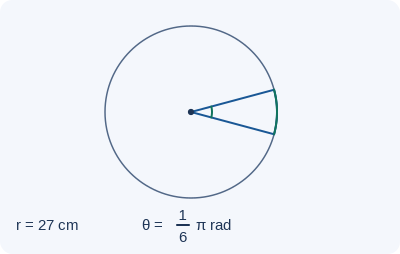
A curved edge joins the ends of two 2727 cm radii. The angle at the centre is 16π\frac{1}{6}\pi radians.

The chosen arc is highlighted. Radius 27 cm. Angle 1/6 times pi radians.

  1. Find the length of the curved edge.

    [2]
  2. Find the length of the remaining arc of the same circle.

    [2]
  3. Find the perimeter of a sector with the original angle and a radius 1616 cm longer.

    [2]
  1. Use s=rθs=r\theta for the curved edge. A complete sector perimeter adds two straight radii.

  2. (a) Multiply the radius 2727 by the given radian angle.

  3. 92π\frac{9}{2}\pi cm.

  4. (b) The remaining sector angle is 116π\frac{11}{6}\pi radians.

  5. Keep the centre and radius fixed as you use s=rθs=r\theta again.

  6. 992π\frac{99}{2}\pi cm.

  7. (c) The larger sector has radius 4343 cm and still subtends the original angle.

  8. Add both new radial sides and its longer arc.

  9. 86+436π86+\frac{43}{6}\pi cm.

Your turn

A curved edge joins the ends of two 2828 cm radii. The angle at the centre is 14π\frac{1}{4}\pi radians.

The chosen arc is highlighted. Radius 28 cm. Angle 1/4 times pi radians.

Find the length of the curved edge.

Enter an exact value or round to 3 significant figures.

Worked example

From an arc to the whole sector edge

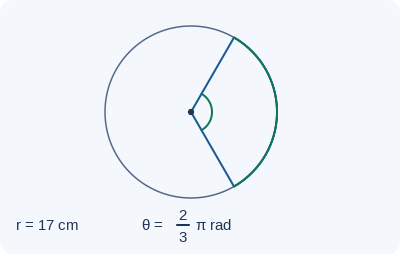
A curved edge joins the ends of two 1717 cm radii. The angle at the centre is 23π\frac{2}{3}\pi radians.

The chosen arc is highlighted. Radius 17 cm. Angle 2/3 times pi radians.

  1. Find the length of the curved edge.

    [2]
  2. Find the length of the remaining arc of the same circle.

    [2]
  3. Find the perimeter of a sector with the original angle and a radius 1717 cm longer.

    [2]

Try it on paper first.

  1. Use s=rθs=r\theta for the curved edge. A complete sector perimeter adds two straight radii.

  2. (a) Multiply the radius 1717 by the given radian angle.

  3. 343π\frac{34}{3}\pi cm.

  4. (b) The remaining sector angle is 43π\frac{4}{3}\pi radians.

  5. Keep the centre and radius fixed as you use s=rθs=r\theta again.

  6. 683π\frac{68}{3}\pi cm.

  7. (c) The larger sector has radius 3434 cm and still subtends the original angle.

  8. Add both new radial sides and its longer arc.

  9. 68+683π68+\frac{68}{3}\pi cm.

Your turn

A curved edge joins the ends of two 3030 cm radii. The angle at the centre is 25π\frac{2}{5}\pi radians.

The chosen arc is highlighted. Radius 30 cm. Angle 2/5 times pi radians.

Find the length of the curved edge.

Enter an exact value or round to 3 significant figures.

Section 2 of 3 · Lesson · about 8 min

Which pieces belong to a sector perimeter?

Trace the boundary with your finger. Begin at the centre, move along one radius, trace the arc, and come back along the other radius.

Worked example

From an arc to the whole sector edge

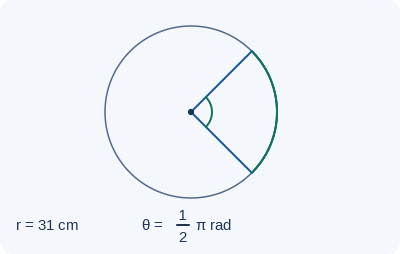
A complete sector boundary of radius 3131 cm has perimeter 62+312π62+\frac{31}{2}\pi cm.

  1. Find the exact angle at the centre, in radians.

    [2]
  2. Find the length of the remaining arc of the same circle.

    [2]
  3. Find the perimeter of a sector with the original angle and a radius 1919 cm longer.

    [2]
  1. Use s=rθs=r\theta for the curved edge. A complete sector perimeter adds two straight radii.

  2. (a) The radii contribute 6262 cm to the perimeter. The arc therefore has length 312π\frac{31}{2}\pi cm.

  3. Divide the arc length by 3131.

  4. 12π\frac{1}{2}\pi rad.

  5. (b) The remaining sector angle is 32π\frac{3}{2}\pi radians.

  6. Keep the centre and radius fixed as you use s=rθs=r\theta again.

  7. 932π\frac{93}{2}\pi cm.

  8. (c) The larger sector has radius 5050 cm and still subtends the original angle.

  9. Add both new radial sides and its longer arc.

  10. 100+25π100+25\pi cm.

  11. The chosen arc is highlighted. Radius 31 cm. Angle 1/2 times pi radians.

Your turn

A complete sector boundary of radius 3232 cm has perimeter 64+965π64+\frac{96}{5}\pi cm.

Find the exact angle at the centre, in radians.

Enter one number. Fractions and decimals are accepted.

Worked example

From an arc to the whole sector edge

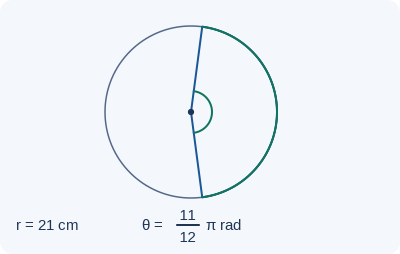
A complete sector boundary of radius 2121 cm has perimeter 42+774π42+\frac{77}{4}\pi cm.

  1. Find the exact angle at the centre, in radians.

    [2]
  2. Find the length of the remaining arc of the same circle.

    [2]
  3. Find the perimeter of a sector with the original angle and a radius 2020 cm longer.

    [2]

Try it on paper first.

  1. Use s=rθs=r\theta for the curved edge. A complete sector perimeter adds two straight radii.

  2. (a) The radii contribute 4242 cm to the perimeter. The arc therefore has length 774π\frac{77}{4}\pi cm.

  3. Divide the arc length by 2121.

  4. 1112π\frac{11}{12}\pi rad.

  5. (b) The remaining sector angle is 1312π\frac{13}{12}\pi radians.

  6. Keep the centre and radius fixed as you use s=rθs=r\theta again.

  7. 914π\frac{91}{4}\pi cm.

  8. (c) The larger sector has radius 4141 cm and still subtends the original angle.

  9. Add both new radial sides and its longer arc.

  10. 82+45112π82+\frac{451}{12}\pi cm.

  11. The chosen arc is highlighted. Radius 21 cm. Angle 11/12 times pi radians.

Your turn

A complete sector boundary of radius 1818 cm has perimeter 36+272π36+\frac{27}{2}\pi cm.

Find the exact angle at the centre, in radians.

Enter one number. Fractions and decimals are accepted.

Section 3 of 3 · Further practice · about 8 min

Can two different sectors have the same arc length?

A larger circle needs a smaller angle to sweep the same distance along its circumference.

Worked example

The same arc length on different circles

A sector of radius 2020 cm has angle 32π\frac{3}{2}\pi radians. A second circle of radius 2323 cm has an arc of equal length.

  1. Find the angle subtended by the arc on the second circle.

    [3]
  2. Find the perimeter of the sector associated with the second arc.

    [2]
  3. Explain why the angle is smaller on the second circle.

    [1]
  1. Compare rθr\theta on both circles.

  2. (a) The common arc length is 30π30\pi cm.

  3. Divide it by the second radius, 2323 cm.

  4. 3023π\frac{30}{23}\pi rad.

  5. (b) The sector edge uses the given arc and the two new radii.

  6. 46+30π46+30\pi cm.

  7. (c) With ss fixed, θ=sr\theta=\frac{s}{r} decreases as the radius increases.

  8. For a fixed arc length, the angle is inversely proportional to radius.

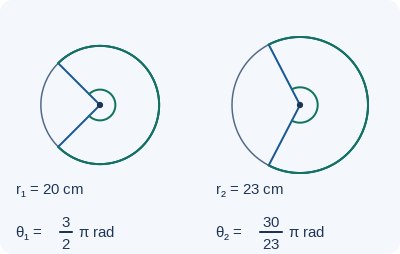
  9. Sectors on the same scale have equal arcs. Their radii are 20 cm and 23 cm, and their angles are 3/2 and 30/23 times pi radians.

Your turn

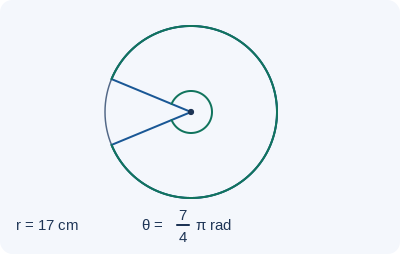
A sector of radius 2121 cm has angle 74π\frac{7}{4}\pi radians. A second circle of radius 2424 cm has an arc of equal length.

Find the angle subtended by the arc on the second circle.

Enter an exact value or round to 3 significant figures.

Worked example

The same arc length on different circles

A sector of radius 1010 cm has angle 25π\frac{2}{5}\pi radians. A second circle of radius 1313 cm has an arc of equal length.

  1. Find the angle subtended by the arc on the second circle.

    [3]
  2. Find the perimeter of the sector associated with the second arc.

    [2]
  3. Explain why the angle is smaller on the second circle.

    [1]

Try it on paper first.

  1. Compare rθr\theta on both circles.

  2. (a) The common arc length is 4π4\pi cm.

  3. Divide it by the second radius, 1313 cm.

  4. 413π\frac{4}{13}\pi rad.

  5. (b) The sector edge uses the given arc and the two new radii.

  6. 26+4π26+4\pi cm.

  7. (c) With ss fixed, θ=sr\theta=\frac{s}{r} decreases as the radius increases.

  8. For a fixed arc length, the angle is inversely proportional to radius.

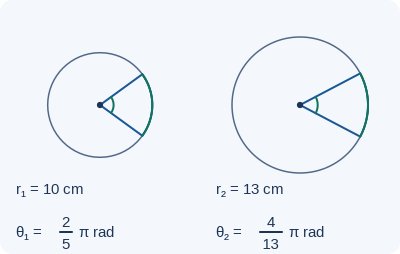
  9. Sectors on the same scale have equal arcs. Their radii are 10 cm and 13 cm, and their angles are 2/5 and 4/13 times pi radians.

Your turn

A sector of radius 77 cm has angle 16π\frac{1}{6}\pi radians. A second circle of radius 1010 cm has an arc of equal length.

Find the angle subtended by the arc on the second circle.

Enter an exact value or round to 3 significant figures.

Worked examples

Practise the method

Core practice

Question 1 of 5

0 / 5 checked in this collection

Question list

Core practice

Fresh variants

Exam-style

From an arc to the whole sector edge

1 mark

A curved edge joins the ends of two 1717 cm radii. The angle at the centre is 74π\frac{7}{4}\pi radians.

Find the length of the curved edge.

The chosen arc is highlighted. Radius 17 cm. Angle 7/4 times pi radians.

Enter an exact value or round to 3 significant figures.

Full answer-format guide

Exact numbers: 3/2, sqrt(5), 2-sqrt(3), pi/6, 3*pi/2. Sets: {1,4}. Intervals: (3,5]; a round bracket excludes the endpoint. Infinity: inf; union: U; no solutions: empty. Separate coordinate pairs or triples with semicolons. Expressions: 2x^2+3x-1; equations: x^2=3x+1 or the polynomial equal to zero. Factors: x-1 ; x+2. Parameter fraction: numerator ; denominator. List integer answers individually.

Review the method

Progress stays in this browser. Create an account to save it or sign in.

Extra practice from this lesson

A curved edge joins the ends of two 2020 cm radii. The angle at the centre is 56π\frac{5}{6}\pi radians.

The chosen arc is highlighted. Radius 20 cm. Angle 5/6 times pi radians.

Find the length of the curved edge.

Enter an exact value or round to 3 significant figures.

A curved edge joins the ends of two 2121 cm radii. The angle at the centre is 1112π\frac{11}{12}\pi radians.

The chosen arc is highlighted. Radius 21 cm. Angle 11/12 times pi radians.

Find the length of the curved edge.

Enter an exact value or round to 3 significant figures.

A complete sector boundary of radius 2424 cm has perimeter 48+36π48+36\pi cm.

Find the exact angle at the centre, in radians.

Enter one number. Fractions and decimals are accepted.

A complete sector boundary of radius 2525 cm has perimeter 50+1754π50+\frac{175}{4}\pi cm.

Find the exact angle at the centre, in radians.

Enter one number. Fractions and decimals are accepted.

A sector of radius 1313 cm has angle 23π\frac{2}{3}\pi radians. A second circle of radius 1616 cm has an arc of equal length.

Find the angle subtended by the arc on the second circle.

Enter an exact value or round to 3 significant figures.

A sector of radius 1414 cm has angle 34π\frac{3}{4}\pi radians. A second circle of radius 1717 cm has an arc of equal length.

Find the angle subtended by the arc on the second circle.

Enter an exact value or round to 3 significant figures.

Apply it · original exam-style problems

Show your working on paper and compare it with the worked solution and marking guidance.

Come back to what needs practice

Quick revision sheet (A4)

Your review plan starts after your first check.