Worked example
Find a running total for a class boundary
| Time (s) | Frequency |
|---|---|
Find the cumulative frequency at seconds.
Add the frequencies up to and including the class that ends at .
Answer .
Use running totals, plot them at the upper boundaries and work back to class counts.
Try the quick check →Section 1 of 3 · Extension · about 6 min
Cumulative frequency tells how many observations are at or below a given upper class boundary.
| Class boundary (s) | Cumulative frequency |
|---|---|
Worked example
| Time (s) | Frequency |
|---|---|
Find the cumulative frequency at seconds.
Add the frequencies up to and including the class that ends at .
Answer .
Worked example
| Class boundary (s) | Cumulative frequency |
|---|---|
| ? | |
| Time (s) | Frequency |
|---|---|
Find the missing cumulative frequency.
Try it on paper first.
Answer .
Section 2 of 3 · Extension · about 7 min
Each point needs an upper boundary and its cumulative frequency. Mark the plotted points with clear crosses.
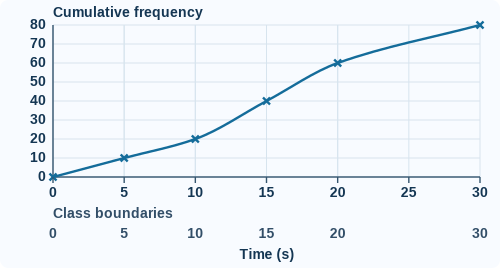
The first point starts at cumulative frequency zero. Mark crossed points at the upper boundaries and join with a smooth curve.
The main scale is evenly spaced. The separate labels below show the exact class boundaries.
Worked example
| Time (s) | Frequency |
|---|---|
Which point is plotted for the class ending at seconds?
Use the upper boundary as the horizontal coordinate, and the running total as the vertical coordinate.
Answer .
Worked example
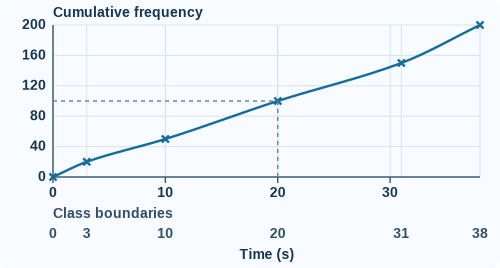
How many times were at most seconds?
Try it on paper first.
Move up from the stated time to the curve. Then move left to the cumulative frequency scale.
Answer .
Section 3 of 3 · Extension · about 8 min
A cumulative reading includes every observation up to the given boundary. It does not give a single class frequency directly.
Worked example
| Class boundary (s) | Cumulative frequency |
|---|---|
How many times were in ?
Answer .
Worked example
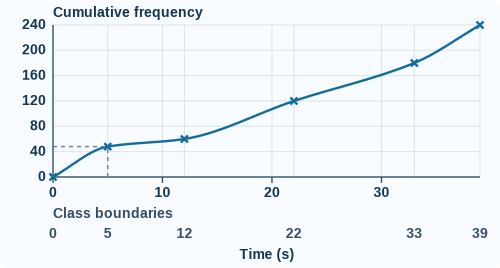
How many times were greater than seconds?
Try it on paper first.
The curve counts all values up to and including the threshold.
Answer .
Question 1 of 5
0 / 5 checked in this collection
| Time (s) | Frequency |
|---|---|
Find the cumulative frequency at seconds.
Progress stays in this browser. Create an account to save it or sign in.
Show your working on paper and compare it with the worked solution and marking guidance.
Your review plan starts after your first check.