Worked example
List the integers in a set
Write all the elements of .
Read the condition from left to right. Begin at the first integer greater than , which is .
The sign includes the upper endpoint . The set is .
List the elements of a set, count distinct members and use Cambridge's Extended membership and subset symbols.
Try the quick check →Section 1 of 3 · Core · about 6 min
A set groups objects that pass a test. The objects can be numbers, cards or anything else named in the question. A rule after a colon tells you which objects belong.
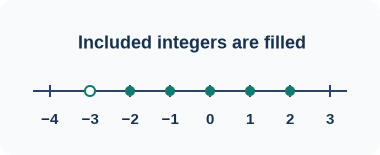
The rule allows integers greater than −3 up to and including 2.
Read one boundary at a time. A strict sign excludes its endpoint. Write the candidates in order so you can check that every allowed integer is present.
Worked example
Write all the elements of .
Read the condition from left to right. Begin at the first integer greater than , which is .
The sign includes the upper endpoint . The set is .
Worked example
Write all the elements of .
Try it on paper first.
Read the condition from left to right. Begin at the first integer greater than , which is .
The sign includes the upper endpoint . The set is .
Section 2 of 3 · Core · about 5 min
A set may be listed in any order. Each distinct element belongs just once, even if a list repeats it. Compare which entries appear before comparing counts.
Cross out repeated copies. Count each remaining entry once and give the count as a number.
Worked example
. Find .
The repeated entry is the same element each time. Write the distinct elements as .
Count the members of that set. .
Worked example
. Find .
Try it on paper first.
The repeated entry is the same element each time. Write the distinct elements as .
Count the members of that set. .
Section 3 of 3 · Extension · about 8 min
To test membership, look up an individual entry. To test a subset, check every member of a whole set. Use the object on the left of the symbol to decide what kind of test to make.
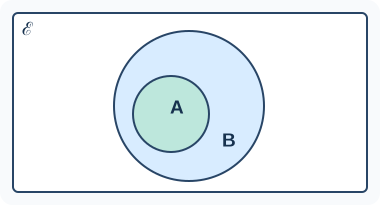
Every member of A also lies in B, so .
One missing element is enough to rule out a subset. The empty set has no members and is a subset of every set. Equal sets are subsets of each other.
Worked example
Let . Complete with the correct symbol.
A. B. C. D.
The object on the left is the number , so we need a membership symbol.
The number is absent from the list. Use .
Worked example
Let . Which statement is true?
A. B. C. D.
Try it on paper first.
Check the members of each candidate set. is not in , so option A is false.
Both and belong to . A set is a subset of itself, so B is correct.
Question 1 of 5
0 / 5 checked in this collection
Write all the elements of .
Progress stays in this browser. Create an account to save it or sign in.
Show your working on paper and compare it with the worked solution and marking guidance.
Your review plan starts after your first check.